N.K. Jemisin's trilogy, though much better than most current attempts at speculative fiction, shares similar problems, not least being an inability to create nuanced characters and an over-investment in ideological statements at the expense of creativity.
When I read the first book in the series, THE FIFTH SEASON, I was fascinated by Jemisin's thoroughly original take on post-apocalyptic fiction. To be sure, the author never actually says that her "broken earth" is actually a future-version of our Earth, though the narrative has its share of suggestive clues. It's not purely a "science fiction" world, starting with the idea that the Earth itself is sentient, having absorbed the spirit-force of living beings over the centuries. Somewhere in the very distant past, human scientists sought to tap the occult power of the Earth with assorted devices, including floating sky-obelisks and a race of inhuman humanoids called "tuners," who can move through stone like air.
At some point, the moon is flung out of orbit with its parent planet, and the sentient Earth unleashes vengeance of Old Testament proportions. Human beings are constantly subjected to chaotic "seasons," including massive earthquakes and volcano eruptions, making it inevitable that people only exist in small, unstable enclaves. However, some humans are born with a mutant-like ability to manipulate stone through a magic-like process. The main viewpoint character is an older woman, Nassun, whose primary motive throughout all three books is her Demeter-like quest to find her lost, similarly powered daughter Essun. In addition, both females are drawn into the plans of the surviving "Stone Eaters"-- the former "tuners," who live for centuries and are no longer strictly human. Some Stone Eaters want to placate Earth by bringing the moon back to its proper orbit, while others want the whole world eradicated for good.
Jemisin's apocalyptic world is worked out with an amazing thoroughness. The first book is particularly strong in terms of showing how the ongoing cataclysms affect everything humans perceive-- civic organization, codification of time-passage, and-- perhaps inevitably, because Jemisin is a Black American-- the separation of the magic-users, or "orogenes," into marginalized castes, as against amid the more numerous "normals." Indeed, the quest of Nassun and Essun to rebel against their marginalization seems is a far more pervasive theme than the restoration of some degree of stability to the fractured planet.
Though many critics have scorned fantasy-fiction for its lack of well developed characters, I've often argued that the fantasy-author must prioritize the nature of the world he or she creates, with the result that mimetic character-development is usually a secondary consideration. "Realistic" authors need devote no creative attention to the world they describe; it's just "the world as everyone sees it.." Jemisin certainly makes an attempt to get away from the stock image of the fantasy-author as the worldbuilder who can't create rich characters. However, after the first book it becomes increasingly obvious that Jemisin's character palette is extremely limited, not because of her worldbuilding but her liberal ideology.
I could embrace such an ideology if I felt that Jemisin had created at least a cast of characters as rich as Frank Herbert's early DUNE books. However, over the next two books it becomes evident that most of the supporting-characters are merely functional echoes of either Nassun or Essun. The only exceptions are the villainous figures, most of whom are vague at best, with the exception of Nassun's husband Jija, the abductor of Essun, rabidly opposed to having any orogeny in the family. I wanted the characters to be as rich as their world, but they aren't.
Finally, Jemisin's theory of liberation seems to depend on forcing others to give you respect, rather than befriending them. Toiward the end of the third book, the moon has (rather predictably) been rejoined to the Earth, and Essun expresses the opinion that the system of oppression will never change:
"They're not going to choose anything different."
To which another support-character, Hoa, responds:
"They will if you make them."
I suppose it's fortunate for me that I never warmed to Jemisin's characters, for this expression of "by any means necessary" would have made me dislike them for their author's flawed ideology.
Showing posts with label science fiction. Show all posts
Showing posts with label science fiction. Show all posts
Monday, June 25, 2018

Wednesday, August 19, 2015
A BROKEN FOUNDATION

I began reading prose fantasy and science fiction, in addition to comic books, steadily at the age of 15 and have never stopped. In my first ten years of SF-reading, I probably read most of the works that early fans considered "the classics," not least the works of "the Big Three:" Asimov, Clarke, and Heinlein. None of them wrote the sort of fantastic fiction to which I aspired, as I soon became most enamored with the genre of fantasy, but of the three, Asimov was the one whose works I most consistently enjoyed.
Yet I did not enjoy the two books in the FOUNDATION series that I read in those days, and consequently did not bother to read the first book in the series, entitled simply FOUNDATION. Much more recently, though, my SF-book club voted to read the book. Therefore I finally read the missing chapter in the series once given a 1966 Hugo Award for "Best All-Time Series."
Harlan Ellison once gave an interview-- which I'm recalling purely from memory here-- in which he described talking to Asimov about adapting the latter's "Robot" stories into a coherent screenplay-- which was certainly not used for the later Will Smith movie I, ROBOT. Ellison claimed that Asimov cautioned him that these were all "bad stories" and wouldn't make good movie-fodder.
I've no way of knowing whether or not Asimov actually said this. But if he did, it's interesting that he would downgrade the "Robot" stories, since in my eyes the early tales are eminently good reading. They're simple, problem-oriented stories, but they have the sort of humor and lively dialogue that I found characteristic in the best works of the author.
In contrast, I still remember my extreme distaste for the two FOUNDATION novels that I did read. All novels in the series were predicated on the idea that in a far-future galactic empire, founded exclusively by humans from Earth, which was doomed to fall into chaos (Asimov was reading Gibbon's DECLINE AND FALL OF THE ROMAN EMPIRE at the time). However, this Empire could be saved, thanks to the genius of one scientist, Hari Seldon. Seldon creates a mathematical science called "psychohistory" that can predict large-scale future developments by analyzing the movements of the societal masses. Although the original Empire does decline and fall, Seldon's system, carried on by his adherents long after his death, manages to circumvent total galactic chaos, making possible the rise of a better form of empire, called the Foundation.
The original book is not a novel as such, having been composed of eight interrelated stories originally serialized in SF-magazines; to the best of my knowledge, the two sequels followed the same pattern. And all of the story-arcs follow the same basic story-pattern. An adherent of Seldon encounters some obstruction to the grand plan for the Foundation's rise, and takes steps, usually off-camera, to prevent them. Then he sits down with his opponent, and the two of them go back and forth in endless talking-head scenes, as the "Seldonite" demonstrates his superior cleverness and the inevitability of psychohistorical destiny.
I remember thinking that the Foundation novels were just like watching chess-moves translated into vapid dialogue from cookie-cutter characters: "You thought you had me with that move, but I countered thusly." "Yes, but I knew you would counter thusly, so I counter-countered you." "Yes, but I knew that you knew that you would counter-counter, so..." Since even watching a real chess-match would probably be more entertaining than this folderol, I'm somewhat of a loss to figure out how such a series became so popular in science-fiction.
A simple answer would be that the appeal of the FOUNDATION novels is basically "Revenge of the Nerds." Characters endlessly chant the favorite maxim of Hari Seldon, that "violence is the last resort of the incompetent," while finding all sorts of ways to trick or hoodwink their opponents into defeat. The Seldonites, then, use indirect rather than direct, violent means to effect compulsion, just as the heroes of the "Nerds" movies use trickery to get around their stronger opponents. However, that by itself seems too simple an answer.
Long before reading FOUNDATION, I'd come across another critic's assertion that psychohistory was just Karl Marx's historical materialism under the veil of pretend-science. And indeed, the book ends with one of its sound-alike narrators predicting the likelihood of future problems:
What business of mine is the future? No doubt Seldon has foreseen it and prepared against it. There will be other crises in the time to come when money power has become as dead a force as religion is now. Let my successors solve those new problems, as I have solved the one of today.
This is probably the principal appeal of the FOUNDATION series: it offers a technocratic solution to all of the inequities against which modern-day man struggles. Not surprisingly, the main opponents to the rise of the Foundation are "religion" and "money power," the same factors that Marx hoped would be nullified by the rise of the proletariat. Asimov, himself a scientist, envisions a world where
such factors cannot affect man's destiny, which is controlled entirely by rational scientists.
I could probably tolerate Asimov's simplistic enshrinement of scientific knowledge and methodology, if FOUNDATION had put across his wonky technocracy with any wit or charm. But even though Asimov was a master at creating simple but charming characters, all of his characters in the series are walking ciphers, whether good or bad. The common world of birth, death, and family relations does not exist for them, and I don't even remember any female characters in FOUNDATION itself. Like Marx's historical materialism, Asimov's psychohistory can only work within a universe where human beings are almost completely predictable. The only exception to this rule appears in the latter two books, as the Foundation is threatened by a psychically-endowed mutant named "the Mule"-- and he's the only character I remember from these books.
I can't fairly review the latter two books, not having read them for over thirty years. But FOUNDATION is an awful "classic" of science fiction, full of stodgy characters and preening self-congratulation.
Monday, April 13, 2015
A VERNIAN VERTIGO
Though like most fantasy-fans I've been entertained by the films based on the works of Jules Verne, I've been somewhat more ambivalent about the author's fiction. I have sampled more of his oeuvre than many modern readers, largely the "usual suspects" like JOURNEY TO THE CENTER OF THE EARTH, TWENTY THOUSAND LEAGUES UNDER THE SEA, and AROUND THE WORLD IN 80 DAYS, though I also have sampled some obscurities like OFF ON A COMET and THE CARPATHIAN CASTLE. But I had never come across the two novels that gave rise to his character Robur the Conqueror, entitled ROBUR THE CONQUEROR and MASTER OF THE WORLD. Elements from these novels were used in their most famous cinematic adaptation, 1961's MASTER OF THE WORLD, starring the redoubtable Vincent Price.

Recently I was able to correct that situation, as I came across an Ace combination of both novels, originally issued to take advantage of the then-current movie. I crossed my fingers before reading them, for although I'd enjoyed some sections of both LEAGUES and EARTH when I recently re-read them, I found that Verne's tended to be over-indulgent with his copious research of places and physical phenomena, often at the expense of his characters.
The first of the two novels, "Robur" (published 1886), was a heady surprise. Verne starts slow, with a lot of detail about the state of manned flight-craft in his era, and introduces a whole society of balloon-specialists. Two members of this society, young hero Evans and his mentor Uncle Prudent, become the novel's heroes as they encounter the arrogant engineer Robur, who predicts that "heavier-than-air" flight will soon eclipse the "lighter-than-air" type. When the balloonists reject his claim, Robur kidnaps both men and their Negro valet (more on whom later). He takes them aboard his fantastic craft, the Albatross, and shows them how easily he can confound the military resources of every nation by simply sailing beyond their reach.
Verne is never great with characterization, so it's not clear what Robur gains from the kidnapping beyond a big "told you so," nor is it clear as to why he wants to keep the three men prisoners once he's accomplished this. Robur is clearly in the mold of Verne's earlier Captain Nemo, but Robur is more arrogant, in contrast to the way Nemo is mostly minding his own business when he's forced to take Professor Arronax and his companions aboard the Nautilus. While Nemo and Arronax enjoy each other's company as men of science, Robur does not socialize with his captives, though Verne may have meant to suggest that down deep, Robur wanted from them some validation of his accomplishment. Yet the fact that Evans and Prudent are unremittingly hostile toward Robur endows the novel with more tension than I found in LEAGUES: I read ROBUR with the same excitement I get from the best adventure-pulp.
Robur is in some ways a more compelling character than moody Captain Nemo, but unfortunately he's also more inconsistent. Sometimes he goes about mocking the authority of the European countries, but he also goes out of his way to prevent an African tribe committing a mass ritual murder of several innocent subjects. Evans and Prudent succeed in escaping the Albatross, and they also damage it with an explosive charge. However, when the two men and their crew are in danger during the test-flight of one of their balloons, Robur brings in the Albatross to rescue his rebellious guests, and then sets them free. He then issues another mocking declaration of the inevitable superiority of "heavier-than-air" flight, and vanishes into the sky. It's as if Robur, like his author, was just keeping Evans and Prudent in his company just to build tension, when his long-range aim was actually to catch the balloonists in an embarrassing situation, the better to prove publicly the superiority of his concept-- and indeed, the last we hear of the novel's protagonists is that the citizens of the U.S. are mocking them for their craft's failure.
MASTER OF THE WORLD (1904) lacks any of the virtues of the previous novel. Wikipedia notes that Verne's health was failing when he wrote MASTER, and indeed he passed in 1905, so one can understand if this was something less than a triumph.
However, this doesn't make MASTER any more fun to read. It's outrageously padded with tourist-like descriptions as the protagonist John Strock investigated strange phenomena in the Blue Ridge Mountains of North Carolina. Strock eventually finds out that Robur has holed up in one of the mountains while perfecting a new device: a triple-threat vehicle, "The Terror," which can convert from an air-craft to a land-vehicle to a submersible. Toward the short novel's end Robur captures Strock but never gives any reason as to why he chose to convert his Albatross into this new "Transformer-style" vehicle. Whereas a character named John Strock is instrumental to Robur's defeat in the 1961 film, here Verne takes the lazy way out and has Robur's craft struck by lightning. Strock survives the debacle but Robur's body is never found in his miracle-craft's wreckage.
I said that I would comment on Verne's character of Uncle Prudent's Negro valet, who goes by the name "Frycollin." I haven't read enough Verne to know of his general attitude toward characters of color, but Frycollin has got to be one of the worst minstrel-show Negroes of all time. In my commentary on the first two Tarzan books, I remarked that although Edgar Rice Burroughs was somewhat ambivalent on African Blacks, he found it expedient to heap cruel humor on a Black African-American character, a maid named Esmerelda. But at least once or twice Esmerelda seems like a human being, while Frycollin is just a concatenation of every minstrel-show trope in existence: he's witless, he eats like a pig, and he's a complete coward-- so much so that even when Prudent and Evans lay plans to escape, they know they can't confide in Frycollin or he'd reveal their plans, either out of stupidity or cowardice. For that matter, given the unimaginative way Verne uses the tropes, I can't imagine them being even modestly funny to those who like racist humor.
Robur is in some ways a more compelling character than moody Captain Nemo, but unfortunately he's also more inconsistent. Sometimes he goes about mocking the authority of the European countries, but he also goes out of his way to prevent an African tribe committing a mass ritual murder of several innocent subjects. Evans and Prudent succeed in escaping the Albatross, and they also damage it with an explosive charge. However, when the two men and their crew are in danger during the test-flight of one of their balloons, Robur brings in the Albatross to rescue his rebellious guests, and then sets them free. He then issues another mocking declaration of the inevitable superiority of "heavier-than-air" flight, and vanishes into the sky. It's as if Robur, like his author, was just keeping Evans and Prudent in his company just to build tension, when his long-range aim was actually to catch the balloonists in an embarrassing situation, the better to prove publicly the superiority of his concept-- and indeed, the last we hear of the novel's protagonists is that the citizens of the U.S. are mocking them for their craft's failure.
MASTER OF THE WORLD (1904) lacks any of the virtues of the previous novel. Wikipedia notes that Verne's health was failing when he wrote MASTER, and indeed he passed in 1905, so one can understand if this was something less than a triumph.
However, this doesn't make MASTER any more fun to read. It's outrageously padded with tourist-like descriptions as the protagonist John Strock investigated strange phenomena in the Blue Ridge Mountains of North Carolina. Strock eventually finds out that Robur has holed up in one of the mountains while perfecting a new device: a triple-threat vehicle, "The Terror," which can convert from an air-craft to a land-vehicle to a submersible. Toward the short novel's end Robur captures Strock but never gives any reason as to why he chose to convert his Albatross into this new "Transformer-style" vehicle. Whereas a character named John Strock is instrumental to Robur's defeat in the 1961 film, here Verne takes the lazy way out and has Robur's craft struck by lightning. Strock survives the debacle but Robur's body is never found in his miracle-craft's wreckage.
I said that I would comment on Verne's character of Uncle Prudent's Negro valet, who goes by the name "Frycollin." I haven't read enough Verne to know of his general attitude toward characters of color, but Frycollin has got to be one of the worst minstrel-show Negroes of all time. In my commentary on the first two Tarzan books, I remarked that although Edgar Rice Burroughs was somewhat ambivalent on African Blacks, he found it expedient to heap cruel humor on a Black African-American character, a maid named Esmerelda. But at least once or twice Esmerelda seems like a human being, while Frycollin is just a concatenation of every minstrel-show trope in existence: he's witless, he eats like a pig, and he's a complete coward-- so much so that even when Prudent and Evans lay plans to escape, they know they can't confide in Frycollin or he'd reveal their plans, either out of stupidity or cowardice. For that matter, given the unimaginative way Verne uses the tropes, I can't imagine them being even modestly funny to those who like racist humor.
Tuesday, November 25, 2014
THE 100 GREATEST CROSSOVERS OF ALL TIME #37

The above illustration doesn't precisely represent the memorable crossover story presumably within. The male hero might be a passable visualization of the titular C.L.Moore protagonist "Northwest Smith," except for the fact that he's carrying a rapier rather than his trusty futuristic "heat gun"-- Smith being a space-opera hero who lives in some era when Earth has colonized the planets of this solar system.
The female illustrated, though, could never pass for the other character in the crossover, Moore's currently better-known Jirel of Joiry, an imperious noblewoman who lived in a fictitious medieval French setting. The original Jirel would never cling like the woman in the picture does: she was a fiery swordswoman who could lead her followers into battle without a second thought and could slay a sorcerer as soon as look at him.
The story "Quest of the Star-Stone" was published in a 1937 issue of WEIRD TALES, some time after both Jirel and Northwest Smith had earned some cachet, though Moore never wrote more than a dozen stories for either character. "Quest" is the only one of these in which Moore collaborated with her husband Henry Kuttner, also a renowned SF-writer, and it may be that they did so in order to let their own personal romance infuse the story.
The "Starstone" of the title, a sort of magical dingus, is what Hitchcock called a "Macguffin" over which the characters could contend. In medieval Joiry, the warrior-woman breaks into the castle of the warlock Franga to kill him. He escapes, but Jirel takes possession of his valued Starstone. Franga, who has not yet had a chance to tap its powers, can only recover it by either winning the stone from her in battle, or by forcing her to give it up of her own free will.
For no clear reason Franga travels in time to find the one agent who can help him: cosmic troubleshooter Northwest Smith. Smith accepts Franga's commission to recover his stolen property. When Franga takes Smith into the past, he inadvertently also takes Smith's Venusian buddy Yarol as well; when Yarol tries to stop Smith from going.
As a result of Franga's manipulations, Smith, Yarol and Jirel (whose names are suspiciously similar!) end up in an extradimensional world, and Sniith divines that Franga plans to double-cross his agents and leave them, and Jirel, stranded once the wizard gets the stone. Thus Jirel and Smith are forced to make common cause despite their differences.
Though Moore and Kuttner certainly don't invent any wheels here, "Starstone" is a heady pulp-action story which is given special resonance by the instantaneous lust experienced by both Smith and Jirel when they see each other. They continually check one another out whenever they're together, and only the exigencies of the narrative keep them from bumping uglies. Moore and Kuttner also throw a few humorous moments to break the tension, as when Jirel calls Smith by the name "Smeet."
This one's a treat worth seeking out in the few collections where it's appeared.
Tuesday, October 28, 2014
THE 100 GREATEST CROSSOVERS OF ALL TIME #34

This one-shot novel is a conceptual kissing cousin to H.P. Lovecraft's THE DREAM-QUEST OF UNKNOWN KADATH, insofar as it brings together over a dozen characters or milieus created by a single author. But these creations were all spawned by Edgar Allan Poe, while the two authors bringing them all together for this Poe-pastiche are Roger Zelazny and Fred Saberhagen.
The viewpoint character of the story is one Edgar Allan Perry, who exists in our world but shares a telepathic relationship with his other-dimensional counterpart, Edgar Allan Poe and with a young woman named Annie. Both men are somewhat in love with her, which is enough to motive Perry when he's shunted into a dimension where Poe's literary creations and finds Annie in peril there. I think-- but am not sure-- that Annie is a native of this dimension, while Poe is hurled into Perry's world, which seems to be "our" world, in that Poe will then live out a doleful life in which he never feels at home. Perry, having lived in a time approximate to Poe's, does not recognize any of the people or situations that he meets as being literary creations. The authors devote zero time to explaining why they have independent existence, to say nothing of the fact that their stories are conflated. Dirk Peters, one of the protagonists of Poe's CONFESSIONS OF A. GORDON PYM, not only becomes an aide to Perry, he's altered into being both (1) the sailor who owns the ourang-outang from MURDERS IN THE RUE MORGUE, and (2) the vengeful dwarf from HOP-FROG, who in turn works his devilment on the court of Prince Prospero from THE MASQUE OF THE RED DEATH.
I presume that Perry's imperiled romantic partner Annie is named for the character from the poem "Annabel Lee." Annie is a powerful psychic who's kidnapped by a threesome of conspirators who want to use her talents to help them obtain an alchemical gold-making process. Two of the conspirators are named for Poe characters, while the third is named for Rufus Griswold, a real-life acquaintance of Poe's who defamed the author after his death. Perry, given the command of a ship by yet another Poe-character ("Seabright Ellison" from THE DOMAIN OF ARNHEIM), undertakes to pursue the villains and liberate Annie.
Although there are a few quotes from Poe's works that contribute to the reader's sense of what Poe accomplished, the simplistic quest-narrative doesn't lend itself to much complexity. It's moderately fun to see Zelazny and Saberhagen bring together so many "centric crossovers," as I've termed them. Aside from those already mentioned, the duo also work in Ligeia, Hans Pfall and his balloon, King Pest and his court, Montressor and Fortunato, the living corpse M. Valdemar, the detective Dupin, a maelstrom, a gold-bug, the pit and the pendulum, and the asylum of Doctor Tarr and Professor Fether. And yet, I found that after a while one crossover seemed much like another, and that Perry's quest for Annie took a back seat to all of these witty references.
Still, BLACK THRONE is an exceptional crossover-work even if it's far from perfect as a novel.
Monday, July 28, 2014
SUMMATION: THE DOOR THROUGH SPACE (1961)
I recently reread the obscure Marion Zimmer Bradley book, THE DOOR THROUGH SPACE, which originally appeared as one of the famous "Ace Doubles," paired with an A. Bertram Chandler novel.
This is not a review as such, but rather a summation of the unusual incest-themes in the book, which I have not noted in the majority of the Bradley books I've read-- and I've probably read a little over twenty of them. I've capitalized most of the names just because I felt like it.
______________________

RACE CARGILL is a Terran Intelligence agent on Wolf, a planet of aliens who look human but are not genetically related to earthpeople. Prior to the novel’s beginning RACE has suffered facial injuries from a duel he fought against his best friend RAKHA, said to have suffered even worse injuries of the same kind. Both men are described as nearly identical in many ways—though the similarity of their names is not mentioned--, but RAKHAL can do one thing RACE can’t: marry RACE’s sister JULI.
The quarrel is later explained as one between RACE’s loyalty to the Terran Empire and RAKHAL’s advocacy of the rights of Wolf against Terran influence. However, in the opening chapters it seems more like RACE being possessive of JULI. In the present day JULI comes to him, asking him to play “rescuer,” because RAKHAL has run away with their little daughter RINDY. RACE consents to investigate, partly because RAKHAL is rumored to be allied to a weapons-smuggler, “the Toymaker,” who may be an ally to Earth’s enemies. However, in the final scene between RACE and JULI, she embraces him and accidentally hurts him, and he reacts by snapping the ritual chains she wears; the symbol of JULI’s marriage to RAKHAL. In so doing he accidentally wounds her slightly, a “mutual wounding” that mirrors the duel of RACE and RAKHAL.
RACE begins his investigation by journeying to a town off-limits to Earth-people, and he tries to gain information from KYRAL, one of Wolf’s nonhumans and an enemy to Terran interests. KYRAL mistakes RACE for RAKHAL but refuses to help the Earthman once he knows the truth. KYRAL is, however, married to his two half-sisters, DALISSA and MIELLYN, both desirable women RACE meets during his investigations. There’s no clarity about whether or not KYRAL has had intercourse with either sibling, as RACE remembers that most if not all “brother-sister marriages” on Wolf are “loveless.” Aggressive DALISSA gives RACE the opportunity to win information if he endures ritual torture; he does so and DALISSA ends up not only giving RACE intel but also making love to him. She asks him to take her away from KYRAL but RACE senses that she’s too bound to Wolifan customs and never sees her again.
This clears the path for RACE’s union with MIELLYN, a sort of child-woman who can look like an underaged “pixie” without her makeup, but can metamorphose into a more mature figure when she chooses. Through the complicated web of connections between MIELLYN, the Toymaker, and RAKHAL, RACE eventually encounters his rival, but ends up saving his rival’s life rather than taking it. The novel ends with the implication that RAKHAL will be able to return to a normal family life with JULI and RINDY, while RACE’s incest-demons have been exorcised by his alliance to the child-woman MIELYNN, implicitly “stolen” from KYRAL as RAKHAL “stole” JULI.
This is not a review as such, but rather a summation of the unusual incest-themes in the book, which I have not noted in the majority of the Bradley books I've read-- and I've probably read a little over twenty of them. I've capitalized most of the names just because I felt like it.
______________________
RACE CARGILL is a Terran Intelligence agent on Wolf, a planet of aliens who look human but are not genetically related to earthpeople. Prior to the novel’s beginning RACE has suffered facial injuries from a duel he fought against his best friend RAKHA, said to have suffered even worse injuries of the same kind. Both men are described as nearly identical in many ways—though the similarity of their names is not mentioned--, but RAKHAL can do one thing RACE can’t: marry RACE’s sister JULI.
The quarrel is later explained as one between RACE’s loyalty to the Terran Empire and RAKHAL’s advocacy of the rights of Wolf against Terran influence. However, in the opening chapters it seems more like RACE being possessive of JULI. In the present day JULI comes to him, asking him to play “rescuer,” because RAKHAL has run away with their little daughter RINDY. RACE consents to investigate, partly because RAKHAL is rumored to be allied to a weapons-smuggler, “the Toymaker,” who may be an ally to Earth’s enemies. However, in the final scene between RACE and JULI, she embraces him and accidentally hurts him, and he reacts by snapping the ritual chains she wears; the symbol of JULI’s marriage to RAKHAL. In so doing he accidentally wounds her slightly, a “mutual wounding” that mirrors the duel of RACE and RAKHAL.
RACE begins his investigation by journeying to a town off-limits to Earth-people, and he tries to gain information from KYRAL, one of Wolf’s nonhumans and an enemy to Terran interests. KYRAL mistakes RACE for RAKHAL but refuses to help the Earthman once he knows the truth. KYRAL is, however, married to his two half-sisters, DALISSA and MIELLYN, both desirable women RACE meets during his investigations. There’s no clarity about whether or not KYRAL has had intercourse with either sibling, as RACE remembers that most if not all “brother-sister marriages” on Wolf are “loveless.” Aggressive DALISSA gives RACE the opportunity to win information if he endures ritual torture; he does so and DALISSA ends up not only giving RACE intel but also making love to him. She asks him to take her away from KYRAL but RACE senses that she’s too bound to Wolifan customs and never sees her again.
This clears the path for RACE’s union with MIELLYN, a sort of child-woman who can look like an underaged “pixie” without her makeup, but can metamorphose into a more mature figure when she chooses. Through the complicated web of connections between MIELLYN, the Toymaker, and RAKHAL, RACE eventually encounters his rival, but ends up saving his rival’s life rather than taking it. The novel ends with the implication that RAKHAL will be able to return to a normal family life with JULI and RINDY, while RACE’s incest-demons have been exorcised by his alliance to the child-woman MIELYNN, implicitly “stolen” from KYRAL as RAKHAL “stole” JULI.
Sunday, July 6, 2014
THE 100 GREATEST CROSSOVERS OF ALL TIME #19

The STAR TREK DEEP SPACE NINE episode "Trials and Tribble-ations" is something of a "crossover after the fact," but it satisfies my criteria for melding two separate series-concepts with different sources of appeal.
"The Trouble with Tribbles," the original "Star Trek Classic" episode on which the DS9 episode is based, has long been a favorite for fans of the series, as well as a touchstone that can be used to sum up one aspect of the show's appeal to outsiders. However, "Tribbles" was not the DS9 producers' original choice for a salute to the classic series. Originally they envisioned a follow-up to the episode "A Piece of the Action," but a demonstration of the digital techniques used in 1994's FORREST GUMP convinced the producers to insert the DS9 characters into the "Classic" cast.
The result proved popular with fans, though the main plot of the DS9 additions-- selected crew-members must journey back to the era of the original Enterprise, to prevent Captain Kirk from being killed by a "tribble-bomb"-- is thin at best. It's largely an excuse to put the latter-day Trek epigoni in touch with their "ancestors." The DS9 crew generally express admiration for the Enterprise crew, though not without a touch of amusement at the indicators of a simpler time, as with the mini-skirted female yeomen. Possibly the best "meeting of the generations" is one in which Bashir encounters a woman who may be his great-grandmother. In tune with the classic time-paradox, he wonders if he ought to sleep with her to make sure he's born in the future.
On the other hand, the DS9 producers weren't well advised to insert their characters into the one sequence of "Tribbles" that depended on precise choreography and an equally well-timed musical score. In order to put the DS9'ers into the big space-station brawl, the producers had to re-score the sequence, resulting in a pointless mishmash of new and old that does nothing for either. The only decent moment involves Worf's refusal to comment on the appearance of the "old style" Klingons, and this verbal exchange could have appeared any place in the storyline.
However, the best aspect of "Tribble-ations" is probably not just that it turned out as well as it did, but the fact that the producers happily did not make a second attempt at this sort of retcon-crossover, which could have turned out much less felicitously.
Wednesday, June 11, 2014
THE 100 GREATEST CROSSOVERS OF ALL TIME #15

Like a few other crossovers mentioned here, the two long stories in which the cast of the SIMPSONS meets the crew of FUTURAMA are not the greatest stories in either mythos. For that matter, I've never thought the humor of these Matt Groening concepts translated well to the comics page. In the animated TV shows, if a joke doesn't work, you just move on to the next one, a la the example of vaudeville. If a joke doesn't work on the comics page, it just there, silently reminding the reader of its failure.
Still, the first of the two Simpsons- Futurama crossovers, written by Ian Boothby and drawn in the Groening style, has some decent SF/comics-related in-jokes, like the one above, in which SIMPSONS character Waylon Smithers dons the outfit of classic anime character Captain Harlock. Similarly, the planet Nerdicus looks like Jack Kirby's "living planet" Ego crossed with the face of Jerry Lewis. Most of the interactions of the protagonists from the respective series are at best fair: Lisa gets along well with Leela, but nothing catches fire between Homer and Bender, Bart and Fry, or Marge and Maggie with Nibbler. The best joke appears when the universes of the respective characters are interconnected by a cosmic rift that looks just like a tear in a comic book page.
But though the first Groening-fest is reasonably enjoyable, Boothby's second trip to the well comes up with an empty bucket. The Simpsons cast-members, who are fictional characters to the world of Futurama, accidentally plunge into the "real" world. Because they have no legal status, the evil tyrant "Mom" subjects them to slavery-- an idea which sounds promising but doesn't go anywhere. All things considered, it's not the "worst crossover ever," but even the good jokes would have worked better had the same project been undertaken in the form of an animated special.
Wednesday, May 14, 2014
THE 100 GREATEST CROSSOVERS OF ALL TIME #9
Philip Jose Farmer's "Wold Newton" concept has been a major influence on crossover-fiction. The idea first appeared in his two "imaginary biographies," TARZAN ALIVE (1972) and DOC SAVAGE: HIS APOCALYPTIC LIFE (1973), in which Farmer wove a complicated web of interrelationships between the titular heroes and a wide number of other fictional and real-life personages. All of these figures were loosely related through ancestors who had been exposed to a radioactive meteor that fell to earth in Wold Newton, Yorkshire, in 1795. The meteor's radioactivity mutated various humans, so that many of their descendants inherited high levels of physical ability and/or mental acuity.
Influential though these books were, neither of them is actually a crossover between two or more centric characters: they are pseudo-histories devoted to making what I called "allusion crossovers"-- and therefore not admissible here.
But then there's this novel, published the same year as the DOC SAVAGE history:

THE OTHER LOG OF PHILEAS FOGG does not invoke the meteor-theory, though Farmer may have had it on his mind when he conceived the novel. Farmer's conceit here is that the assorted inconsistencies he Farmer finds in Jules Verne's only novel to feature Fogg, 1873's AROUND THE WORLD IN 80 DAYS, are explained by "another log" that reveals that Fogg was actually an alien-human hybrid, descended from an intermarriage between an Earth human and an alien called an "Eridanean." Other Eridaneans form a spy-network on Earth, where they can easily pass as human beings as they attempt to thwart the plans of the evil Cappelleans, who have more ruthless plans with regard to humanity. Just like the Eridaneans, all Cappellean agents are human-alien hybrids, the most noteworthy being Jules Verne's most famous character, Captain Nemo of 20,000 LEAGUES UNDER THE SEA and THE MYSTERIOUS ISLAND. Two other Verne characters from AROUND THE WORLD, Passepartout and Aouda, are said by Farmer to be part of the Eridanean network.
OTHER LOG is a good, readable adventure, even though it can be a little tedious whenever Farmer offers his nitpicking critique of the original Verne novels. But though I can't say that I liked Farmer's re-interpretation of Nemo-- who becomes a simple "pirate" rather than a Byronic hero, and who is even to be coterminous with Sherlock Holmes' main villain Moriarty-- I have to say that for the most part Farmer does understand the appeal of both Verne characters, and so often a satisfactory interaction of their unique personalities.
Influential though these books were, neither of them is actually a crossover between two or more centric characters: they are pseudo-histories devoted to making what I called "allusion crossovers"-- and therefore not admissible here.
But then there's this novel, published the same year as the DOC SAVAGE history:
THE OTHER LOG OF PHILEAS FOGG does not invoke the meteor-theory, though Farmer may have had it on his mind when he conceived the novel. Farmer's conceit here is that the assorted inconsistencies he Farmer finds in Jules Verne's only novel to feature Fogg, 1873's AROUND THE WORLD IN 80 DAYS, are explained by "another log" that reveals that Fogg was actually an alien-human hybrid, descended from an intermarriage between an Earth human and an alien called an "Eridanean." Other Eridaneans form a spy-network on Earth, where they can easily pass as human beings as they attempt to thwart the plans of the evil Cappelleans, who have more ruthless plans with regard to humanity. Just like the Eridaneans, all Cappellean agents are human-alien hybrids, the most noteworthy being Jules Verne's most famous character, Captain Nemo of 20,000 LEAGUES UNDER THE SEA and THE MYSTERIOUS ISLAND. Two other Verne characters from AROUND THE WORLD, Passepartout and Aouda, are said by Farmer to be part of the Eridanean network.
OTHER LOG is a good, readable adventure, even though it can be a little tedious whenever Farmer offers his nitpicking critique of the original Verne novels. But though I can't say that I liked Farmer's re-interpretation of Nemo-- who becomes a simple "pirate" rather than a Byronic hero, and who is even to be coterminous with Sherlock Holmes' main villain Moriarty-- I have to say that for the most part Farmer does understand the appeal of both Verne characters, and so often a satisfactory interaction of their unique personalities.
Thursday, March 27, 2014
ALLEY TRAMPING
I decided to reread Roger Zelazny's DAMNATION ALLEY prior to re-screening the film. It's a good basic action-opus, which takes place in a post-apocalyptic world following a nuclear strike. The hero-- whom some would call an antihero-- is enlisted to perform a dangerous task: Hell Tanner, an extraordinary good driver, is enjoined to drive from the "nation of California" across the perilous territory of Damnation Alley in order to take a vaccine to plague-ridden Boston. He does so initially not out of any noble motives, but because he's been locked away for his commission of violent crimes, for which California authorities are prepared to pardon him, as long as he completes his task to their satisfaction.

The plot of DAMNATION ALLEY boasts no innovations: Hell is sent on his task with other specialized cars from the authorities, cars that are supposed to keep watch on him and make sure he performs the task. Zelazny gets rid of the accompanying cars before the first third of the novel ends, and though one of Hell's guards ends up riding in the hero's car for a short time, he too gets unloaded fairly quickly. None of the characters Hell meets along the way have any great impact on his life, any more than the menaces he fights off, be they human raiders or mutant snake-monsters. Zelazny's aim in minimizing plot-complications is to give his readers a character story of a hero who resists the standard notions of heroism.
Hell Tanner, in keeping with his exotic name, is supposed to be the last of the real-life motorcycle-riding club the Hell's Angels. In the edition I read, the name is never used outright, probably to avoid copyright infringement. He disdains authority and has committed a number of crimes, though one can't always be sure whether or not the authorities are veracious on all accounts. The novel begins with Hell trying to flee the law to avoid his commitment, and he only goes through with it because the law-enforcers stick with him for the first few miles. However, Zelazny isn't simply glorifying the type of antihero that became fashionable in the 1960s. Although Hell is a son of a bitch, he begins to have a very unsentimental appreciation for the magnitude of his task, perhaps showing some influence from Greg, the one driver who ends up sticking with him for a while. While Greg sleeps and Hell drives, Hell thinks:
Hell Tanner may not be a standard heroic type, but these are not the motivations of an antihero; he's just a very nasty, selfish hero. Without giving away too much, Hell succeeds in his quest, but still manages to give society the middle finger.
The novel is a good quick read, but beyond the unusual take on a SF-hero, there's not much to recommend it. Zelazny occasionally cuts away from Hell's journey to show the suffering people in Boston, and I suspect these sections were added just to expand the original novella to novel-length. I for one skipped them and felt that I missed nothing.
The plot of DAMNATION ALLEY boasts no innovations: Hell is sent on his task with other specialized cars from the authorities, cars that are supposed to keep watch on him and make sure he performs the task. Zelazny gets rid of the accompanying cars before the first third of the novel ends, and though one of Hell's guards ends up riding in the hero's car for a short time, he too gets unloaded fairly quickly. None of the characters Hell meets along the way have any great impact on his life, any more than the menaces he fights off, be they human raiders or mutant snake-monsters. Zelazny's aim in minimizing plot-complications is to give his readers a character story of a hero who resists the standard notions of heroism.
Hell Tanner, in keeping with his exotic name, is supposed to be the last of the real-life motorcycle-riding club the Hell's Angels. In the edition I read, the name is never used outright, probably to avoid copyright infringement. He disdains authority and has committed a number of crimes, though one can't always be sure whether or not the authorities are veracious on all accounts. The novel begins with Hell trying to flee the law to avoid his commitment, and he only goes through with it because the law-enforcers stick with him for the first few miles. However, Zelazny isn't simply glorifying the type of antihero that became fashionable in the 1960s. Although Hell is a son of a bitch, he begins to have a very unsentimental appreciation for the magnitude of his task, perhaps showing some influence from Greg, the one driver who ends up sticking with him for a while. While Greg sleeps and Hell drives, Hell thinks:
Nobody had ever asked him to do anything important before, and he hoped that nobody ever would again. Now, though, he was taken by the feeling that he could do it. He wanted to do it. Damnation Alley lay all about him, burning, fuming, shaking, and if he could not run it, then half the world would die, and the chances would be doubled that one day all the world would be part of the Alley.
Hell Tanner may not be a standard heroic type, but these are not the motivations of an antihero; he's just a very nasty, selfish hero. Without giving away too much, Hell succeeds in his quest, but still manages to give society the middle finger.
The novel is a good quick read, but beyond the unusual take on a SF-hero, there's not much to recommend it. Zelazny occasionally cuts away from Hell's journey to show the suffering people in Boston, and I suspect these sections were added just to expand the original novella to novel-length. I for one skipped them and felt that I missed nothing.
Saturday, March 15, 2014
NEUROMANCER: THOUGHTS
Though I reread NEUROMANCER recently, I don't feel moved to give it a "review" as such.

The book deserves the credit it receives for having effectively launched the cyberpunk subgenre of science fiction. It's also generally well written, though I can't say as much for William Gibson's early short story "Johnny Mnemonic," which introduced one of NEUROMANCER's major characters, the bodyguard "Molly Millions." Both the short story and NEUROMANCER-- the first in Gibson's "Sprawl trilogy" series-- take place in a near-future demimonde where criminality is common and no one seems to have a "regular job."
NEUROMANCER's plot is one reason I prefer not to review the book, as I found it hard to fathom. It seemed complicated for the sake of complication, as opposed to being complex, like an earlier book dealing with a version of "cyber-technology," Samuel R. Delany's NOVA. I found the characters flat and uninvolving, though I give Gibson full credit for trying to avoid the sort of characters that have been overused in the genre-- the innocent everyman, for example. NEUROMANCER's protagonist is a drug addict and a low-level thief who becomes important only when he gets involved with a burgeoning artificial intelligence and those who seek to prevent the AI from thriving.
What I did appreciate about NEUROMANCER, though, was that in contrast to many naïve heroes, Gibson's protagonist casually accepts the corruption around him, and at no point does the plot suggest that anything will change radically. And nothing shows this better than this meditation by viewpoint character Case:
And a little later:
Someday I may read the other two novels in the Sprawl trilogy to see if Gibson managed to show people more of this intriguing Machiavellian world, or if he just repeated the same idea over and over.
The book deserves the credit it receives for having effectively launched the cyberpunk subgenre of science fiction. It's also generally well written, though I can't say as much for William Gibson's early short story "Johnny Mnemonic," which introduced one of NEUROMANCER's major characters, the bodyguard "Molly Millions." Both the short story and NEUROMANCER-- the first in Gibson's "Sprawl trilogy" series-- take place in a near-future demimonde where criminality is common and no one seems to have a "regular job."
NEUROMANCER's plot is one reason I prefer not to review the book, as I found it hard to fathom. It seemed complicated for the sake of complication, as opposed to being complex, like an earlier book dealing with a version of "cyber-technology," Samuel R. Delany's NOVA. I found the characters flat and uninvolving, though I give Gibson full credit for trying to avoid the sort of characters that have been overused in the genre-- the innocent everyman, for example. NEUROMANCER's protagonist is a drug addict and a low-level thief who becomes important only when he gets involved with a burgeoning artificial intelligence and those who seek to prevent the AI from thriving.
What I did appreciate about NEUROMANCER, though, was that in contrast to many naïve heroes, Gibson's protagonist casually accepts the corruption around him, and at no point does the plot suggest that anything will change radically. And nothing shows this better than this meditation by viewpoint character Case:
Power, in Case's world, meant corporate power. The zaibatsus, the multinationals, that shaped the course of human history, has transcended old barriers. Viewed as organisms, they had attained a kind of immortality.
And a little later:
Case had always taken it for granted that the real bosses, the kingpins in a given industry, would be both more and less than people... He'd always imagined it as a gradual and willing accommodation of the machine, the system the parent organism. It was the root of street coll, too, the knowing posture that implied connection, invisible lines up to hidden levels of influence.
Someday I may read the other two novels in the Sprawl trilogy to see if Gibson managed to show people more of this intriguing Machiavellian world, or if he just repeated the same idea over and over.
THE ISLAND OF DOCTOR MOREAU; THOUGHTS
I recently reread Wells' 1896 book THE ISLAND OF DOCTOR MOREAU, which many know best from its three major film adaptations, as well as about two dozen knockoff horror-films, mostly from the Philippines.

What I found most interesting is that in Chapter 14, that little old beast-maker Moreau relates his theory of human morality to the viewpoint character:
"Very much indeed of what we call moral education is such an artificial modification and perversion of instinct; pugnacity is trained into courageous self-sacrifice, and suppressed sexuality into religious emotiom."
What interests me is that this sounds like the standard Freudian theory of sublimation; of repressing normal instincts in order to become a member of an ordered society. Yet though Freud had published some papers by 1896, he certainly was not the household word he had become in the early 20th century. Freud's first major book, INTERPRETATION OF DREAMS, was not published until 1899.
Since I don't think of Wells himself as a particularly original philosopher, it's arguable that he was transmitting then-current empirical thoughts about the sublimation of instincts. I'm not sufficiently versed in the philosophies of the 18th and 19th centuries, though, so I don't know to whom Wells might have been indebted for this idea of "suppressed sexuality." But of course today, everyone thinks of the idea as having been articulated by Sigmund Freud.
Slightly later in this chapter, Wells relates that his animal-men, though they show signs of regressing to brute status, also show more positive signs. "There is a kind of upward striving in them, part vanity, part waste sexual emotion, part waste curiosity." I must assume that this materialistic outlook-- which views the so-called "higher emotions" as evolving from lower ones-- also probably stemmed from currents in empirical thought at the time, though of course one can probably find evidence of it as far back as the Cynics of Classical Greece.
On an unrelated note, in the book Moreau is undone-- and killed-- by one of his most involved experiments. A puma, subjected to Moreau's transformation experiments, breaks free and in the ensuing melee kills Moreau even as Moreau slays the beast-- which happens to be a female, his own "Bride of Frankenstein." Various film adaptations, particularly the 1932 ISLAND OF LOST SOULS, put forth the idea of Moreau attempting to mate a "panther-woman" to a male visitor. No element of miscegenation arises in the novel, but it's an interesting correspondence that the creature who kills Moreau is a panther-like female.
What I found most interesting is that in Chapter 14, that little old beast-maker Moreau relates his theory of human morality to the viewpoint character:
"Very much indeed of what we call moral education is such an artificial modification and perversion of instinct; pugnacity is trained into courageous self-sacrifice, and suppressed sexuality into religious emotiom."
What interests me is that this sounds like the standard Freudian theory of sublimation; of repressing normal instincts in order to become a member of an ordered society. Yet though Freud had published some papers by 1896, he certainly was not the household word he had become in the early 20th century. Freud's first major book, INTERPRETATION OF DREAMS, was not published until 1899.
Since I don't think of Wells himself as a particularly original philosopher, it's arguable that he was transmitting then-current empirical thoughts about the sublimation of instincts. I'm not sufficiently versed in the philosophies of the 18th and 19th centuries, though, so I don't know to whom Wells might have been indebted for this idea of "suppressed sexuality." But of course today, everyone thinks of the idea as having been articulated by Sigmund Freud.
Slightly later in this chapter, Wells relates that his animal-men, though they show signs of regressing to brute status, also show more positive signs. "There is a kind of upward striving in them, part vanity, part waste sexual emotion, part waste curiosity." I must assume that this materialistic outlook-- which views the so-called "higher emotions" as evolving from lower ones-- also probably stemmed from currents in empirical thought at the time, though of course one can probably find evidence of it as far back as the Cynics of Classical Greece.
On an unrelated note, in the book Moreau is undone-- and killed-- by one of his most involved experiments. A puma, subjected to Moreau's transformation experiments, breaks free and in the ensuing melee kills Moreau even as Moreau slays the beast-- which happens to be a female, his own "Bride of Frankenstein." Various film adaptations, particularly the 1932 ISLAND OF LOST SOULS, put forth the idea of Moreau attempting to mate a "panther-woman" to a male visitor. No element of miscegenation arises in the novel, but it's an interesting correspondence that the creature who kills Moreau is a panther-like female.
MYTHINKINGS PT. 1
In a response to Shannon Knight's post on "Labeling Science Fiction and Fantasy," I wrote:
It's beyond question that both genres are grounded in producing a wide spectrum of marvelous effects, many of which go far beyond the perimeter of known science. Some practitioners of science fiction don't hold with venturing into that "terra incognita;" allegedly at one point in his life, the late L. Sprague de Camp vowed that he wouldn't write any space-opera stories because he didn't believe in the real-world possibility of "hyperspace" and similar devices.
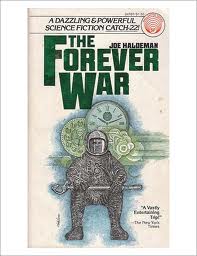
De Camp and his "camp" are certainly in the minority, though. For most practitioners of science fiction, it doesn't really matter whether or not mankind ever discovers a method of scientifically transcending the boundaries of time and space and so building galactic empires. Devices like "hyperspace" are tools by which authors can tell stories, whether they're wild adventure-epics like STAR WARS or relatively realistic dramas like Joe Haldeman's THE FOREVER WAR.
Nevertheless, though the majority of SF-writers perforce make up their technologies, their alien life-forms, etc., out of whole cloth, they don't entirely toss out the basic notion of science fiction, which is that scientific innovation proceeds out of incremental advancements in technological knowledge. No matter many SF-miracles a given writer may pull out of his hat, the general expectation for the genre is that space and time cannot really be transcended, only circumvented. Indeed, as heady as STAR WARS is, with its infusions of quasi-magic and mysticism, one of the original film's charms is that the characters exist in a world where machines get old and break down-- which is the very reason Luke Skywalker's uncle needs to buy a pair of new droids.
Now, fantasy is much less unified in its appeal than science fiction, and even the type I usually address here-- the "otherworldly fantasy"-- is divided into at least two major types, the "nonsense fantasies" of Lewis Carroll and similar authors, and the "mythic fantasies" of Tolkien, Lewis, Howard and many others. Putting aside the first type as irrelevant to this discussion, I would say that mythic fantasies usually (though not inevitably) endeavor to reproduce a mythology of magic and/or sorcery. This mythology is usually the source of the fantasy-author's miracle-making "devices." In rare instances some authors will introduce something comparable to the miracle-technology of straight science fiction, as when Lin Carter mixes Burroughsian technology with sorcerers in a work like THE WIZARD OF LEMURIA, his initial "Thongor" novel.

Not all mythic fantasies appeal to magical beings like Lewis' "Aslan" or Tolkien's "Valar." Nevertheless, writers who invoke miracles of magic and sorcery usually have to posit some source for their sorcerers' powers, and the default position is that the sorcerers earn or acquire powers from gods, demons, faeries, or comparable beings.
Such beings may not always be immune to the ravages of time and space, as we see in Neil Gaiman's AMERICAN GODS. Nevertheless, the dominant trend in mythic fantasy is one of "essence precedes existence"-- in other words, that a being like Aslan exists independently of the mundane realities he inhabits.

In Ursula LeGuin's Earthsea novels, LeGuin's protagonist repeatedly stresses that the nature of magic is essentially one of "uncreating," or at least reordering, the nature of the created universe. This takes the exact opposite philosophical position from that of science fiction, which is more along the line of "existence precedes essence."
More in Part 2.
I came across a remark in a lit-crit book, THE NARRATIVE OF REALISM AND MYTH, where author Greg Lucente argued that “myth” described worlds where time and space could be transcended, while “realism” described worlds where they could not be transcended. I’ve always felt that formula could have application to SF and fantasy, but others’ mileage may vary.Lucente's use of the term "myth" in this lit-crit book is highly idiosyncratic-- possibly even more so than my own, which I'll get to later. I wouldn't use "myth" this way myself, but I think that he's onto something by saying that's a mental distinction on the way readers think about time and space, specifically with regard to the differences in science fiction and fantasy.
It's beyond question that both genres are grounded in producing a wide spectrum of marvelous effects, many of which go far beyond the perimeter of known science. Some practitioners of science fiction don't hold with venturing into that "terra incognita;" allegedly at one point in his life, the late L. Sprague de Camp vowed that he wouldn't write any space-opera stories because he didn't believe in the real-world possibility of "hyperspace" and similar devices.
De Camp and his "camp" are certainly in the minority, though. For most practitioners of science fiction, it doesn't really matter whether or not mankind ever discovers a method of scientifically transcending the boundaries of time and space and so building galactic empires. Devices like "hyperspace" are tools by which authors can tell stories, whether they're wild adventure-epics like STAR WARS or relatively realistic dramas like Joe Haldeman's THE FOREVER WAR.
Nevertheless, though the majority of SF-writers perforce make up their technologies, their alien life-forms, etc., out of whole cloth, they don't entirely toss out the basic notion of science fiction, which is that scientific innovation proceeds out of incremental advancements in technological knowledge. No matter many SF-miracles a given writer may pull out of his hat, the general expectation for the genre is that space and time cannot really be transcended, only circumvented. Indeed, as heady as STAR WARS is, with its infusions of quasi-magic and mysticism, one of the original film's charms is that the characters exist in a world where machines get old and break down-- which is the very reason Luke Skywalker's uncle needs to buy a pair of new droids.
Now, fantasy is much less unified in its appeal than science fiction, and even the type I usually address here-- the "otherworldly fantasy"-- is divided into at least two major types, the "nonsense fantasies" of Lewis Carroll and similar authors, and the "mythic fantasies" of Tolkien, Lewis, Howard and many others. Putting aside the first type as irrelevant to this discussion, I would say that mythic fantasies usually (though not inevitably) endeavor to reproduce a mythology of magic and/or sorcery. This mythology is usually the source of the fantasy-author's miracle-making "devices." In rare instances some authors will introduce something comparable to the miracle-technology of straight science fiction, as when Lin Carter mixes Burroughsian technology with sorcerers in a work like THE WIZARD OF LEMURIA, his initial "Thongor" novel.
Not all mythic fantasies appeal to magical beings like Lewis' "Aslan" or Tolkien's "Valar." Nevertheless, writers who invoke miracles of magic and sorcery usually have to posit some source for their sorcerers' powers, and the default position is that the sorcerers earn or acquire powers from gods, demons, faeries, or comparable beings.
Such beings may not always be immune to the ravages of time and space, as we see in Neil Gaiman's AMERICAN GODS. Nevertheless, the dominant trend in mythic fantasy is one of "essence precedes existence"-- in other words, that a being like Aslan exists independently of the mundane realities he inhabits.
In Ursula LeGuin's Earthsea novels, LeGuin's protagonist repeatedly stresses that the nature of magic is essentially one of "uncreating," or at least reordering, the nature of the created universe. This takes the exact opposite philosophical position from that of science fiction, which is more along the line of "existence precedes essence."
More in Part 2.
Subscribe to:
Posts (Atom)