Showing posts with label greatest crossovers. Show all posts

Monday, May 27, 2024

THE 100 GREATEST CROSSOVERS OF ALL TIME #62

Since I'm making up for not having done many villain-crossovers, I'm obliged to state that "Almost Got 'Im," the 1992 episode of BATMAN THE ANIMATED SERIES, is easily the best villain-cross in that series, if not in all Batman cartoons of all time.


"Almost" only has one close rival: "Mayhem is the Music Meister" from BATMAN: THE BRAVE AND THE BOLD, which I mentioned in GREATEST #43. In any case, that one's less notable for its villain-crossovers than playing Batman off such familiar heroes as Black Canary, Green Arrow and Aquaman.


Thursday, January 18, 2024

THE 100 GREATEST CROSSOVERS OF ALL TIME #61

 Here's my review of TEN YEARS BEYOND BAKER STREET, the superlative intermingling of the continuities of Sherlock Holmes and Fu Manchu.


Tuesday, May 16, 2017

THE 100 GREATEST CROSSOVERS OF ALL TIME #60

In this essay I defined the "static crossover" thusly:

The STATIC CROSSOVER is characteristic of both Homer's Iliad and Apollonius' Argonautica.  In such works, the author assumes an overall cosmos in which all of the myth-characters he invokes are capable of encountering one another at any time.

In the static crossover, then, there's not as much emotional impact about seeing characters of diverse origins appear in one another's company, because it's become a regular occurrence.  Many of the "Silver Age" Superman stories constantly associate the characters in that mythology with one another, sometimes for no more than a few panels. And another such mythology appeared in Disney comic books of the same period.

Disney cartoon shorts had already displayed some minor crossover aspects in their classic period, bringing together separately conceived characters like Mickey Mouse and Donald Duck into the same narrative terrain. The "Duck Universe," particularly due to Carl Barks' talents, built up Donald's retinue with characters like wealthy Uncle Scrooge, incredibly lucky Gladstone Gander, and inventor Gyro Gearloose. And in some of the giant-size efforts, like MICKEY AND DONALD AT VACATIONLAND (Dell Giant #47, 1961), the unbilled writers and artists sometimes went whole-hog on the crossover aspects.


This one puts together not only Mickey, Donald, Goofy and several members of the "Duck group" and the "Mouse group," but also several villains from disparate sources. While the good Disney-spawn are on their way to the fabulous "Vacationland"-- a stand-in for Disneyland itself if there ever was one-- they manage to honk off the Wicked Witch, who somehow survived her apparent death at the end of SNOW WHITE. The Witch, who had already been laying plans for a villains' convention, promptly sends various Disney villains to harass the vacationers. Three villains are still well-known since they came from feature films or shorts-- Captain Hook from PETER PAN, the Big Bad Wolf from THE THREE LITTLE PIGS, and Black Pete from assorted Disney cartoons and comic strips. By dumb luck, every time one of these villains encounters the vacationers, the finks become seduced into having vacation-fun instead of making trouble. Only the Witch's last group of pawns-- the Beagle Boys, who alone debuted in comic books-- aren't technically won over by fun-fun-fun. Rather, they bang their heads and forget that they're hardened crooks, and begin careers of honest labor at Vacationland.

Whoever wrote the story had a fine sense of character continuity. When inventor Gyro sees the Witch do magic, he boasts that "magic is no match for science." Later, Mickey manages to undo the sorceress' source of power by stealing her hat, drawing on his past experience as a "sorcerer's apprentice."

Tuesday, August 30, 2016

THE 100 GREATEST CROSSOVERS OF ALL TIME #59


I've just finished a blogpost examining the 1990-91 BOOKS OF MAGIC mini-series as a "mythcomic," and I would be remiss not to mention that it's also one of the best "continuity-fests" ever served up by DC comics.

As noted in the post, the narrative focuses on giving Tim Hunter-- a British teenager with the potential to become a "super-magus"-- a tour of DC's magical universe with the help of four major occultists: the Phantom Stranger, Mister E, John Constantine, and-- barely seen in comics since the Golden Age-- Doctor Occult.

What I want to note here, though, are the narratives many continuity delights, such as:

Tim's encounter with Golden Age characters Zatara and  Sargon the Sorcerer, both slain in one of Alan Moore's SWAMP THING stories.


His meeting with Constantine's apparent romantic conquests, Zatanna and Madame Xanadu, and an amusing tete-a-tete between sorcerer-villains The Wizard and Felix Faust. (I'm still geek enough to remember protesting, "But Faust is so much more powerful than the Wizard!")


The appearance of characters as obscure as Nightmaster in Book Three, and a complicated future history involving everything from the Legion of Super-Heroes to FLASH-foe Abra Kadabra.


An insider's delight, to be sure, but no less a delight.


Thursday, July 14, 2016

THE 100 GREATEST CROSSOVERS OF ALL TIME #58


The high-flying Hillman characters Airboy and Sky Wolf started out in separate features during WWII, and I don't have the impression that they crossed over much-- certainly not to the extent they did when Eclipse Comics revived most of the Hillman franchises in the 1980s. But I found this postwar adventure, from AIRBOY vol. 3, #12 (1947), to be of more than passing interest.

The scene above may remind some of the typical "Marvel-heroes-meet-and-beat-cute" schtick. In the story Airboy has fallen under the spell of a master hypnotist, and must encourage his friend Sky Wolf to knock him out in order to get him out of the villain's aegis. As a bonus, Airboy's sometime girlfriend the Valkyrie appears in the story as well, making, as I recall, her last Golden Age appearance.

The villain is one of a group of "Tartar" warriors-- all drawn to look like Vikings-- who have been somehow brought back to life by atomic testing. Their mesmeric leader is named "Black Tamerlane," named for the partly-Mongolian conqueror of the 13th century. The modern villain's idea of bringing a new level of conflict to a war-weary world was a pretty common trope in postwar popular entertainment, though it was unusual to see that goal conflated with the old "Mongol peril" trope.

The whole story appears at Digital Comics Museum here.

Tuesday, December 8, 2015

THE 100 GREATEST CROSSOVERS OF ALL TIME #57


DC Comics's flirtation with pulp crusaders in the 1970s didn't bear profitable fruit: they managed only 13 issues of their title THE SHADOW and four issues of JUSTICE, INC., both based on properties licensed from the publisher Street and Smith. The later book was probably entitled JUSTICE INC. because the actual name of the starring hero, The Avenger, would have invited a "cease and desist" letter from Marvel Comics, home of "The Avengers." However, on the whole JUSTICE INC. was an undistinguished work. In contrast, DC's SHADOW comic, though short-lived, enjoyed a handful of memorable stories crafted by writers Denny O'Neil and Michael Uslan, and drawn by artists Michael Kaluta, Frank Robbins and ER Cruz.

The one good thing about DC's brief licensing of "The Avenger" was that it eventuated in this crossover. Certainly the story was an attempt to boost the visibility of the lesser-known feature, but the raconteurs in charge of having the Shadow and the Avenger-- Uslan and Cruz-- also made it one of the stronger comics-crossovers of the 1970s.

I won't claim that the plot is anything special. Both heroes employed crews of subsidiary agents who helped the main guy fight his battles, so the script took advantage of this by having a nasty evildoer-- the Shadow's most celebrated villain, Shiwan Khan-- kidnap members from both crews. He then hypnotized the assistants and used them as catspaws in a successful attempt to make the two crime-crusaders fight one another.

As a fight, it's not much: ER Cruz is more successful at creating oppressive mood than pulse-pounding action. But Uslan is excellent in the way he gives both the Shadow and the Avenger a waspish wariness of one another, rather than simply having them make nice once they learn how they've been manipulated. I particularly like the succinct way the Avenger explains things to a subordinate when they witness one of the Shadow's quasi-supernatural feats: ""All is not as we see it, Mac! But I DO know what it was I saw!" At a time when many comics-writers over-explained nearly everything in the story, Uslan shows a charming reticence as to divulging the inner secrets of his mysterioso protagonists.

Monday, October 19, 2015

THE 100 GREATEST CROSSOVERS OF ALL TIME #56


One of the great "guilty pleasures" of 1980s TV was the 1981-89 series DYNASTY. Having seen the first season in reruns a while back, I've the sense that even then the producers hoped to create a spin-off by postulating that the Denver-based oil barons, the Carringtons, had a rival in another super-rich family, the Colbys. The two big families were bound in part by marriages between members, but it didn't seem to make them any more friendly over time.

The 1985 DYNASTY episode "The Titans" served to introduce the cast of the spinoff to the parent show's viewers prior to COLBYS's debut in November of that year. From then on the two shows didn't share many plotlines, and some of DYNASTY's actors , notably Joan Collins, refused to appear on COLBYS for fear of "weakening the brand," as some people call it these days. COLBYS started off with some powerhouse actors, particularly cinematic icons Charlton Heston and Barbara Stanwyck, both of whom certainly were more famous than John Forsythe and Linda Evans. Yet COLBYS never caught on and only lasted two seasons. I've not seen it in many years, but all I remember about it was a running plotline about incestuous desires between a brother and sister.

The crossover episode is okay fun, if one has a great tolerance for over-the-top line-deliveries and a wealth of scenes in which enemies bare their fangs at one another over champagne and studied innuendo. One of my first crossover-listings took a similar form, in that once the series ALL IN THE FAMILY was successful, its producer used not one but two episodes of that show as "back-door pilots" for his second series MAUDE. I'm not a big fan of the latter series, but I must admit that MAUDE by far a better spin-off than COLBYS. If COLBYS has any significance in a societal sense, it's probably just that the American public could only take so much champagne and caviar.

Thursday, September 10, 2015

THE 100 GREATEST CROSSOVERS OF ALL TIME #55


I haven't read more than a handful of Clive Barker's prose works, so I know of his Hellraiser and Nightbreed concepts only through their incarnations in the cinema, where Barker's control of the franchises was, to say the least, compromised. I've read a handful of the Nightbreed comics published by Marvel's Epic line, and none of the Hellraiser comics from the same source. Fortunately, Epic's 1991 Hellraiser-Nightbreed crossover, JIHAD, is not tied into any of other serials, and neither writer D.G. Chichester nor artist Paul Johnson worked on either of the ongoing titles. Unlike some other Epic Comics graphic novels-- notably, the debut issue of VOID INDIGO-- JIHAD can be read without reference to any other serials. Admittedly, though, one is likely to be lost if one hasn't seen both the 1990 NIGHTBREED film and at least the first two Hellraiser films, which I have reviewed here and here. Indeed, I was thinking largely of JIHAD when I wrote in the second review that "HELLBOUND, while far from a perfect film, expanded on the Cenobite mythology originated by Barker, and arguably, it is the Randel-Atkins mythology that has been most fruitful in other adaptations of the franchise." (Note: Peter Atkins, writer of HELLBOUND, gets the honor of having a denizen of the Cenobite Hell named after him in JIHAD.)

Since JIHAD shows a febrile creativity in terms of both script and art, I will speak of it as the joint creation of Johnson and Chichester. The two creators had a formidable challenge before them, for of the two franchises, only Hellraiser had proved popular with horror-fans, while the NIGHTBREED film proved itself a critical and commercial failure when it debuted in American theaters in February 1990. This meant that the Nightbreed characters-- and JIHAD features a quite unwieldly quantity of them-- probably weren't really that familiar to JIHAD's readers, unless they also followed the ongoing NIGHTBREED comic book, which began a couple of months after the film's release in 1990. Still, the society of freaks and monsters who made up the Nightbreed offered more potential for reader-identification than the Cenobites from the Hellraiser franchise. These characters-- almost always represented by their articulate leader "Pinhead"-- existed largely to tempt their victims into entering their hellish domain, where they would then undergo ceaseless tortures in what might best be described as a S-&-M updating of medieval stories of infernal punishments.

So Johnson and Chichester essentially interwove the very loose "Randel-Atkins mythology" of the second Hellraiser film into the equally loose mythos created by Barker for the Nightbreed film. The result is one very heavily layered crossover, in which the Cenobites are discovered to have been the forces that caused the monstrous Nightbreed race to be divorced from their somewhat distant cousins, the human beings. I should note that Barker's concept for the Nightbreed bears a strong resemblance to the Stan Lee-Jack Kirby "Inhumans" franchise, in that both groups are comprised of a motley crew of superhumans who have little if any physical resemblance to one another-- though of course, Barker's concept ratchets up the sex, violence and perversity far beyond the boundaries of any mainstream comic book.

Despite all the transgressive elements in JIHAD, however, Johnson and Chichester bring an artfulness to their franchise-crossover. I for one consider that its theme is at least as deep as that of the Moore-Gibbons WATCHMEN, but would concede that JIHAD's space limitations-- consisting of just two 48-page novels, with gorgeously grotesque painted art by Johnson-- might make some overlook it as just another desultory franchise-crossover.  I'll be exploring said theme in more depth elsewhere.

As an odd coda to this overlooked work, both Chichester and Johnson left the medium of comic books for employment in other artistic venues.


Wednesday, September 2, 2015

THE 100 GREATEST CROSSOVERS OF ALL TIME #54


Though I made up my "best 100 crossovers" list months ago, the gradual nature of the project has allowed for me to occasionally bring in more recent stuff and drop out previous choices.

"Say Uncle," a STEVEN UNIVERSE cartoon lasting less than a quarter-hour, debuted in April 2015 on Cartoon Network. I just saw it, and it's easily one of the most "meta" commentaries on the dynamics of engineering a crossover between franchise-characters. The above scan takes place when visiting guest-star "Uncle Grandpa" assures Steven that the episode in which they're jointly appearing "is not canon"-- and then he proceeds to show him how to use a real cannon, by firing off his own head as a projectile.

In contrast to many non-canonical episodes of serial shows, in which nothing much happens aside from the crossover, "Say Uncle" does relate to a continuing storyline from the UNIVERSE show, in which he struggles to master his latent powers as one of the "Crystal Gems." At the same time, the story is written so that writers dealing with more canonical matters can freely ignore the intrusion of Uncle Grandpa into Steven's universe. Similarly, when the goony Grandpa transports Steven into his own universe, one of Steven's Gem-friends ends up devouring one of the regular characters of Grandpa's show-- an event which I imagine was also cheerfully ignored in any GRANDPA episodes that followed.

I've become only a minor fan of STEVEN UNIVERSE, and have not really followed UNCLE GRANDPA, but this episode does what any good crossover should do. The whole purpose is to encourage audiences to partake of both franchises more regularly-- and after this, I may even watch UNCLE GRANDPA a little more.

Tuesday, August 18, 2015

THE 100 GREATEST CROSSOVERS OF ALL TIME #53


One of the most impressive feats of Roy Thomas during his last years as an exclusive employee of Marvel Comics was a multi-issue THOR storyline involving Wagner's Ring operas, the polytheistic pantheons of the Marvelverse, and the reason that Thor's daddy Odin created the Destroyer. However, as explained by Thomas in the comic's letters-column, one of the main purposes of the storyline was to bring Kirby's 1976-78 concept THE ETERNALS into Marvel continuity. Though it's clear that Jack Kirby didn't care anything about melding his creation with the other Marvel books, Thomas clearly intuited that since Marvel owned the whole concept, sooner or later someone would bring Kirby's creations into mainstream Marvel, if only within the context of some dismal team-up issue. Thus the principal purpose of THOR #283-300 was to produce a mammoth crossover that did justice to the scope of Kirby's creation, by having the Lee-Kirby version of Thor investigate this strange new breed of "gods"-- although they were only gods in terms of the names they inherited. In truth, the Eternals were not creative forces, but the creations of brobdinagian aliens called the "Celestials," with whom Thor finds himself in conflict.

Having re-read the continuity, I have to admit that the crossovers with Thor and the Eternals are probably the clunkiest parts of the long sequence, although the Celestials make for great villains. Thomas did not actually complete the entire epic, as exigencies forced him to turn over the writing duties to Mark Gruenwald and Ralph Macchio. Similarly, though John Buscema began the sequence, the majority of the penciling was done by Keith Pollard, and may represent his best work for Marvel Comics.

Despite Thomas' legendary commitment to continuity, he drops the ball in the "Seigfried" sections in that he shows how Odin gave birth to Thor by a non-Asgardian mother-- yet somehow tries to imply that Odin's mortal spawn, the Seigfried of the Wagnerian narrative, is also actually Thor by some unexplained logic, rather than being simply the Thunder God's half-brother. Perhaps Thomas meant to use one concept introduced in issue #294, "the Celestial Axis," as a catch-all explanatory device, but if so, he failed to follow up on it, as did Macchio and Gruenwald.

Nevertheless, it's a great romp through the many worlds of the Marvel cosmos.

Monday, June 15, 2015

THE 100 GREATEST CROSSOVERS OF ALL TIME #52

A small number of hero-crossovers appear in the Italian "muscleman adventure" subgenre of the late 1950s and early 1960s. Until recently I'd considered choosing, as the best representative of these, 1963's HERCULES, SAMSON, AND ULYSSES. Like most of these mini-epics, the storyline of H,S & U is so conventional as to stifle one's imagination, though there is at least a decent fight-scene between the two strongmen of the title.


Happily, thanks to a contributor to Youtube, I came across a far superior nominee: a broad comedy entitled SAMSON AND THE MIGHTY CHALLENGE. I go into more detail in my review, but suffice to say that Hercules falls in love with a young woman who doesn't want him-- a development that probably never occurred in any other Italian Hercules film.  The lady's parents try to stave Hercules with a challenge-- and from a plot-standpoint, the film really is a challenge given to Hercules, not to Samson. They tell Hercules that the gods will not give permission for the marriage unless Hercules can defeat the Jewish strongman Samson.

In addition to once again bringing together Samson and Hercules-- this time in a humorous context-- two other heroes also jump into the mix. One is "Maciste," who began his career in the 1914 Italian historical epic CABIRIA, and who then starred as the hero of various silent films, as well as a horde of muscleman-adventures of the fifties and sixties, many of which were re-titled as Hercules films for the American market. The other is "Ursus," whose name was taken from the novel/film QUO VADIS for a handful of "Ursus" films. The Ursus of MIGHTY CHALLENGE is more like a comic brute rather than a hero in his own right, so he's not really a continuation of the noble fellow who had his own series. Then again, I must admit that almost none of these muscleman films maintain any consistency from one episode to the next. So the Hercules, Samson and Maciste of MIGHTY CHALLENGE are similarly not in line with any of the previous adventures of those cinema-characters, much less any mythic or literary forbears.

The highest compliment I can pay the film is to say that while most Italian knockabout comedies aren't nearly as funny as their makers think they are, this one actually brings the goods.

Thursday, June 11, 2015

THE 100 GREATEST CROSSOVERS OF ALL TIME #51


It's a slam dunk that Jack Kirby, co-creator of both Thor and the Hulk, should be the one to render the best (thus far) face-off between the two Marvel titans, covered in my previous post.

Nevertheless, the Hulk-Thor battle in DEFENDERS #10, scripted by Steve Englehart and pencilled by Sal Buscema, comes a close second. The scene represented on the cover, in which the two super-strong guys, after lots of pounding and throwing things, presents the argument that the two are fundamentally equals, in that they struggle against each other, arm against arm, for something like a solid hour.

This was the high point-- though not the only good moment-- of the seven-issue crossover  called "The Avengers-Defenders War." This took place in the AVENGERS (issues #115-118) and DEFENDERS (issues #8-10) titles, both at the time being written by Englehart. In later interviews Englehart would assert that other Marvel employees doubted that he and his artists could pull off a crossover that had to be timed so that each segment came out precisely on the heels of the last installment. Later, this sort of multi-issue crossover would become standard practice at both Marvel and DC, often criticized for weak storylines and a transparent attempt to boost sales in an artificial manner. But Englehart's story carries the same innocent thrill of the "heroes-meet-and-fight-cute" trope that Marvel perfected in its Silver Age heyday.

The plot, dealing with a conspiracy by villains Loki and Dormammu to reshape the Earth into one of Dormammu's realms, serves adequately to bring the two teams into a conflict in which each believes the other to be villains. The only downside of this generally enjoyable outing is that although Sal Buscema is perfectly fine in his DEFENDERS segments, penciller Bob Brown, given mediocre inks by Mike Esposito, gives the AVENGERS segments a sloppy and unfocused look. The one exception to this generalization is a chapter devoted to a battle between Captain America and the Sub-Mariner, but only because this section is crisply inked by an uncredited Frank McLaughlin.

Monday, May 11, 2015

THE 100 GREATEST CROSSOVERS OF ALL TIME #50

FANTASTIC FOUR 25-26, with its Thing-Hulk battle, remains the best example of Jack Kirby cutting loose with his trademark fight-kinetics. However, despite a shorter length, the first major battle between the Hulk and the Mighty Thor-- appearing in JOURNEY INTO MYSTERY #112-- is nothing to sneeze at.


Rather than coming up with a new reason for the Asgardian hero to confront the Green Goliath, Lee and Kirby choose to tell an "untold story" of a previous meeting.  Thor himself narrates the story to a gaggle of young admirers, revealing that during the Avengers' sortie against the team of the Hulk and the Sub-Mariner in AVENGERS #3, Thor managed to get the Hulk alone in a room and the two of them matched muscles for roughly a minute. This, Thor tells his comics-audience (but not his listeners), is all the time the hero allows himself to defeat the Hulk, swearing not to pick up his dropped hammer until he defeats his monstrous opponent. Since in those days Thor would revert to the human Doc Blake if the hammer was out of his hands for more than 60 seconds, this sounds like a suicide impulse on Thor's part-- though it certainly fits in with his Viking macho rep.

It's a good fight, but the panels above capture a curious dichotomy in the Lee-Kirby corpus: an admiration for the brutal power of the Hulk played off against Thor's embodiment of the virtues of nobility. The THOR feature would sometimes explore these issues, resonant of class conflict, but here it's just a side-note to the Clashing of Titans.

Saturday, May 9, 2015

THE 100 GREATEST CROSSOVERS OF ALL TIME #49


I selected this film for roughly the same reasons I chose CRISIS ON INFINTE EARTHS here in post #47, less for the work's quality than for its significance as a crossover.

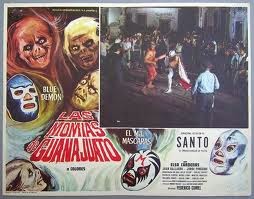
As all fans of luchaodore cinema know, the dominant idea behind the genre was to portray established professional wrestlers as itinerant superheroes, running around fighting everything from crime bosses and spies to aliens and monsters. IMDB cites the date of the first crossover, SANTO AND BLUE DEMON AGAINST THE MONSTERS, as 1970. I haven't screened this flick as yet, but I have seen two other Santo-Blue Demon team-ups from the same period, so I have to pass on these two-wrestler team-ups to stand as the best of the genre.

If 1972's THE MUMMIES OF GUANAJUATO had nothing else going for it, at least it brought together the three wrestlers who had the longest careers as movie superheroes: Santo, the Blue Demon, and Mil Mascaras. Fortunately, the film also gave the wrestlers opponents who aren't simply retreads of Hollywood figures. These mummies were based on a group of well- preserved corpses found in Guanajuato, Mexico, which city subsequently became a major Mexican tourist attraction.

These two elements are the best aspects of the film: otherwise MUMMIES is not the equal of the more brain-fried Mex-horror films. For most of the narrative, director Federico Curiel seems content to show the heroes in a series of running battles with their super-strong, almost invulnerable enemies. More than that I can't  say, for I only watched a Spanish language version of the film. However, I honestly don't think I'm missing any great subtleties here.

The mummies are moderately imposing, if not scary, and there's lots of action. I should note, though, that Santo doesn't show up until the last fifteen minutes; it's been strongly suggested that he was a last-minute addition to the film..

Monday, April 13, 2015

THE 100 GREATEST CROSSOVERS OF ALL TIME #48


PLOT SPOILERS AHEAD...

While a lot of the crossovers I've covered here have elements of hand-to-hand conflict, here's one based in "foot vs. foot."

FLASH #175 was published as a follow-up to a similar set-up in SUPERMAN #199, which had only seen publication about three months earlier. The Superman story is a good read, but it has a somewhat "kiddie-level" feel to it. Superman and the Flash race one another for charity, but have to deal with illegal gamblers trying to sabotage the race for their own benefit.

As the cover above shows, the FLASH version of this conflict hinges more on the hero's pathos in contention with DC's premiere hero. The script by E. Nelson Bridwell shows a little more concern with overall continuity than was typical of DC comics in 1967.

In short, Superman and the Flash are forced to run across the galaxy in a competition managed by two alien gamblers, Rokk and Sorban, who had appeared in an earlier Superman story. The aliens also hold the whole Justice League hostage and threaten to destroy the home city of whichever hero loses the race. Refreshingly, Bridwell does manage to find ways for three of the Justice Leaguers to provide aid to the racing heroes, so that they're not simply confined to sitting around playing cheerleaders.

The story doesn't stand up to close scrutiny. Since Flash can't breathe in space, the alien betting on him promises to supply him with a force-field of breathable air throughout the race. However, you learn by story's end that the aliens are actually two of Flash's old foes, Professor Zoom and Abra Kadabra, who have only instigated the race in order to lure the Flash into various death-traps. When one of the villains says that he cancelled the force-field so that Flash should have died in space, Superman advances the absurd explanation that he provided the Flash with enough air to breathe via his "super-breath." Hmm, so Superman can expel pure oxygen from his lungs, rather than carbon dioxide? Still, I didn't really worry about such niceties as a kid reading this comic.

Ross Andru's art puts a lot of verve into the galaxy-spanning race, and the two heroes are seen to be somewhat distrustful of one another, possibly in response to the pervasive influence of Marvel Comics during the period.


Thursday, April 9, 2015

THE 100 GREATEST CROSSOVERS OF ALL TIME #47

I've finished a lengthier analysis of DC Comics' CRISIS ON INFINITE EARTHS here. but that essay doesn't discuss the series from the POV of crossover aesthetics.

First, I should note that this type of crossover is the one I defined here as the STATIC CROSSOVER:

In such works, the author assumes an overall cosmos in which all of the myth-characters he invokes are capable of encountering one another at any time.

The first example of the static type that I cited on this blog was FANTASTIC FOUR ANNUAL #3, Marvel Comics' first large-scale assemblage of most of their 20th-century characters in one story. CRISIS ON INFINTE EARTHS-- "COIE" for short-- has many of the same faults and virtues of this annual. On the one hand, the seasoned fan enjoys the experience of seeing characters mixed together that did not typically meet, be it Mr. Hyde and Hawkeye, or Swamp Thing and the Losers. On the other hand, the meetings are so short that there's often a sense of frustration in such brief encounters.

A lot of COIE consists of characters looking up at the sky in apprehension or laying plans to deal with the Anti-Monitor, and these don't exactly give artist George Perez the chance to excel with his mastery of superhero kinetics.

The best issues to seek out for heroic action in the Mighty Perez Manner are COIE #6, in which the DC heroes contend with characters from other publishers, including Fawcett and Charlton:


And COIE #9, which puts the heroes in conflict with a contingent of DC's best villains, plus a tiny handful of Fawcett villains.


Thursday, April 2, 2015

THE 100 GREATEST CROSSOVERS OF ALL TIME #46


I've already discussed the two best Stan Lee-Steve Ditko crossover stories of the Silver Age, here and here,  and the one Stan Lee-written comic that wasn't a collaboration with either Ditko or Jack Kirby  here. But Ditko also did one other notable crossover in the Silver Age. Given Ditko's contrarian nature, though, it's significant that he refuses to give the casual reader what he might expect. "Blue Beetle Faces the Destroyer of Heroes," the lead story of BLUE BEETLE #5, does have the hero of the titular feature cross paths twice with the hero of the same comic's backup strip, The Question. However, the heroes do not meet with both in costume.

First, Vic Sage (aka the Question) crosses paths with Ted Kord (aka the Blue Beetle) when both happen to be at a museum. They stand together to prevent some scuzzy hippies from assaulting one of the Greek artworks on display, but they part ways thereafter and don't so much as shake hands.


Later, one of the hippies takes it into his head to don a costume based on a sculpture that represents absurdity and pointlessness, and to break into the museum to finish what his buddies started: destroying images of heroism and purpose.  While Blue Beetle is fighting the costumed kook atop the museum's roof, on the street below one of the hippies grabs a cop's gun and tries to shoot the Beetle. Vic Sage happens to be around, and he disarms and clouts the bum, perhaps saving the Beetle's life. The Beetle then goes looking for his opponent, and never pauses to find out who shot at him or who saved him from being shot.


The "Blue Beetle" story also introduces a character who is featured as the villain in the "Question" backup, but this second story is not a crossover as such.


It's doubtful that "Destroyer of Heroes" made much impact on its dominantly juvenile audience at the time. However, many hardcore fans of the period still regard "Destroyer" as one of the most important stories of the decade.  Though philosophical concerns did sometimes pop up as side-issues in the Silver Age stories of, say, Superman and the Fantastic Four, BLUE BEETLE #5 is arguably the first mainstream comic book to devote an entire issue to exploring its author's philosophical outlook. (It's rivaled only by MYSTERIOUS SUSPENSE #1, but this full-length comic was also authored by Steve Ditko, and bears the same cover date, October 1968, as BLUE BEETLE #5.)

Of course one can argue with many aspects of Ditko's Ayn Rand-flavored meritocracy, but the story remains one of Ditko's best dramatizations of his concerns. Later, Blue Beetle and Question teamed up "for real" in another story from Charlton, one from Americomics, and finally from DC Comics. This established the trope of a bond of friendship between the two heroes that never existed in the original Ditko crossover, a bond referenced in Alan Moore's WATCHMEN, where the Ditko characters are transformed into Rorschach and Nite Owl.

Monday, March 23, 2015

THE 100 GREATEST CROSSOVERS OF ALL TIME #45


Silver Age Marvel's western line quickly followed the pattern established by the superhero line of the early sixties. Thus mundane cowboy protagonists began meeting costumed crooks with names like the Red Raven and Iron Mask, and many of the characters began crossing over into each other's adventures. Usually the crossovers were limited to Marvel's Big Three-- the Rawhide Kid, the Two-Gun Kid, and Kid Colt-- though even in the early 1970s, when the western line was petering out, one could still come across oddball meetings like the Ghost Rider and the Gunhawk.

Unfortunately, though Marvel's western riders had their share of good-to-fair solo adventures, the crossovers were never as epic as one might have wished. All too often, the writers seemed to spend all their energies finding some excuse to have Kid Colt and Rawhide-- the two most frequent crossover-subjects-- to meet one another. But they usually only encountered mediocre villains-- routine owlhoots or rampaging Indians. On one occasion, the two Kids met a disguise-using criminal named the Masquerader, but I for one would rather have seen some variation on the old "rogues' galleries of different heroes band together" to fight the heroes. Unfortunately, the closest fans ever got to this setup occurred long after the western heroes had all been reduced to reprint status, when they guested in AVENGERS #142. That story bring together the three above named Kids, the 1960s Ghost Rider (under the new sobriquet "Night Rider"), and the Ringo Kid, who hadn't appeared in a comic book since the late 1950s. For good measure the story also included a handful of Western super-villains like the aforementioned Iron Mask and Red Raven. For fans of the colorful, entirely escapist cowboy crusaders, this would be the closest thing they would get to an "epic western crossover."


The 2000 four-issue miniseries BLAZE OF GLORY. while it substantially rewrites several character-histories, does succeed in putting across the aura of western epic. The small town of Wonderment, founded by black ex-slaves who fled the South, is besieged by masked bandits called "Nightriders," who are determined to scatter the town's inhabitants to the four winds. One of the inhabitants, however, has his own heroic history, for he is Reno Jones, who co-starred in Marvel's first "salt-and-pepper" team-title, GUNHAWKS (1972-73). Jones goes looking for his own "magnificent seven" and manages to corral three fighting cowboys--the Rawhide Kid, Kid Colt, and the Outlaw Kid. In addition Reno's ally, a fellow named Fournier, attempts to get the Two-Gun Kid to come out of retirement, and eventually succeeds. However, Colt is being pursued by the bounty hunter Gunhawk and the Pinkerton enforcer Caleb Hammer. The Gunhawk was, as mentioned above, a short-lived hero of the early 1970s, while Hammer enjoyed just one spotlighted appearance in a 1980 issue of MARVEL PREMIERE.  In addition, the Indian hero Red Wolf, another 1970s creation, is hanging about, as is what appears to be a reborn version of the Ghost Rider.

The story by John Ostrander is at least bracing if not strikingly original, but its primary virtue is in bringing together so many of Marvel's cowpoke crusaders, even though Ostrander and artist Leonardo Manco re-imagine all of the old clean-cut heroes as scruffy "spaghetti western" types. I like spaghetti westerns as much as the next western fan, but despite copious references to racial injustice, the script doesn't manage to sell its concept of "the Real Wild West," and Manco's rendition of western action is entirely too painterly. Still, BLAZE OF GLORY remains a pleasing salute to Marvel's history with the western genre, whose moribund state is perhaps signified by the fact that two of the oldest Marvel heroes end up on Boot Hill.

Thursday, February 26, 2015

THE 100 GREATEST CROSSOVERS OF ALL TIME #44


This is the only crossover that I'll feature where the story-line was not finished as planned, because the titular character was intended to "cross over" with an unacceptable guest star; i.e., Jesus of Nazareth.

The title SWAMP THING was born from the melting-pot of 1970s comics, at a time when the 1960s dominance of superheroes had waned somewhat and the industry was still actively seeking other genres that might pay off at the newsstand. Most non-superheroes, however, did not last past the 1980s unless they already established their popularity in earlier decades, as with DC's perennial war-hero Sergeant Rock, or had established bonafides outside comics, as with the Robert E. Howard character who became one of Marvel's longest success-stories.  Swamp Thing's original 1972-1976 run was not especially successful, even in comparison to other protagonists in 1970s horror-themed comics. However. its popularity with hardcore comics-fans led to the 1982 film, which in turn to the reborn series in the same year. During Alan Moore's groundbreaking tenure on the series, Swamp Thing's universe, which had featured only minimal ties to the greater DC Universe, began to feature crossovers far more liberally. This liberality may have stemmed from an editorial mandate, given that eighties comics became increasingly concerned with playing to the direct market, but I cannot explore those issues here.

Though Moore had his swamp-monster encounter a number of "offbeat" DC characters like the Demon and Adam Strange, Rick Veitch's time-travel story, featured in SWAMP THING #80-87, arguably provided a fresh angle. Instead of meeting heroes within his own timeline-- at least some of whom might boost the title's sales, as with Superman and Batman-- Veitch allowed his plant-protagonist to exclusively interact with characters who neither had their own series nor much chance of getting new ones. These crossover-characters included the aforementioned Sergeant Rock (whose regular title had died the year before he appeared in SWAMP THING #82), Enemy Ace, Tomahawk, the Shining Knight, and a gaggle of DC's western heroes, ranging from the sober-sided (Johnny Thunder), the humorous (Bat Lash), and the demonstrably weird (El Diablo, Super Chief).  For long-time fans of DC Comics, it was a blast from a long-dead past; of a time when comics companies could publish successful titles based in periods other than the present or the far future.

It's also occurred to me that some of the "non-superhero" genres spotlighted by Veitch's sequence tended toward a harder-edged "blood and thunder" approach than DC was known for in its superhero titles. This wasn't invariably the case. The short-lived Native American hero Super Chief was indistinguishable from a regular superhero yarn of the period, and for most of Tomahawk's career since his debut in 1947, the frontiersman enjoyed adventures just as vanilla as those of the Man of Steel; only in the last years of the Tomahawk feature did the hero's adventures assume a tougher outlook.  Still, it was largely in the non-superhero genres that DC pushed the envelope in the "blood and thunder" department, which might be viewed as a stepping-stone to later, more adult-flavored features-- not least SWAMP THING itself.

As most fans know, the Swamp Thing time-travel opus was never completed. Veitch had received approval from DC to finish the series by having Swamp Thing encounter Jesus Christ (as well as a considerably more obscure DC hero, The Golden Gladiator). DC Comics then reversed itself, apparently fearing negative publicity. Veitch resigned and the opus was completed by a new writer Doug Wheeler. Though SWAMP THING #88 technically finished the plot-threads of the time-travel story, I for one don't regard it as part of the whole-- not just because it wasn't Veitch's original story, but because it failed to follow through on the themes established-- particularly that of the wonky "DC history lesson."

Saturday, February 7, 2015

THE 100 GREATEST CROSSOVERS OF ALL TIME #43


Just as I did with the comic-book BRAVE AND BOLD last post, I wanted to find a representative episode of the 2008-2011 Cartoon Network teleseries BATMAN: THE BRAVE AND THE BOLD.

To the lover of DC Comics esoterica, B:TBATB was a cornucopia of daffy pleasures. The writers went out of their way to stress the wild, campy elements of superhero comics, though with a very different approach to "camp" than that of the 1966 BATMAN teleseries.

But of all the series' many strong entries, it was never better-- or "campier"-- than the 2009 episode "Mayhem of the Music Meister."  The plot is fairly simple: Music Meister (cunningly voiced by Neil Patrick Harris), a criminal able to enthrall others with his singing, plots to use a special broadcasting device to gain control over everyone in the world.  But the simplicity allows Batman and his guest heroes, Black Canary and Green Arrow, the freedom to indulge in all the deliberate artificiality of musical theater. In fact, the artificiality of such musical tropes as non-diegetic tunes can be fairly compared to a superhero trope like the "villain puts the heroes into a death trap but doesn't stick around and watch them die."

The songs are all fun doggerel-style tunes, and there's a cool subplot in which Black Canary's affection for Batman finally turns to Green Arrow, which any fan worth his salt should appreciate.