N.K. Jemisin's trilogy, though much better than most current attempts at speculative fiction, shares similar problems, not least being an inability to create nuanced characters and an over-investment in ideological statements at the expense of creativity.
When I read the first book in the series, THE FIFTH SEASON, I was fascinated by Jemisin's thoroughly original take on post-apocalyptic fiction. To be sure, the author never actually says that her "broken earth" is actually a future-version of our Earth, though the narrative has its share of suggestive clues. It's not purely a "science fiction" world, starting with the idea that the Earth itself is sentient, having absorbed the spirit-force of living beings over the centuries. Somewhere in the very distant past, human scientists sought to tap the occult power of the Earth with assorted devices, including floating sky-obelisks and a race of inhuman humanoids called "tuners," who can move through stone like air.
At some point, the moon is flung out of orbit with its parent planet, and the sentient Earth unleashes vengeance of Old Testament proportions. Human beings are constantly subjected to chaotic "seasons," including massive earthquakes and volcano eruptions, making it inevitable that people only exist in small, unstable enclaves. However, some humans are born with a mutant-like ability to manipulate stone through a magic-like process. The main viewpoint character is an older woman, Nassun, whose primary motive throughout all three books is her Demeter-like quest to find her lost, similarly powered daughter Essun. In addition, both females are drawn into the plans of the surviving "Stone Eaters"-- the former "tuners," who live for centuries and are no longer strictly human. Some Stone Eaters want to placate Earth by bringing the moon back to its proper orbit, while others want the whole world eradicated for good.
Jemisin's apocalyptic world is worked out with an amazing thoroughness. The first book is particularly strong in terms of showing how the ongoing cataclysms affect everything humans perceive-- civic organization, codification of time-passage, and-- perhaps inevitably, because Jemisin is a Black American-- the separation of the magic-users, or "orogenes," into marginalized castes, as against amid the more numerous "normals." Indeed, the quest of Nassun and Essun to rebel against their marginalization seems is a far more pervasive theme than the restoration of some degree of stability to the fractured planet.
Though many critics have scorned fantasy-fiction for its lack of well developed characters, I've often argued that the fantasy-author must prioritize the nature of the world he or she creates, with the result that mimetic character-development is usually a secondary consideration. "Realistic" authors need devote no creative attention to the world they describe; it's just "the world as everyone sees it.." Jemisin certainly makes an attempt to get away from the stock image of the fantasy-author as the worldbuilder who can't create rich characters. However, after the first book it becomes increasingly obvious that Jemisin's character palette is extremely limited, not because of her worldbuilding but her liberal ideology.
I could embrace such an ideology if I felt that Jemisin had created at least a cast of characters as rich as Frank Herbert's early DUNE books. However, over the next two books it becomes evident that most of the supporting-characters are merely functional echoes of either Nassun or Essun. The only exceptions are the villainous figures, most of whom are vague at best, with the exception of Nassun's husband Jija, the abductor of Essun, rabidly opposed to having any orogeny in the family. I wanted the characters to be as rich as their world, but they aren't.
Finally, Jemisin's theory of liberation seems to depend on forcing others to give you respect, rather than befriending them. Toiward the end of the third book, the moon has (rather predictably) been rejoined to the Earth, and Essun expresses the opinion that the system of oppression will never change:
"They're not going to choose anything different."
To which another support-character, Hoa, responds:
"They will if you make them."
I suppose it's fortunate for me that I never warmed to Jemisin's characters, for this expression of "by any means necessary" would have made me dislike them for their author's flawed ideology.
Showing posts with label prose fiction reviews. Show all posts
Showing posts with label prose fiction reviews. Show all posts
Monday, June 25, 2018

Monday, January 25, 2016
THE READING RHEUM: KISS ME DEADLY (1952)

This is not a full review of Mickey Spillane's sixth Mike Hammer novel, but rather a companion to a forthcoming review of the far-from-faithful 1955 film adaptation. The novel's a good read, and perhaps displays less of the so-called misogyny for which Spillane's works are routinely criticized-- until the ending, which I'll proceed to reveal, so...
SPOILERS SPOILERS SPOILERS
For most of the novel, the tough-guy hero has pursued a mysterious package, causing him to come into conflict with sinister Mafiosi. As is standard in such novels, Hammer also protects a gorgeous "helpless femme," this one going by the name of Lily Carver. In contrast to many such novels, Hammer doesn't get any advance romantic rewards from the mysterious young woman, but there's a good reason for this, beyond Hammer simply playing the part of a noble rescuer. Probably no one was much surprised back in the day when it's revealed that Lily is a femme fatale who's also seeking the valuable whatsit. She's not even the real Lily Carver, but an unnamed schemer who has assumed the real woman's identity. But the concluding scene suddenly amps up the misogyny by Warp Factor Five:
"Her hands slipped through the belt of the robe, opened it. Her hands parted it slowly....until I could see what she was really like. I wanted to vomit worse than before. I wanted to let my guts come up and felt my belly retching. She was a horrible caricature of a human! There was no skin, just a disgusting mass of twisted, puckered flesh from her knees to her neck, making a picture of gruesome freakishness that made you want to shut your eyes against it."
This strange image of a woman who presents an alluring face and form but whose garments conceal a monstrous "freakishness" remains riveting even today, and even though I've only read a handful of the author's works, I'll hypothesize that this may well be Spillane's most misogynistic-- and mythopoeic-- scene in any of his books. Hammer only gets a look at the goods after Lily has shot him once, and is preparing to shoot him again, but she stops only to mess with his mind before she kills him. While pointing her gun directly at Hammer's "belt"-- which is probably as close as a 1950s pop-culture author could come to intimating the groin-- she tries to force him to "kiss me, deadly," knowing that he'll be grossed out by her injuries, briefly explained as having been caused by a fire. Hammer manages a last-minute save, improbably managing to set "Lily" on fire because she's soaked in alcohol from an earlier rubdown.
I for one would not characterize Spillane's use of violence against a woman to be misogynistic in itself, for Hammer is just as wildly violent against his male enemies.Yet, as averse as I am to quick-stop Freudianian readings, I must admit that Spillane's era was uniquely saturated with the ideas of the Viennese "father of psychology." There had been many femme fatales before "False Lily," and they too combined the idea of physical allure coupled with a "masculine" will to turn on the hero and try to kill him. But few of them reproduced an image that was so resonant of the Medusa-myth, in which the female combines aspects of normative beauty and a repulsive hideousness. A Freudian-influenced reader would probably opine that the ugliness beneath Lily's garments was a displacement for male fears of the vagina; indeed, in SEXUAL PERSONAE Camille Paglia goes so far as to claim that Western culture's enshrinement of feminine beauty is a means of avoiding the unlovely reality of the female sex organ (not that Paglia thinks the male organ is much better). I myself don't subscribe to this reading as being broadly applicable, but it does seem to fit Spillane's particular brand of female-fear.
The 1955 adaptation, while it subverts many of the masculine priorities of Spillane's novel, doesn't make its version of Lily a hideously scarred woman. However, in place of the original's rapacity, the film script makes learned comparisons to the myth of feminine curiosity, directly referencing such figures as Medusa and Lot's wife, and implicitly invoking the idea of the Greeks' Pandora and the Box of Evils. And since Pandora's Box may also be seen as a symbol for the female sex organ, it's arguable that the film-maker may have also demonized femininity every bit as much as Spillane did.
Wednesday, August 19, 2015
A BROKEN FOUNDATION

I began reading prose fantasy and science fiction, in addition to comic books, steadily at the age of 15 and have never stopped. In my first ten years of SF-reading, I probably read most of the works that early fans considered "the classics," not least the works of "the Big Three:" Asimov, Clarke, and Heinlein. None of them wrote the sort of fantastic fiction to which I aspired, as I soon became most enamored with the genre of fantasy, but of the three, Asimov was the one whose works I most consistently enjoyed.
Yet I did not enjoy the two books in the FOUNDATION series that I read in those days, and consequently did not bother to read the first book in the series, entitled simply FOUNDATION. Much more recently, though, my SF-book club voted to read the book. Therefore I finally read the missing chapter in the series once given a 1966 Hugo Award for "Best All-Time Series."
Harlan Ellison once gave an interview-- which I'm recalling purely from memory here-- in which he described talking to Asimov about adapting the latter's "Robot" stories into a coherent screenplay-- which was certainly not used for the later Will Smith movie I, ROBOT. Ellison claimed that Asimov cautioned him that these were all "bad stories" and wouldn't make good movie-fodder.
I've no way of knowing whether or not Asimov actually said this. But if he did, it's interesting that he would downgrade the "Robot" stories, since in my eyes the early tales are eminently good reading. They're simple, problem-oriented stories, but they have the sort of humor and lively dialogue that I found characteristic in the best works of the author.
In contrast, I still remember my extreme distaste for the two FOUNDATION novels that I did read. All novels in the series were predicated on the idea that in a far-future galactic empire, founded exclusively by humans from Earth, which was doomed to fall into chaos (Asimov was reading Gibbon's DECLINE AND FALL OF THE ROMAN EMPIRE at the time). However, this Empire could be saved, thanks to the genius of one scientist, Hari Seldon. Seldon creates a mathematical science called "psychohistory" that can predict large-scale future developments by analyzing the movements of the societal masses. Although the original Empire does decline and fall, Seldon's system, carried on by his adherents long after his death, manages to circumvent total galactic chaos, making possible the rise of a better form of empire, called the Foundation.
The original book is not a novel as such, having been composed of eight interrelated stories originally serialized in SF-magazines; to the best of my knowledge, the two sequels followed the same pattern. And all of the story-arcs follow the same basic story-pattern. An adherent of Seldon encounters some obstruction to the grand plan for the Foundation's rise, and takes steps, usually off-camera, to prevent them. Then he sits down with his opponent, and the two of them go back and forth in endless talking-head scenes, as the "Seldonite" demonstrates his superior cleverness and the inevitability of psychohistorical destiny.
I remember thinking that the Foundation novels were just like watching chess-moves translated into vapid dialogue from cookie-cutter characters: "You thought you had me with that move, but I countered thusly." "Yes, but I knew you would counter thusly, so I counter-countered you." "Yes, but I knew that you knew that you would counter-counter, so..." Since even watching a real chess-match would probably be more entertaining than this folderol, I'm somewhat of a loss to figure out how such a series became so popular in science-fiction.
A simple answer would be that the appeal of the FOUNDATION novels is basically "Revenge of the Nerds." Characters endlessly chant the favorite maxim of Hari Seldon, that "violence is the last resort of the incompetent," while finding all sorts of ways to trick or hoodwink their opponents into defeat. The Seldonites, then, use indirect rather than direct, violent means to effect compulsion, just as the heroes of the "Nerds" movies use trickery to get around their stronger opponents. However, that by itself seems too simple an answer.
Long before reading FOUNDATION, I'd come across another critic's assertion that psychohistory was just Karl Marx's historical materialism under the veil of pretend-science. And indeed, the book ends with one of its sound-alike narrators predicting the likelihood of future problems:
What business of mine is the future? No doubt Seldon has foreseen it and prepared against it. There will be other crises in the time to come when money power has become as dead a force as religion is now. Let my successors solve those new problems, as I have solved the one of today.
This is probably the principal appeal of the FOUNDATION series: it offers a technocratic solution to all of the inequities against which modern-day man struggles. Not surprisingly, the main opponents to the rise of the Foundation are "religion" and "money power," the same factors that Marx hoped would be nullified by the rise of the proletariat. Asimov, himself a scientist, envisions a world where
such factors cannot affect man's destiny, which is controlled entirely by rational scientists.
I could probably tolerate Asimov's simplistic enshrinement of scientific knowledge and methodology, if FOUNDATION had put across his wonky technocracy with any wit or charm. But even though Asimov was a master at creating simple but charming characters, all of his characters in the series are walking ciphers, whether good or bad. The common world of birth, death, and family relations does not exist for them, and I don't even remember any female characters in FOUNDATION itself. Like Marx's historical materialism, Asimov's psychohistory can only work within a universe where human beings are almost completely predictable. The only exception to this rule appears in the latter two books, as the Foundation is threatened by a psychically-endowed mutant named "the Mule"-- and he's the only character I remember from these books.
I can't fairly review the latter two books, not having read them for over thirty years. But FOUNDATION is an awful "classic" of science fiction, full of stodgy characters and preening self-congratulation.
Monday, April 13, 2015
A VERNIAN VERTIGO
Though like most fantasy-fans I've been entertained by the films based on the works of Jules Verne, I've been somewhat more ambivalent about the author's fiction. I have sampled more of his oeuvre than many modern readers, largely the "usual suspects" like JOURNEY TO THE CENTER OF THE EARTH, TWENTY THOUSAND LEAGUES UNDER THE SEA, and AROUND THE WORLD IN 80 DAYS, though I also have sampled some obscurities like OFF ON A COMET and THE CARPATHIAN CASTLE. But I had never come across the two novels that gave rise to his character Robur the Conqueror, entitled ROBUR THE CONQUEROR and MASTER OF THE WORLD. Elements from these novels were used in their most famous cinematic adaptation, 1961's MASTER OF THE WORLD, starring the redoubtable Vincent Price.

Recently I was able to correct that situation, as I came across an Ace combination of both novels, originally issued to take advantage of the then-current movie. I crossed my fingers before reading them, for although I'd enjoyed some sections of both LEAGUES and EARTH when I recently re-read them, I found that Verne's tended to be over-indulgent with his copious research of places and physical phenomena, often at the expense of his characters.
The first of the two novels, "Robur" (published 1886), was a heady surprise. Verne starts slow, with a lot of detail about the state of manned flight-craft in his era, and introduces a whole society of balloon-specialists. Two members of this society, young hero Evans and his mentor Uncle Prudent, become the novel's heroes as they encounter the arrogant engineer Robur, who predicts that "heavier-than-air" flight will soon eclipse the "lighter-than-air" type. When the balloonists reject his claim, Robur kidnaps both men and their Negro valet (more on whom later). He takes them aboard his fantastic craft, the Albatross, and shows them how easily he can confound the military resources of every nation by simply sailing beyond their reach.
Verne is never great with characterization, so it's not clear what Robur gains from the kidnapping beyond a big "told you so," nor is it clear as to why he wants to keep the three men prisoners once he's accomplished this. Robur is clearly in the mold of Verne's earlier Captain Nemo, but Robur is more arrogant, in contrast to the way Nemo is mostly minding his own business when he's forced to take Professor Arronax and his companions aboard the Nautilus. While Nemo and Arronax enjoy each other's company as men of science, Robur does not socialize with his captives, though Verne may have meant to suggest that down deep, Robur wanted from them some validation of his accomplishment. Yet the fact that Evans and Prudent are unremittingly hostile toward Robur endows the novel with more tension than I found in LEAGUES: I read ROBUR with the same excitement I get from the best adventure-pulp.
Robur is in some ways a more compelling character than moody Captain Nemo, but unfortunately he's also more inconsistent. Sometimes he goes about mocking the authority of the European countries, but he also goes out of his way to prevent an African tribe committing a mass ritual murder of several innocent subjects. Evans and Prudent succeed in escaping the Albatross, and they also damage it with an explosive charge. However, when the two men and their crew are in danger during the test-flight of one of their balloons, Robur brings in the Albatross to rescue his rebellious guests, and then sets them free. He then issues another mocking declaration of the inevitable superiority of "heavier-than-air" flight, and vanishes into the sky. It's as if Robur, like his author, was just keeping Evans and Prudent in his company just to build tension, when his long-range aim was actually to catch the balloonists in an embarrassing situation, the better to prove publicly the superiority of his concept-- and indeed, the last we hear of the novel's protagonists is that the citizens of the U.S. are mocking them for their craft's failure.
MASTER OF THE WORLD (1904) lacks any of the virtues of the previous novel. Wikipedia notes that Verne's health was failing when he wrote MASTER, and indeed he passed in 1905, so one can understand if this was something less than a triumph.
However, this doesn't make MASTER any more fun to read. It's outrageously padded with tourist-like descriptions as the protagonist John Strock investigated strange phenomena in the Blue Ridge Mountains of North Carolina. Strock eventually finds out that Robur has holed up in one of the mountains while perfecting a new device: a triple-threat vehicle, "The Terror," which can convert from an air-craft to a land-vehicle to a submersible. Toward the short novel's end Robur captures Strock but never gives any reason as to why he chose to convert his Albatross into this new "Transformer-style" vehicle. Whereas a character named John Strock is instrumental to Robur's defeat in the 1961 film, here Verne takes the lazy way out and has Robur's craft struck by lightning. Strock survives the debacle but Robur's body is never found in his miracle-craft's wreckage.
I said that I would comment on Verne's character of Uncle Prudent's Negro valet, who goes by the name "Frycollin." I haven't read enough Verne to know of his general attitude toward characters of color, but Frycollin has got to be one of the worst minstrel-show Negroes of all time. In my commentary on the first two Tarzan books, I remarked that although Edgar Rice Burroughs was somewhat ambivalent on African Blacks, he found it expedient to heap cruel humor on a Black African-American character, a maid named Esmerelda. But at least once or twice Esmerelda seems like a human being, while Frycollin is just a concatenation of every minstrel-show trope in existence: he's witless, he eats like a pig, and he's a complete coward-- so much so that even when Prudent and Evans lay plans to escape, they know they can't confide in Frycollin or he'd reveal their plans, either out of stupidity or cowardice. For that matter, given the unimaginative way Verne uses the tropes, I can't imagine them being even modestly funny to those who like racist humor.
Robur is in some ways a more compelling character than moody Captain Nemo, but unfortunately he's also more inconsistent. Sometimes he goes about mocking the authority of the European countries, but he also goes out of his way to prevent an African tribe committing a mass ritual murder of several innocent subjects. Evans and Prudent succeed in escaping the Albatross, and they also damage it with an explosive charge. However, when the two men and their crew are in danger during the test-flight of one of their balloons, Robur brings in the Albatross to rescue his rebellious guests, and then sets them free. He then issues another mocking declaration of the inevitable superiority of "heavier-than-air" flight, and vanishes into the sky. It's as if Robur, like his author, was just keeping Evans and Prudent in his company just to build tension, when his long-range aim was actually to catch the balloonists in an embarrassing situation, the better to prove publicly the superiority of his concept-- and indeed, the last we hear of the novel's protagonists is that the citizens of the U.S. are mocking them for their craft's failure.
MASTER OF THE WORLD (1904) lacks any of the virtues of the previous novel. Wikipedia notes that Verne's health was failing when he wrote MASTER, and indeed he passed in 1905, so one can understand if this was something less than a triumph.
However, this doesn't make MASTER any more fun to read. It's outrageously padded with tourist-like descriptions as the protagonist John Strock investigated strange phenomena in the Blue Ridge Mountains of North Carolina. Strock eventually finds out that Robur has holed up in one of the mountains while perfecting a new device: a triple-threat vehicle, "The Terror," which can convert from an air-craft to a land-vehicle to a submersible. Toward the short novel's end Robur captures Strock but never gives any reason as to why he chose to convert his Albatross into this new "Transformer-style" vehicle. Whereas a character named John Strock is instrumental to Robur's defeat in the 1961 film, here Verne takes the lazy way out and has Robur's craft struck by lightning. Strock survives the debacle but Robur's body is never found in his miracle-craft's wreckage.
I said that I would comment on Verne's character of Uncle Prudent's Negro valet, who goes by the name "Frycollin." I haven't read enough Verne to know of his general attitude toward characters of color, but Frycollin has got to be one of the worst minstrel-show Negroes of all time. In my commentary on the first two Tarzan books, I remarked that although Edgar Rice Burroughs was somewhat ambivalent on African Blacks, he found it expedient to heap cruel humor on a Black African-American character, a maid named Esmerelda. But at least once or twice Esmerelda seems like a human being, while Frycollin is just a concatenation of every minstrel-show trope in existence: he's witless, he eats like a pig, and he's a complete coward-- so much so that even when Prudent and Evans lay plans to escape, they know they can't confide in Frycollin or he'd reveal their plans, either out of stupidity or cowardice. For that matter, given the unimaginative way Verne uses the tropes, I can't imagine them being even modestly funny to those who like racist humor.
Monday, January 12, 2015
WOMAN IN WHITE: THE ANTI-DETECTIVE STORY

I've recently finished Wilkie Collins' THE WOMAN IN WHITE, often cited as one of the first novels that cemented the European mystery-detective genre. I didn't find it nearly as salutary an experience as his arguably more famous novel THE MOONSTONE, which boasts not only a better plot but an exciting pace and more rounded characters.
That said, THE WOMAN IN WHITE has one thing going for it that MOONSTONE did not: a story that totally invalidates one of the major tropes of the detective genre, so much so that I view it as being "anti-detective," at least in theme.
One of the most enduring themes of the straightforward detective story is the reader's experience of salvation when the clever detective sees the solution to some puzzle that has confounded all others. I don't know whether literary pundits still deem Edgar Allan Poe to be the creator of the detective story, but in at least two of his Dupin stories, Poe concretized the idea of the detective as the solver of great puzzles, both in "Murders in the Rue Morgue" and "The Purloined Letter."
As in many such detective stories, the 1860 novel WOMAN IN WHITE does present the audience with a very convoluted scheme involving certain villains' attempts to despoil an heiress of her inheritance, And two of the principal witnesses to the scheme-- main characters Walter Hartright and Marian Halcombe-- become amateur detectives in order to figure out what has been done and what they can do about it.
Without detailing that scheme, though, I will say that Collins structures the novel so that even when the heroes find out the truth, the villains have arranged things so thoroughly to their advantage that the detectives can't DO anything with their knowledge. At the very time when a Dupin or Holmes would unveil the secret that solves the whole difficulty, Walter and Marian find themselves helpless to make that revelation, because they know that no one will believe them.
Collins, in other words, has no faith that society will listen to the detective once he reveals the truth. Early in the novel the main villain Count Fosco pokes fun at one character's belief that "murder will out," claiming that only stupid criminals are easily found out, and he does arrange things so that it takes advantage of both the inertia of society and the straightjacketing effects of the legal system. On a side-note Collins' father nagged the author into studying law, so that Collins might have some more profitable employment than being a writer. Collins, in showing in his novel that the law hampers more than it helps, may be demonstrating his extreme dislike for the legal profession in THE WOMAN IN WHITE-- though to be sure, Collins' friend and collaborator Charles Dickens had provided an even greater excoriation of the law in 1852's BLEAK HOUSE.
The undoing of the novel's villains takes place not because of any great revelation, but simply because Walter, by sheer coincidence, lucks into making contact with an enemy of Fosco, and that enemy is key to tearing down Fosco's tapestry of deception. And thus, though THE WOMAN IN WHITE still qualifies as a "detective novel" in terms of content, in terms of theme it rejects one of the main emotional satisfactions of the genre.
Thursday, December 18, 2014
THE MURK OF AVALON

I'm usually a sucker for fiction about Arthurian Britain, particularly when they delve into the conflicts between pagan lore and Christian doctrine during that not-strictly-historical period. I'd heard nothing but good things about Marion Zimmer Bradley's 1982 novel, THE MISTS OF AVALON, and finally chose to crack this massive 800-page tome.
I knew before reading that MISTS was a feminist rendition of the Arthurian tradition, which emphasized the male agency of King Arthur and his knights, but did, in contrast to some comparable traditions of other cultures, allow for some agency on the part of female characters. The most famous of these are generally Guinevere, queen to Arthur and lover to Lancelot, and Morgan LeFay, sometimes represented as half-sister to Arthur, and the mother to Modred, the child of their mutual incestuous encounter. I also knew in advance that MISTS' focus was the character Morgaine, Bradley's take on the evil, magic-wielding sorceress LeFay. The traditional Morgan was not invariably associated with the magical isle of Avalon, but in MISTS Morgaine is not just a sorceress, but an iniatiate into the mysteries of matrifocal British paganism. Avalon, a domain perpetually shrouded in mists, is in some ways a perfect visual symbol for what some have called "the mystery of womanhood," at least as compared to the blunt, obvious preoccupations of the male gender-- few of whom, in Bradley's cosmos, are particularly sharp blades.
Unfortunately, Bradley reveals more than she conceals through having most of her characters chew the fat endlessly about who's sleeping with whom and whose parents brought about what psychological traumas. I have no objection to a latter-day author transporting some modern-day psychological observations into the matrix of Arthurian myth; indeed, as every writer is a child of his or her time, it's well nigh impossible not to do so. What I found egregious in Bradley's MISTS is the repetitiveness of many of her tropes regarding character makeup and ongoing plot-conflicts. This authorial inability to know when "less would be more" may have come about simply because during the majority of her career Bradley did not work in such lengths.
As I commented in my only other blog-comments on a Bradley book here, I've read twenty or more of Bradley's SF-fantasy works. She came to prominence in a period when almost the only publishing outlet for SF-fantasy was in the format of the paperback novel, usually not much beyond 100,000 words in length. I've rarely retained strong memories of those Bradley novels that I've read: whether written in the 1960s or the 1980s, I've found them to be efficiently plotted stories told in a simple "meat-and-potatoes" style. Obviously, given the strong popularity of her ongoing "Darkover" series and MISTS itself, it's possible that I'm simply not destined to be one of Bradley's bigger fans.
Nevertheless, even though MISTS by design is meant to be a long, generation-spanning work, the book's substance could have been boiled down to a more comfortable 500 pages without losing anything but repetitious character-and-plot tropes. Another culprit may be the fact that any author attempting to do a "big novel" on the Arthurian theme has a prodigious number of stories from which to choose. Naturally, Bradley gives preference to stories focused on the Morgan character, providing quasi-realistic takes on stories like this one from Thomas Malory in which Morgan forces Arthur to fight a warrior named Accolon. A minor consequence of this focus as that male-focused tropes, such as Arthur drawing the sword Excalibur from a stone or a tree, are substantially altered, and downplayed save when they are relevant to the novel's main conflict: the fading of the pagan and matrifocal way of life before that of all conquering Christianity.
I fully understand why Bradley chose to focus on the domestic world of women in her feminist re-writing of Arthurian themes. Although Arthur's Camelot did not exist as such in recorded history, Bradley must model her version of that world upon the medieval society of the time, with its extremely bifurcated gender-roles (though she does mention in passing that the older Celtic tribes harbored women who took up arms upon the battlefield). Yet for all the talk of rival religious traditions, Bradley's world is one in which both God and the gods are silent. Any fans of Arthurian fantasy will find that the only magic in MISTS can be explained by the evocation of various psychic powers that have simply been interpreted as magic. Oh, and there's one "dragon," never seen "on-camera" as it were, but Bradley implies that it's nothing more than some prehistoric venom-spitting worm.
These rationalizations of mythic material are standard enough in what I tend to deem "bestseller fiction," and indeed Bradley's MISTS may have been successful with audiences precisely because it did not require those readers to believe in dragons and enchanted swords. Still, bestseller fiction is capable of providing some philosophical discourse on certain topics, like what makes one religion different from one another. Bradley, no philosopher, placates possible Christian readers by having many of her pagans assure the Christians that "all gods are one." Yet clearly all religions are not one, given that so much of the novel is devoted to showing how feminine agency is reduced and downgraded with the encroachment of patrifocal Christian beliefs. But I will admit that since most of Bradley's characters don't have the intellectual background conducive to long religious debates, such discourse would have been difficult to render credible.
Morgaine, the center of the novel, is fascinating in the novel's first half, as we see her caught in the machinations of the king-making pagan priests who plot to bring about the birth of Arthur. Yet while I admire the complexity with which Bradley lays out her vision of familial relations between dozens of Arthurian figures, some of them result in the aforementioned repetitiveness. As a young woman Morgaine falls in love with Lancelet (the novel's version of Lancelot), with the result that she and the novel's version of Guinevere are rivals for the knight's charms. This could have been a sound plot-idea, but Bradley returns to it again and again, rarely saying anything new beyond another chorus of Morgaine singing "Poor Poor Pitiful Me."
I'll note in conclusion that just as the Morgan-Arthur relationship is sometimes incestuous in certain stories, Bradley uses incest-motifs frequently throughout MISTS: for instance, Lancelet is Morgaine's cousin, the son of the woman who initiates Morgaine into the mysteries and who is more of a mother to Morgaine that the woman who births her. In my other essay I commented that THE DOOR THROUGH SPACE is replete with such motifs, though only a more thorough reading of her corpus of works would reveal whether or not it's a repeated theme.
Wednesday, October 1, 2014
MORRIS DANCES PT. 4

THE SUNDERING FLOOD was completed in 1896, just a few weeks before its author died. Of the four fantasy-novels, this still uses archaic diction, but Morris no longer seems to use forty words when four will do, as in the other novels. Perhaps the writer sensed that he no longer had time to waste, and chose to tell his last story more concisely.
FLOOD is also the only Morris fantasy that evokes the
magical potential of what Lin Carter calls the “imaginary-world novel.” In the other three books, Morris avoids depicting
acts of magic, or magical beings, save where they’re strictly necessary to the
plot. Thus one character possesses a magical boat that gets her where she needs
to go, and another character sees visions of people he has met or is fated to
meet. But in contrast to most later fantasy-authors, Morris has no interest in
the dynamics of the faerie world. It may be that he was just too strongly
influenced by the historical fiction of his time, as produced by writers like
Dumas and Scott.
FLOOD, though, evokes faerie very strongly in its early
chapters, though again, it’s for the purpose of empowering the hero, whose
central conflict is one of overcoming mundane opponents. As a child the
parent-less Osberne encounters a capricious dwarf who demonstrates his ability
to cut off his own head and survive. Osberne refuses to let the trick be played
on him, and his physical resistance wins the dwarf’s respect—so much so that
the dwarf gives him a special knife. A little later Osberne, while standing
guard over a sheep-flock, uses the knife to kill a pack of wolves. This heroic
deed apparently wins the approval of another denizen of faerie, for at the age
of thirteen, long before Osberne is deemed a man, a strange knight named
Steelhead visits Osberne’s village and gives him two gifts: arrows that never
miss their target, and a huge sword named Broadcleaver.
The sword presents a problem: Osberne is not yet strong
enough to wield it. What follows might be termed the medievalist’s version of
endowing a hero with some special abilities. In modern times heroes are
empowered by mutant genes or the bites of radioactive nightcrawlers, but
Steelhead empowers Osberne by the venerable medieval method known as “the
laying-on of hands.”
“And the lad stood still before [Steelhead], and Steelhead
laid his hands on the head of him first, and let them abide there a while; then
he passes his hands over the shoulders and arms of the boy, and his legs and
thighs and breast, and all over his body…”
In our current culture there’s no way that we can read
this scene—which takes place when both thirteen-year-old Osberne and apparently
adult Steelhead are standing naked in a pool—and not think “gayboys!” I can’t
absolutely deny that Morris might have written the scene with some mild gay-curious
sentiment. But it’s worth pointing out that in the same section, Steelhead
states that he’s performing the laying-on of hands because it’s considered the
duty of a father, and he says of his deed: “Thus then have I done to thee to
take the place of a father to thee.” I
think that while a gay sentiment is not impossible, it’s more likely that this
ritual is a rite of passage, in which the adult only touches the
different sections of the child’s whole body in order to bless them. And the
result is indeed that thirteen-year-old Osberne gains the magical strength to
wield the huge sword, and thus to become the village’s premiere warrior.
Osberne’s prowess also leads to a heterosexual conclusion.
In place of the “older woman-younger woman” constellation seen in the other
novels, here older women are no threat to Osberne’s relationship with his
“Woman of Innocence.” The only opponent
to his tryst with Elfhild, girl of a neighboring village, is “Mother Earth,” for
the villages of Osberne and Elfhild are separated by a titanic river-torrent
that goes on for miles. This “Sundering Flood” prevents them from doing
anything more than talking to one another across opposing river-banks, and thus
builds good narrative tension for the early section of the novel.
Evil deeds break the impasse, as raiders called “the Red
Skinners” take Elfhild prisoner. Osberne gathers some companions and pursues
the raiders until he finally reaches a point where the Sundering Flood
ends—culminating in the defeat of the raiders and the final union of the
romantic couple.
Of Morris’ four fantasy novels SUNDERING FLOOD is the
easiest to read, in addition to having the most compelling storyline. It’s
slightly disappointing that all trace of faerie drops out of the story once
Osberne goes in quest of Elfhild, but it may be that on some level Morris
simply wasn’t as “bullish” as Tolkien with regard to “dreaming of dragons” and
all the other tropes of fantasy. Morris, it seems, made use of faerie “as
needed.” For this reason none of his
four “imaginary world” novels rate among the best of their subgenre. Still,
William Morris continues to deserve the appropriate honors for forging a new
pathway, along which others chose to build more impressive structures.
MORRIS DANCES PT. 3

1896’s WELL AT THE WORLD’S END benefits from a more forthright hero, the inauspiciously named “Ralph of Upmeads.” In a clear evocation of folktales in which three brothers leave their home to seek their fortunes, Morris begins WELL with four princes of a small kingdom. All four want to seek their fortunes, but the king asks them to draw lots, so that one will stay behind to comfort the king and his wife their mother. The three older brothers win the right to leave, and Ralph is expected to stay behind. Yet in contrast to the folktale “three brothers” motif, where the older brothers fail at some task that the youngest one fulfills, the three brothers barely re-appear in the novel. Ralph chooses to break faith and go forth anyway, seeking the fabled “Well at the World’s End.” He has heard that a drink from the well gives one not immortality but unblemished youth for the rest of one’s life. But the author’s real goal is for Ralph to find a perfect feminine companion to remain with him during that blessed life.
Ralph actually meets this helpmate almost as soon as he
embarks upon his quest, but the young woman—confusingly called first
“Dorothea,” and later ”Ursula”—apparently recognizes their joint destiny before
he does. She follows Ralph on his quest,
but remains conveniently far behind him as Ralph has his first adventures,
coming in conflict with a pair of towns at war with one another. But the real
reason for Ursula’s prolonged absence in this section is that this leaves Ralph
free to encounter a “Woman of Experience” paralleling the character of the
Mistress seen in WOOD BEYOND THE WORLD.
The new character, known only as “the Lady of Abundance,”
has suffered bondage under an evil, older female, just as did the characters of
“the Maid” and “Birdalone” from the earlier two Morris novels. Like the Maid, the Lady of Abundance gains a
degree of supernatural wisdom from her association with a tyrannical witch, and
as a result of that wisdom the Lady has managed to drink from the Well at
World’s End. Ralph never explicitly worries about how old she really is, but
even after their lovemaking he does start worrying about how many lovers she’s
had before him. But any Freudian repercussions are literally cut short when one
of those former lovers, a battle-skilled knight, catches her alone and slays
her. Though this grieves Ralph, for the
author it may have been more like exorcising another baleful image of femininity,
so that a Woman of Innocence can enter the picture.
Morris does not emulate those authors who preferred women
to be distressed damsels, though. Ursula’s courage in joining Ralph on his
quest is obvious. In a scene that’s become almost archetypal in
fantasy-fiction, Ursula gets naked in a forest to take a swim, and is promptly
attacked by a gargantuan bear. Though Ralph does have to come to her rescue,
she does attack the beast with a knife rather than waiting to be saved. In
addition, one of the many incidental off-to-the-side battles between opposing
factions mentions a conflict in which the women of a town don armor and battle
male opponents.
WELL’s most
problematic aspect is just this “off-to-the-side” resolution of several
conflicts, as if Morris didn’t wish to waste time building to a climax. Ralph and Ursula are separated when an evil
lord—with the amusing name “Gandolf”—kidnaps
Ursula. But not only is Ursula freed from captivity without Ralph’s aid,
Gandolf is killed in battle by opponents who are of tangential importance to
the story. The fates of the witch who enslaved the Lady and of the murderous
knight are also tossed off with no emotional impact. Worst of all, given the
novel’s title, one might expect that Ralph and Ursula might have to overcome
some obstacle in order to drink from the magical well. But there is no
obstacle; they simply drink and then begin making their labyrinthine way back
to Upmeads, on their way hearing stories about how their enemies were undone in
their absence. At least Ralph does participate in one climactic fight, as he
finally decides that one of the two townships he encountered earlier deserves
his help, and he aids those townspeople in defeating their hereditary—but not
very interesting—enemies.
MORRIS DANCES PT. 2

The most interesting thing about 1895’s THE WATER OF THE WONDROUS ISLES is that, if one does regard Morris’ works as the first in the “imaginary-world tradition,” then WATER is the first such work to focus upon a female protagonist. The central character Birdalone is a clever young innocent like the Maid from WOOD BEYOND THE WORLD, and she begins her novel as the Maid does: as a serving-girl to an unnamed sorceress known only as “the Witch-Wife.” However, though the Witch-Wife also has a sister in sorcery, Birdalone also gains an ally, a mysterious woman named Habundia (“abundance”) conjures up a magical boat with which Birdalone escapes via the ocean to other lands.
However, Birdalone’s first stop takes her to the land
ruled by the witch-wife’s sister, who
has under her thrall not one but three maidens: Aurea, Viridis, and Atra, who
are “named for the hues of our raiment.” Birdalone makes yet another escape and
later encounters a similarly color-coded group of three knights who are lovers
to the three damsels, and later, a knight for Birdalone herself. But I quickly
became bored with all these minimally characterized figures, who displayed no
more depth than mirror reflections—and in a psychological sense, the three
sisters are just Birdalone times three, and the three knights are just
reflections of her destined lover. In addition to the witches—who, like the one
in WOOD BEYOND THE WORLD, do very little actual magic-- there’s a hostile Red
Knight who fights with some of the goodguy knights, but these conflicts did not
increase my involvement. The only interesting aspect of this rather turgid and
self-referential fantasy is that Morris gave it the structure of a labyrinth.
That is, after Birdalone has used her magical boat to visit various isles, she
reaches the narrative “center” of the story and begins to travel back, visiting
all the sites she visited before, though some of them have altered by the time
of the second visit. Morris would use this narrative strategy again in his
best-known and longest fantasy-novel, THE WELL AT THE WORLD’S END.
MORRIS DANCES PT. 1

My most recent project has been to re-read the fantasy
novels of the Victorian author William Morris, whom the 20th-century
fantasy-writer Lin Carter credited with having initiated “the first great masterpiece of the
imaginary-world tradition.” One can certainly quarrel with the criteria Carter
chooses to define this tradition, but in essence he has a valid point. Prior to
Morris, most fantasy-worlds were depicted as being either the phantasms of
dreams, as with Carroll’s two ALICE novels, or as existing in some obscure
corner of the normative world, as with the strange lands described in
GULLIVER’S TRAVELS or the pseudo-Arabian realms of William Beckford’s VATHEK.
For better or worse, Morris gave birth to the archetype of the fantasy-domain
not tied to earthly expectations, which would be more fully elaborated by later
authors like Dunsany, Lewis and Tolkien.
I didn’t anticipate getting much fun out of my scholarly
task. In my first reading of Morris’ fantasies over twenty years ago, I was
less than enthralled with his adoption of an extremely archaic style of
writing, which sought to emulate the convoluted diction of old medieval
romances. However, though during my re-read I still found the archaic style to
be distracting, it didn’t impede me from appreciating Morris’ primary theme:
the quest for a romantic fulfillment Morris apparently did not experience in
his lifetime. Thus his imaginary-world novels—all of which take place in a
medieval England that shares no place-names or history with the real
country—may be interpreted as what Tolkien calls “fantasies of consolation.”
Prior to the fantasies, Morris had also written historical novels after the
primary model of Walter Scott. But since the four novel-length fantasies were
written consecutively during the author’s last years, the last being finished a
few weeks before his death, it’s logical to assume that for Morris the
idealization of love dovetailed with the idealization of an enchanted England
that never existed in history books.
About two years I had already re-read the first novel,
1894’s THE WOOD BEYOND THE WORLD, so this time I only spot-read the novel. It
begins with a character named “Golden Walter,” who on the face of things sounds
less like a medieval hero than a Walter Scott protagonist, being that Walter is
the son of a rich merchant. Further, unlike the many unaligned medieval heroes
Walter begins the novel married to a shrewish, unappreciative wife, and he
leaves his comfortable town of Langton in order to forget his bad marriage. If
the unnamed wife is even disposed of at some point, I may have missed it.
As Walter leaves Langton, he experiences strange visions
of three strangers, a woman who apparently holds as slaves a younger woman and
a male dwarf. Later he will encounter the two women and the dwarf in the flesh
when he crosses the titular “Wood Beyond the World.” None of the three are
given proper names, though the women are dubbed “the Maid” and “the Mistress.”
One doesn’t need a degree in Jungian psychology to perceive that these are
archetypes first and living females second. The Mistress is a sorceress, though
one sees little actual sorcery in the novel. Implicitly, since she has the
authority of an older, landed woman, she is symbolically a “Woman of
Experience,” making her homologous with the shrew Walter leaves behind—and the
opposite of the Maid, who is a younger “Woman of Innocence.” The dwarf-servant may represent the ugliness
beneath the Mistress’ surface beauty. In later chapters Walter will see the
Mistress being friendly with yet another unnamed fellow, known only as the
King’s Son, who is implicitly her lover, but the Mistress also takes a shine to
Walter, and becomes jealous when Walter and the Maid fall in love.
There’s no much action, or even forward momentum, in WOOD.
Walter eventually kills the dwarf, but he doesn’t have a satisfying arc that
fulfills his character at the novel’s end. Rather, by authorial contrivance he
just stumbles across a city that chooses to make him their local king. The
nameless Maid is a little more interesting: after Walter kills the dwarf the
Maid gives him very specific instructions regarding the dead man’s burial so as
to avoid occult consequences—meaning that she really is not as innocent as she
appears, but shares with the Mistress a feminine grasp of magical matters. She
enjoys the novel’s best scene as well. When the Maid suspects that the Mistress
plots to come to the Maid’s bed at night and kill her, the clever young woman
drugs the King’s Son and hides him in the Maid’s bed, so that the Mistress
kills him instead.
Monday, July 28, 2014
SUMMATION: THE DOOR THROUGH SPACE (1961)
I recently reread the obscure Marion Zimmer Bradley book, THE DOOR THROUGH SPACE, which originally appeared as one of the famous "Ace Doubles," paired with an A. Bertram Chandler novel.
This is not a review as such, but rather a summation of the unusual incest-themes in the book, which I have not noted in the majority of the Bradley books I've read-- and I've probably read a little over twenty of them. I've capitalized most of the names just because I felt like it.
______________________

RACE CARGILL is a Terran Intelligence agent on Wolf, a planet of aliens who look human but are not genetically related to earthpeople. Prior to the novel’s beginning RACE has suffered facial injuries from a duel he fought against his best friend RAKHA, said to have suffered even worse injuries of the same kind. Both men are described as nearly identical in many ways—though the similarity of their names is not mentioned--, but RAKHAL can do one thing RACE can’t: marry RACE’s sister JULI.
The quarrel is later explained as one between RACE’s loyalty to the Terran Empire and RAKHAL’s advocacy of the rights of Wolf against Terran influence. However, in the opening chapters it seems more like RACE being possessive of JULI. In the present day JULI comes to him, asking him to play “rescuer,” because RAKHAL has run away with their little daughter RINDY. RACE consents to investigate, partly because RAKHAL is rumored to be allied to a weapons-smuggler, “the Toymaker,” who may be an ally to Earth’s enemies. However, in the final scene between RACE and JULI, she embraces him and accidentally hurts him, and he reacts by snapping the ritual chains she wears; the symbol of JULI’s marriage to RAKHAL. In so doing he accidentally wounds her slightly, a “mutual wounding” that mirrors the duel of RACE and RAKHAL.
RACE begins his investigation by journeying to a town off-limits to Earth-people, and he tries to gain information from KYRAL, one of Wolf’s nonhumans and an enemy to Terran interests. KYRAL mistakes RACE for RAKHAL but refuses to help the Earthman once he knows the truth. KYRAL is, however, married to his two half-sisters, DALISSA and MIELLYN, both desirable women RACE meets during his investigations. There’s no clarity about whether or not KYRAL has had intercourse with either sibling, as RACE remembers that most if not all “brother-sister marriages” on Wolf are “loveless.” Aggressive DALISSA gives RACE the opportunity to win information if he endures ritual torture; he does so and DALISSA ends up not only giving RACE intel but also making love to him. She asks him to take her away from KYRAL but RACE senses that she’s too bound to Wolifan customs and never sees her again.
This clears the path for RACE’s union with MIELLYN, a sort of child-woman who can look like an underaged “pixie” without her makeup, but can metamorphose into a more mature figure when she chooses. Through the complicated web of connections between MIELLYN, the Toymaker, and RAKHAL, RACE eventually encounters his rival, but ends up saving his rival’s life rather than taking it. The novel ends with the implication that RAKHAL will be able to return to a normal family life with JULI and RINDY, while RACE’s incest-demons have been exorcised by his alliance to the child-woman MIELYNN, implicitly “stolen” from KYRAL as RAKHAL “stole” JULI.
This is not a review as such, but rather a summation of the unusual incest-themes in the book, which I have not noted in the majority of the Bradley books I've read-- and I've probably read a little over twenty of them. I've capitalized most of the names just because I felt like it.
______________________
RACE CARGILL is a Terran Intelligence agent on Wolf, a planet of aliens who look human but are not genetically related to earthpeople. Prior to the novel’s beginning RACE has suffered facial injuries from a duel he fought against his best friend RAKHA, said to have suffered even worse injuries of the same kind. Both men are described as nearly identical in many ways—though the similarity of their names is not mentioned--, but RAKHAL can do one thing RACE can’t: marry RACE’s sister JULI.
The quarrel is later explained as one between RACE’s loyalty to the Terran Empire and RAKHAL’s advocacy of the rights of Wolf against Terran influence. However, in the opening chapters it seems more like RACE being possessive of JULI. In the present day JULI comes to him, asking him to play “rescuer,” because RAKHAL has run away with their little daughter RINDY. RACE consents to investigate, partly because RAKHAL is rumored to be allied to a weapons-smuggler, “the Toymaker,” who may be an ally to Earth’s enemies. However, in the final scene between RACE and JULI, she embraces him and accidentally hurts him, and he reacts by snapping the ritual chains she wears; the symbol of JULI’s marriage to RAKHAL. In so doing he accidentally wounds her slightly, a “mutual wounding” that mirrors the duel of RACE and RAKHAL.
RACE begins his investigation by journeying to a town off-limits to Earth-people, and he tries to gain information from KYRAL, one of Wolf’s nonhumans and an enemy to Terran interests. KYRAL mistakes RACE for RAKHAL but refuses to help the Earthman once he knows the truth. KYRAL is, however, married to his two half-sisters, DALISSA and MIELLYN, both desirable women RACE meets during his investigations. There’s no clarity about whether or not KYRAL has had intercourse with either sibling, as RACE remembers that most if not all “brother-sister marriages” on Wolf are “loveless.” Aggressive DALISSA gives RACE the opportunity to win information if he endures ritual torture; he does so and DALISSA ends up not only giving RACE intel but also making love to him. She asks him to take her away from KYRAL but RACE senses that she’s too bound to Wolifan customs and never sees her again.
This clears the path for RACE’s union with MIELLYN, a sort of child-woman who can look like an underaged “pixie” without her makeup, but can metamorphose into a more mature figure when she chooses. Through the complicated web of connections between MIELLYN, the Toymaker, and RAKHAL, RACE eventually encounters his rival, but ends up saving his rival’s life rather than taking it. The novel ends with the implication that RAKHAL will be able to return to a normal family life with JULI and RINDY, while RACE’s incest-demons have been exorcised by his alliance to the child-woman MIELYNN, implicitly “stolen” from KYRAL as RAKHAL “stole” JULI.
Saturday, March 15, 2014
REVIEW: HARPIST IN THE WIND
I finally found time to finish re-reading the last book in Patricia A. McKillip's "Hed trilogy," the first two parts having been reviewed here and here.

I'm sure that I could have found time before this, of course, given that almost a year has passed-- that is, if I really wanted to. But time and time again, I found myself not wanting to return to McKillip's fantasy-world, which as I noted before, was too often marred by soundalike characters and tedious journeys that had all the thrills of watching someone else's home movies.
HARPIST, though, is a little better, and may be the principal reason I remembered liking the trilogy from my initial reading over 20 years ago. The first book is devoted to setting up the hero Morgon, and the second to establishing his intended consort Raederle. Both of them encounter various supporting characters, but none of them proved memorable, and so they accomplished little beyond marking time. However, HARPIST for the most part deals with both the passion and the tensions between the two nobles, and for that reason is much more successful than the first parts.
There's still a major problem in that the motivations of the villains-- a wizard with a long Welsh-inspired name that I choose not to type out, and a race of shapechanging creatures-- are inadequately clarified. But in the battles of Morgon and Raederle, McKillip finally plays to her strengths: the invocation of wild faerie magics. Tanith Lee she's not, but she has some fine moments:
For charity's sake I'll assume a typesetting error turned "coins" into "coin."
So, thanks to some strong passages in the third book, the re-read was not entirely a waste of time. But for some time it did seem like the road to McKillip's world went ever on, and on, and on...
I'm sure that I could have found time before this, of course, given that almost a year has passed-- that is, if I really wanted to. But time and time again, I found myself not wanting to return to McKillip's fantasy-world, which as I noted before, was too often marred by soundalike characters and tedious journeys that had all the thrills of watching someone else's home movies.
HARPIST, though, is a little better, and may be the principal reason I remembered liking the trilogy from my initial reading over 20 years ago. The first book is devoted to setting up the hero Morgon, and the second to establishing his intended consort Raederle. Both of them encounter various supporting characters, but none of them proved memorable, and so they accomplished little beyond marking time. However, HARPIST for the most part deals with both the passion and the tensions between the two nobles, and for that reason is much more successful than the first parts.
There's still a major problem in that the motivations of the villains-- a wizard with a long Welsh-inspired name that I choose not to type out, and a race of shapechanging creatures-- are inadequately clarified. But in the battles of Morgon and Raederle, McKillip finally plays to her strengths: the invocation of wild faerie magics. Tanith Lee she's not, but she has some fine moments:
The sun came out abruptly for a few moments before it drifted into night. Light glanced across the land, out of silver veins of rivers, and lakes dropped like small coin on the green earth.
For charity's sake I'll assume a typesetting error turned "coins" into "coin."
So, thanks to some strong passages in the third book, the re-read was not entirely a waste of time. But for some time it did seem like the road to McKillip's world went ever on, and on, and on...
REVIEW: THE DRUID STONE (1967)

I first read THE DRUID STONE twenty or thirty years ago, and recalled it only as a rousing sword-and-sorcery throwaway. Though the name on the cover is "Simon Majors" (as in the legendary occult seer "Simon Magus,") experts agree that the actual author was Gardner F. Fox, better known in this century for his comic book works (JUSTICE LEAGUE in particular) than for his novels.
Even in my younger days I recognized that Fox's novels were almost without exception simple and derivative, though in general they made for a good quick read. THE DRUID STONE, though, isn't even good trash. On the spine it reads "occult," and the first third of the book concerns a psychic experiment by three occult experts. But it quickly veers into into sword-and-sorcery territory, as one of the three finds himself-- viewpoint character Brian Creoghan-- in a sorcerous world, "Dis" by name, and that he inhabits the body of a mighty-thewed warrior, given the unfortunate name of "Kalgorrn." Both Brian and his alter ego are boring and their mutual struggle to save the world of Dis lacks the visual flourishes Fox often brought to his prose fiction.
For historians of paperback fiction DRUID STONE's only significance is that it was among the earliest original paperbacks that tried to capitalize on the Lancer Books reprints of Robert E. Howard's "Conan the Barbarian" stories; reprints which were key to the revival of Howard's reputation and Conan's rise to iconic prominence. Since "sword and sorcery" had not yet become established, DRUID STONE was marketed as an "occult thriller." The early part of the novel presents something of a Cook's Tour of exotic locales, as Brian reminisces on his encounters with Mau Maus, Tuaregs, "ju ju priests of Kunasi," and "Dyaks of Borneo." But most of this is just trivia, with one exception. At one point Brian remembers having a piece of art made for him "in Hong Kong by a one-eyed brute with the fingers of a Praxiteles." While Fox was a great originator of comic-book myths-- his Golden Age "Hawkman" for instance-- in his prose fiction this seems to be the main outlet he found for his considerable myth-knowledge: recapitulating rich myth-motifs-- like that of Zeus's artisans, the one-eyed Cyclopes-- into offhand touches.
THE WAR OF THE WORLDS (1898): THOUGHTS
I'd reread Wells' classic WAR OF THE WORLDS within the last 3-4 years, and I remain impressed with its dark vision of Earth being "colonized" by superior powers, much in the way primitive Earth-tribes were victimized by advanced weapons.
I gave the novel a quick glance-through this week with one idea in mind: how much does Wells focus on the sheer spectacle of the Martian invasion, in contradistinction to the two famous film adaptations from 1953 and 2005 respectively.
The answer is pretty much as I expected: not very much. Wells depicts a few scenes in which the Earth military retaliates against the Martian tripods, but the dominant mood is one of a hopeless struggle. The key scene in this regard is when an ironsides-style ship manages to ram one of the tripods, which is clearly meant to be 1898's version of a "Yeah" moment. But the ship is blasted the next moment by another Martian machine, thus rendering the victory futile.
It's significant that even after the Martians are accidentally defeated by Earth germs (an ending so well known as to deserve no spoilers) the tone of Wells' final words in the novel is relentlessly dark, in line with the literary form Northrop Frye calls the *irony.*
"Dim and wonderful is the vision I have conjured up in my mind of
life spreading slowly from this little seed bed of the solar system
throughout the inanimate vastness of sidereal space. But that is a
remote dream. It may be, on the other hand, that the destruction of
the Martians is only a reprieve. To them, and not to us, perhaps, is
the future ordained.
I must confess the stress and danger of the time have left an
abiding sense of doubt and insecurity in my mind. I sit in my study
writing by lamplight, and suddenly I see again the healing valley
below set with writhing flames, and feel the house behind and about me
empty and desolate. I go out into the Byfleet Road, and vehicles pass
me, a butcher boy in a cart, a cabful of visitors, a workman on a
bicycle, children going to school, and suddenly they become vague and
unreal, and I hurry again with the artilleryman through the hot,
brooding silence. Of a night I see the black powder darkening the
silent streets, and the contorted bodies shrouded in that layer; they
rise upon me tattered and dog-bitten. They gibber and grow fiercer,
paler, uglier, mad distortions of humanity at last, and I wake, cold
and wretched, in the darkness of the night.
I go to London and see the busy multitudes in Fleet Street and the
Strand, and it comes across my mind that they are but the ghosts of
the past, haunting the streets that I have seen silent and wretched,
going to and fro, phantasms in a dead city, the mockery of life in a
galvanised body. And strange, too, it is to stand on Primrose Hill,
as I did but a day before writing this last chapter, to see the great
province of houses, dim and blue through the haze of the smoke and
mist, vanishing at last into the vague lower sky, to see the people
walking to and fro among the flower beds on the hill, to see the
sight-seers about the Martian machine that stands there still, to hear
the tumult of playing children, and to recall the time when I saw it
all bright and clear-cut, hard and silent, under the dawn of that last
great day. . . .
And strangest of all is it to hold my wife's hand again, and to think
that I have counted her, and that she has counted me, among the dead."
I gave the novel a quick glance-through this week with one idea in mind: how much does Wells focus on the sheer spectacle of the Martian invasion, in contradistinction to the two famous film adaptations from 1953 and 2005 respectively.
The answer is pretty much as I expected: not very much. Wells depicts a few scenes in which the Earth military retaliates against the Martian tripods, but the dominant mood is one of a hopeless struggle. The key scene in this regard is when an ironsides-style ship manages to ram one of the tripods, which is clearly meant to be 1898's version of a "Yeah" moment. But the ship is blasted the next moment by another Martian machine, thus rendering the victory futile.
It's significant that even after the Martians are accidentally defeated by Earth germs (an ending so well known as to deserve no spoilers) the tone of Wells' final words in the novel is relentlessly dark, in line with the literary form Northrop Frye calls the *irony.*
"Dim and wonderful is the vision I have conjured up in my mind of
life spreading slowly from this little seed bed of the solar system
throughout the inanimate vastness of sidereal space. But that is a
remote dream. It may be, on the other hand, that the destruction of
the Martians is only a reprieve. To them, and not to us, perhaps, is
the future ordained.
I must confess the stress and danger of the time have left an
abiding sense of doubt and insecurity in my mind. I sit in my study
writing by lamplight, and suddenly I see again the healing valley
below set with writhing flames, and feel the house behind and about me
empty and desolate. I go out into the Byfleet Road, and vehicles pass
me, a butcher boy in a cart, a cabful of visitors, a workman on a
bicycle, children going to school, and suddenly they become vague and
unreal, and I hurry again with the artilleryman through the hot,
brooding silence. Of a night I see the black powder darkening the
silent streets, and the contorted bodies shrouded in that layer; they
rise upon me tattered and dog-bitten. They gibber and grow fiercer,
paler, uglier, mad distortions of humanity at last, and I wake, cold
and wretched, in the darkness of the night.
I go to London and see the busy multitudes in Fleet Street and the
Strand, and it comes across my mind that they are but the ghosts of
the past, haunting the streets that I have seen silent and wretched,
going to and fro, phantasms in a dead city, the mockery of life in a
galvanised body. And strange, too, it is to stand on Primrose Hill,
as I did but a day before writing this last chapter, to see the great
province of houses, dim and blue through the haze of the smoke and
mist, vanishing at last into the vague lower sky, to see the people
walking to and fro among the flower beds on the hill, to see the
sight-seers about the Martian machine that stands there still, to hear
the tumult of playing children, and to recall the time when I saw it
all bright and clear-cut, hard and silent, under the dawn of that last
great day. . . .
And strangest of all is it to hold my wife's hand again, and to think
that I have counted her, and that she has counted me, among the dead."
THE ILLEARTH WAR: THOUGHTS
I had read the first six books in the CHRONICLES OF THOMAS COVENANT some time ago, and recently considered trying to work through the last four books in the series. To refamiliarize myself with the series, I reread the first two books in the series, LORD FOUL'S BANE and THE ILLEARTH WAR, but then got distracted by other reading-demands and tabled that idea.
What still impresses me about Donaldson's epic-- spoilers ahead for anyone who doesn't want to see endings discussed-- is that both his central character and his story have something of an "anti-Tolkien" tone to them.
To be sure, Tolkien's "Middle-Earth" is almost completely cut off from anything resembling the modern world, while the Covenant books involve a modern Earthman voyaging to a magical land. In this the CHRONICLES show a greater resemblance to C.S. Lewis' Narnia book than to LORD OF THE RINGERS, or even to Joy Chant's RED MOON AND BLACK MOUNTAIN. At a convention I happened to ask Donaldson if he'd read RED MOON, and he said that he had.
But to pursue the RINGS connection anyway-- Tolkien's cosmos, far more than Narnia, appeals because it transmits the view of a pristine pre-industrial world. Donaldson also gives the reader such a world, called simply "the Land." However, the presence of outsider Thomas Covenant immediately calls its perfection into question by introducing an outsider who doubts the Land's veracity, because Covenant is a leper who constantly fears losing control of his own senses and/or sanity.

Book 2, THE ILLEARTH WAR, is particularly interesting with respect to one of the Land's characters, High Lord Elena. Her magic nominally protects the Land from the satanic influence of the story's villain Lord Foul, but she has a psychological weakness one won't find in Tolkien and Lewis. Without going into too many details, Elena was the offspring of Covenant, who united-- under less than ideal circumstances-- with Lena, a woman of the Land. The long absence of her father results in what a psychologist might call an "overvaluation" of the father, so that when Covenant returns, she falls in love with him. Happily, Covenant does not reciprocate, but Elena's father-complex crops up at the climax. She uses her vast magical powers to revive the spirit of one of the Land's foremost defenders, Lord Kevin, intending to pit against Lord Foul's forces. Instead, this "father-spirit" proves utterly unable to overcome the evildoers, and instead is turned against Elena, killing her.
I try to avoid analyzing characters too much in terms of sociological developments of the period, since I believe that it's generally wrong to see fiction as a direct representation of those developments. But I do think that the 1970s, when Donaldson wrote and published these books, was dominantly a time when many of the cultural narratives had broken down, whether as a result of the counterculture or the Vietnam War or what have you. This concluding scene in ILLEARTH WAR, whatever it meant to Donaldson in terms of his overarching theme, suggests to me an eroison of the idea of a stable savior-figure-- specifically, that of a benign father-figure who rides in and conquers the bad guys. However, without my having read the entire ten-book series, this is at best a rough hypothesis.
What still impresses me about Donaldson's epic-- spoilers ahead for anyone who doesn't want to see endings discussed-- is that both his central character and his story have something of an "anti-Tolkien" tone to them.
To be sure, Tolkien's "Middle-Earth" is almost completely cut off from anything resembling the modern world, while the Covenant books involve a modern Earthman voyaging to a magical land. In this the CHRONICLES show a greater resemblance to C.S. Lewis' Narnia book than to LORD OF THE RINGERS, or even to Joy Chant's RED MOON AND BLACK MOUNTAIN. At a convention I happened to ask Donaldson if he'd read RED MOON, and he said that he had.
But to pursue the RINGS connection anyway-- Tolkien's cosmos, far more than Narnia, appeals because it transmits the view of a pristine pre-industrial world. Donaldson also gives the reader such a world, called simply "the Land." However, the presence of outsider Thomas Covenant immediately calls its perfection into question by introducing an outsider who doubts the Land's veracity, because Covenant is a leper who constantly fears losing control of his own senses and/or sanity.
Book 2, THE ILLEARTH WAR, is particularly interesting with respect to one of the Land's characters, High Lord Elena. Her magic nominally protects the Land from the satanic influence of the story's villain Lord Foul, but she has a psychological weakness one won't find in Tolkien and Lewis. Without going into too many details, Elena was the offspring of Covenant, who united-- under less than ideal circumstances-- with Lena, a woman of the Land. The long absence of her father results in what a psychologist might call an "overvaluation" of the father, so that when Covenant returns, she falls in love with him. Happily, Covenant does not reciprocate, but Elena's father-complex crops up at the climax. She uses her vast magical powers to revive the spirit of one of the Land's foremost defenders, Lord Kevin, intending to pit against Lord Foul's forces. Instead, this "father-spirit" proves utterly unable to overcome the evildoers, and instead is turned against Elena, killing her.
I try to avoid analyzing characters too much in terms of sociological developments of the period, since I believe that it's generally wrong to see fiction as a direct representation of those developments. But I do think that the 1970s, when Donaldson wrote and published these books, was dominantly a time when many of the cultural narratives had broken down, whether as a result of the counterculture or the Vietnam War or what have you. This concluding scene in ILLEARTH WAR, whatever it meant to Donaldson in terms of his overarching theme, suggests to me an eroison of the idea of a stable savior-figure-- specifically, that of a benign father-figure who rides in and conquers the bad guys. However, without my having read the entire ten-book series, this is at best a rough hypothesis.
THE ISLAND OF DOCTOR MOREAU; THOUGHTS
I recently reread Wells' 1896 book THE ISLAND OF DOCTOR MOREAU, which many know best from its three major film adaptations, as well as about two dozen knockoff horror-films, mostly from the Philippines.

What I found most interesting is that in Chapter 14, that little old beast-maker Moreau relates his theory of human morality to the viewpoint character:
"Very much indeed of what we call moral education is such an artificial modification and perversion of instinct; pugnacity is trained into courageous self-sacrifice, and suppressed sexuality into religious emotiom."
What interests me is that this sounds like the standard Freudian theory of sublimation; of repressing normal instincts in order to become a member of an ordered society. Yet though Freud had published some papers by 1896, he certainly was not the household word he had become in the early 20th century. Freud's first major book, INTERPRETATION OF DREAMS, was not published until 1899.
Since I don't think of Wells himself as a particularly original philosopher, it's arguable that he was transmitting then-current empirical thoughts about the sublimation of instincts. I'm not sufficiently versed in the philosophies of the 18th and 19th centuries, though, so I don't know to whom Wells might have been indebted for this idea of "suppressed sexuality." But of course today, everyone thinks of the idea as having been articulated by Sigmund Freud.
Slightly later in this chapter, Wells relates that his animal-men, though they show signs of regressing to brute status, also show more positive signs. "There is a kind of upward striving in them, part vanity, part waste sexual emotion, part waste curiosity." I must assume that this materialistic outlook-- which views the so-called "higher emotions" as evolving from lower ones-- also probably stemmed from currents in empirical thought at the time, though of course one can probably find evidence of it as far back as the Cynics of Classical Greece.
On an unrelated note, in the book Moreau is undone-- and killed-- by one of his most involved experiments. A puma, subjected to Moreau's transformation experiments, breaks free and in the ensuing melee kills Moreau even as Moreau slays the beast-- which happens to be a female, his own "Bride of Frankenstein." Various film adaptations, particularly the 1932 ISLAND OF LOST SOULS, put forth the idea of Moreau attempting to mate a "panther-woman" to a male visitor. No element of miscegenation arises in the novel, but it's an interesting correspondence that the creature who kills Moreau is a panther-like female.
What I found most interesting is that in Chapter 14, that little old beast-maker Moreau relates his theory of human morality to the viewpoint character:
"Very much indeed of what we call moral education is such an artificial modification and perversion of instinct; pugnacity is trained into courageous self-sacrifice, and suppressed sexuality into religious emotiom."
What interests me is that this sounds like the standard Freudian theory of sublimation; of repressing normal instincts in order to become a member of an ordered society. Yet though Freud had published some papers by 1896, he certainly was not the household word he had become in the early 20th century. Freud's first major book, INTERPRETATION OF DREAMS, was not published until 1899.
Since I don't think of Wells himself as a particularly original philosopher, it's arguable that he was transmitting then-current empirical thoughts about the sublimation of instincts. I'm not sufficiently versed in the philosophies of the 18th and 19th centuries, though, so I don't know to whom Wells might have been indebted for this idea of "suppressed sexuality." But of course today, everyone thinks of the idea as having been articulated by Sigmund Freud.
Slightly later in this chapter, Wells relates that his animal-men, though they show signs of regressing to brute status, also show more positive signs. "There is a kind of upward striving in them, part vanity, part waste sexual emotion, part waste curiosity." I must assume that this materialistic outlook-- which views the so-called "higher emotions" as evolving from lower ones-- also probably stemmed from currents in empirical thought at the time, though of course one can probably find evidence of it as far back as the Cynics of Classical Greece.
On an unrelated note, in the book Moreau is undone-- and killed-- by one of his most involved experiments. A puma, subjected to Moreau's transformation experiments, breaks free and in the ensuing melee kills Moreau even as Moreau slays the beast-- which happens to be a female, his own "Bride of Frankenstein." Various film adaptations, particularly the 1932 ISLAND OF LOST SOULS, put forth the idea of Moreau attempting to mate a "panther-woman" to a male visitor. No element of miscegenation arises in the novel, but it's an interesting correspondence that the creature who kills Moreau is a panther-like female.
REVIEW: HEIR OF SEA AND FIRE
In my review of Patricia McKillip's THE RIDDLE MASTER OF HED, I wrote:

I finally slogged my way through the middle book in McKillip's trilogy, and by my choice of words it should be apparent that I didn't get a sense that the "middle book" read better than the first part.
Where the first book left off by stranding protagonist Morgon in the midst of a moderately interesting supernatural mystery, the second proceeds to keep Morgon off stage for most of the story, focusing instead on his betrothed, a woman named Raederle. Raederle ('readerly," as in "reading riddles"?) is frequently mentioned in RIDDLE MASTER, but never appears "on stage." She spends most of the novel searching for Morgon and trying to learn more about the conspiracy in which he's become involved.
The most ennervating aspect of HEIR is that it communicates little beyond a sense of marking time. Raederle is potentially a good character, but her quest to find Morgon is dull, dull, dull, too often filling up time with long scenes of how the heroine and her allies get from one place to another. There are a few bright spots as Raederle attempts to come to terms with her burgeoning magical talents-- which she inherits from a race of wizardly shapechangers, more or less her opponents in the story. Occasionally McKillip's poetic talents blossom, but all too often, she goes for the easy simile or metaphor.
What hurts the travel-sequences most is that old writer's enemy: the Curse of Character Sound-Alike. I've struggled with this problem not a little myself. Still, I don't think most of McKillip's supporting characters were worked out to give them strong enough personalities. Thus even those characters with very different backgrounds from the heroine's fail to be distinct in any other way.
Since I probably read the trilogy round about the early 1980s, my negative reaction may show a change in my own tastes regarding writing styles and characterizations. Be that as it may, I almost don't want to reread the final book, despite my good memories of it. But I'll probably do so, if only to reach a sense of completion on this subject.
RIDDLE-MASTER is a solid effort, though on many occasions it feels too transparently like what it is, a setup-novel for the next two parts—which, my memory tells me, read much better.
I finally slogged my way through the middle book in McKillip's trilogy, and by my choice of words it should be apparent that I didn't get a sense that the "middle book" read better than the first part.
Where the first book left off by stranding protagonist Morgon in the midst of a moderately interesting supernatural mystery, the second proceeds to keep Morgon off stage for most of the story, focusing instead on his betrothed, a woman named Raederle. Raederle ('readerly," as in "reading riddles"?) is frequently mentioned in RIDDLE MASTER, but never appears "on stage." She spends most of the novel searching for Morgon and trying to learn more about the conspiracy in which he's become involved.
The most ennervating aspect of HEIR is that it communicates little beyond a sense of marking time. Raederle is potentially a good character, but her quest to find Morgon is dull, dull, dull, too often filling up time with long scenes of how the heroine and her allies get from one place to another. There are a few bright spots as Raederle attempts to come to terms with her burgeoning magical talents-- which she inherits from a race of wizardly shapechangers, more or less her opponents in the story. Occasionally McKillip's poetic talents blossom, but all too often, she goes for the easy simile or metaphor.
What hurts the travel-sequences most is that old writer's enemy: the Curse of Character Sound-Alike. I've struggled with this problem not a little myself. Still, I don't think most of McKillip's supporting characters were worked out to give them strong enough personalities. Thus even those characters with very different backgrounds from the heroine's fail to be distinct in any other way.
Since I probably read the trilogy round about the early 1980s, my negative reaction may show a change in my own tastes regarding writing styles and characterizations. Be that as it may, I almost don't want to reread the final book, despite my good memories of it. But I'll probably do so, if only to reach a sense of completion on this subject.
REVIEW: THE RIDDLE-MASTER OF HED
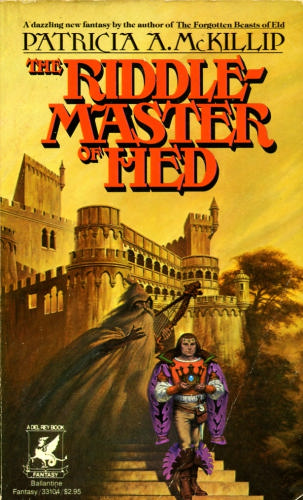
I read Patricia McKillip’s 1976 “Hed” trilogy over twenty years ago, but my memory was basically favorable, though I didn’t recall esteeming the trilogy as highly as her 1974 stand-alone novel “The Forgotten Beasts of Eld.” So I gave the first novel in the trilogy a re-read.
I give McKillip points for trying to find a novel approach to the “reluctant hero,” which, within the genre of modern fantasy, is practically defined by Tolkien’s Frodo. Like Frodo McKillip’s hero Morgon lives in a quiet, bucolic territory bordered by more bellicose realms. In part Morgon wants to do no more than live out his life farming and keeping pigs. But in Morgon McKillip paints a man at odds with his own conscious tendencies—and with a destiny signified by a unique birthmark: three star-shapes on his forehead. Later in life, he enrolls in a college of riddle-masters, whose purpose is to decipher all of the ancient riddles left behind by the long-vanished wizards of their world. Finally, following the death of his parents at sea, he leaves his rulership in the quiet kingdom of Hed and enters a haunted tower, where he challenges a ghost to a riddle-contest and wins. Morgon conceals his great deed and hides his prize under his bed in a doomed effort to return to mundanity. A visit from the harpist of the reigning High One provides a call to action, forcing Morgon to embark upon a quest to solve further riddles.
RIDDLE-MASTER is a solid effort, though on many occasions it feels too transparently like what it is, a setup-novel for the next two parts—which, my memory tells me, read much better. McKillip creates some tantalizing mysteries but sometimes plays a little too coy in fleshing out the details of her world. Sometimes “infodump” in a fantasy can be a good thing, at least when the alternative is leaving the reader floundering about, trying to figure out the histories of the various war-embroiled countries. McKillip seems determined to avoid challenging Tolkien on these terms, seeking instead to focus on mundane, common activities. Perhaps under different circumstances, her aim might have been realized. However, you know you’re in trouble when Morgon learns shapechanging magic from two different masters of the art, and both characters sound roughly the same.
It’s my memory that she does better with her characterization in the latter two segments of the trilogy. Time, and future reviews, will tell.
Subscribe to:
Posts (Atom)