Showing posts with label superheroes. Show all posts

Saturday, April 16, 2016

RAR #12: THE AMERICAN EAGLE


The original version of the American Eagle appeared in 1981's MARVEL TWO-IN-ONE ANNUAL #6, written by Doug Moench and drawn by Ron Wilson. A caption on the first page credits Wilson with sole creatorship, though given that the character only made sporadic appearances after this appearance, I imagine Marvel Comics owns this Real American superhero outright.

I would have to say that Eagle's design, with his colossal and counter-intuitive war-bonnet, strikes me as one of the worst-designed Native American superheroes ever. On his Wikipedia page, one author is quoted as liking the Eagle for not having his roots in Native American mythology, but I think that would have been better than what Moench and Wilson came up with.

In 1981 Jim Shooter ruled the Marvel roost, and he favored very static comics with lots of explanatory dialogue. Thus the story begins with the Thing of the Fantastic Four meeting with old buddy Wyatt Wingfoot to discuss the case of the American Eagle. Wingfoot originally tells a mythic story of two Native American brothers who fight over chieftainship of their tribe, both of whom assume superhuman status. Wingfoot apparently tells this myth-story as a prelude to his real story, regarding a falling-out between two contemporary Native American brothers. Jason Strongbow wants to defend the Navajo people's sacred mountain from a rapacious mining-company, and his thinly-drawn brother Ward wants to play by "the white man's rules." They get into a fight near a complex of machinery in the mine, for as it happens the super-villain Klaw is linked to the mining company. An explosion irradiates both brothers and turns them into superhumans. Only Jason takes a costumed identity, but he ends up fighting his super-powered brother again by the end of the Two-in-One tale, while the Thing, Wingfoot and guest-star Ka-Zar battle Klaw.

Apart from the Eagle's lame costume, I can see why he never inspired many creators. The mere fact that he owes his super-power to Klaw-- a regular punching-bag for the Fantastic Four, Ka-Zar, and the Black Panther-- means that there's no real chance that Klaw will ever really be a big part of the hero's mythos. The best origin-stories don't tie the heroes' beginnings to over-complicated continuity-events; they're at their most evocative when they keep in simple. So as routine as it might be for a Native American hero to get his powers from some supernatural spirit, it would still have worked better than this tawdry exercise in tedium.

Thursday, June 11, 2015

THE 100 GREATEST CROSSOVERS OF ALL TIME #51


It's a slam dunk that Jack Kirby, co-creator of both Thor and the Hulk, should be the one to render the best (thus far) face-off between the two Marvel titans, covered in my previous post.

Nevertheless, the Hulk-Thor battle in DEFENDERS #10, scripted by Steve Englehart and pencilled by Sal Buscema, comes a close second. The scene represented on the cover, in which the two super-strong guys, after lots of pounding and throwing things, presents the argument that the two are fundamentally equals, in that they struggle against each other, arm against arm, for something like a solid hour.

This was the high point-- though not the only good moment-- of the seven-issue crossover  called "The Avengers-Defenders War." This took place in the AVENGERS (issues #115-118) and DEFENDERS (issues #8-10) titles, both at the time being written by Englehart. In later interviews Englehart would assert that other Marvel employees doubted that he and his artists could pull off a crossover that had to be timed so that each segment came out precisely on the heels of the last installment. Later, this sort of multi-issue crossover would become standard practice at both Marvel and DC, often criticized for weak storylines and a transparent attempt to boost sales in an artificial manner. But Englehart's story carries the same innocent thrill of the "heroes-meet-and-fight-cute" trope that Marvel perfected in its Silver Age heyday.

The plot, dealing with a conspiracy by villains Loki and Dormammu to reshape the Earth into one of Dormammu's realms, serves adequately to bring the two teams into a conflict in which each believes the other to be villains. The only downside of this generally enjoyable outing is that although Sal Buscema is perfectly fine in his DEFENDERS segments, penciller Bob Brown, given mediocre inks by Mike Esposito, gives the AVENGERS segments a sloppy and unfocused look. The one exception to this generalization is a chapter devoted to a battle between Captain America and the Sub-Mariner, but only because this section is crisply inked by an uncredited Frank McLaughlin.

Monday, May 11, 2015

THE 100 GREATEST CROSSOVERS OF ALL TIME #50

FANTASTIC FOUR 25-26, with its Thing-Hulk battle, remains the best example of Jack Kirby cutting loose with his trademark fight-kinetics. However, despite a shorter length, the first major battle between the Hulk and the Mighty Thor-- appearing in JOURNEY INTO MYSTERY #112-- is nothing to sneeze at.


Rather than coming up with a new reason for the Asgardian hero to confront the Green Goliath, Lee and Kirby choose to tell an "untold story" of a previous meeting.  Thor himself narrates the story to a gaggle of young admirers, revealing that during the Avengers' sortie against the team of the Hulk and the Sub-Mariner in AVENGERS #3, Thor managed to get the Hulk alone in a room and the two of them matched muscles for roughly a minute. This, Thor tells his comics-audience (but not his listeners), is all the time the hero allows himself to defeat the Hulk, swearing not to pick up his dropped hammer until he defeats his monstrous opponent. Since in those days Thor would revert to the human Doc Blake if the hammer was out of his hands for more than 60 seconds, this sounds like a suicide impulse on Thor's part-- though it certainly fits in with his Viking macho rep.

It's a good fight, but the panels above capture a curious dichotomy in the Lee-Kirby corpus: an admiration for the brutal power of the Hulk played off against Thor's embodiment of the virtues of nobility. The THOR feature would sometimes explore these issues, resonant of class conflict, but here it's just a side-note to the Clashing of Titans.

Saturday, May 9, 2015

THE 100 GREATEST CROSSOVERS OF ALL TIME #49


I selected this film for roughly the same reasons I chose CRISIS ON INFINTE EARTHS here in post #47, less for the work's quality than for its significance as a crossover.

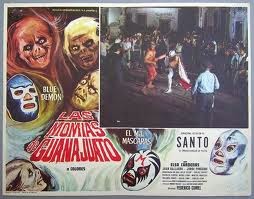
As all fans of luchaodore cinema know, the dominant idea behind the genre was to portray established professional wrestlers as itinerant superheroes, running around fighting everything from crime bosses and spies to aliens and monsters. IMDB cites the date of the first crossover, SANTO AND BLUE DEMON AGAINST THE MONSTERS, as 1970. I haven't screened this flick as yet, but I have seen two other Santo-Blue Demon team-ups from the same period, so I have to pass on these two-wrestler team-ups to stand as the best of the genre.

If 1972's THE MUMMIES OF GUANAJUATO had nothing else going for it, at least it brought together the three wrestlers who had the longest careers as movie superheroes: Santo, the Blue Demon, and Mil Mascaras. Fortunately, the film also gave the wrestlers opponents who aren't simply retreads of Hollywood figures. These mummies were based on a group of well- preserved corpses found in Guanajuato, Mexico, which city subsequently became a major Mexican tourist attraction.

These two elements are the best aspects of the film: otherwise MUMMIES is not the equal of the more brain-fried Mex-horror films. For most of the narrative, director Federico Curiel seems content to show the heroes in a series of running battles with their super-strong, almost invulnerable enemies. More than that I can't  say, for I only watched a Spanish language version of the film. However, I honestly don't think I'm missing any great subtleties here.

The mummies are moderately imposing, if not scary, and there's lots of action. I should note, though, that Santo doesn't show up until the last fifteen minutes; it's been strongly suggested that he was a last-minute addition to the film..

Monday, January 5, 2015

THE 100 GREATEST CROSSOVERS OF ALL TIME #41


On my original "top 100 crossovers" list-- which has been revised several times since I started posting entries here-- I included DC's BRAVE AND THE BOLD #63, which had the distinction of being the only crossover of two starring female characters without any other heroes participating in the main plot (though Superman does make a very brief appearance). But when I recently reread the story, I found it pretty disappointing. Though it was written by Bob Haney, who produced many enjoyably daffy stories for B&B, the winsomely titled "Revolt of the Super Chicks" proved fairly workmanlike, despite a few inspired moments. (For instance, the story begins with Supergirl deciding to chuck her superheroine career-- and when Superman tries to lecture her on her responsibilities, his cousin intimates that his obsession with responsibility has made him a stick-in-the-mud in the romance department.)

So I began hunting in earnest, to find if the DC Comic was actually the first time comic book characters in any genre had assumed co-starring roles in a story. Frankly, I didn't confine my search only to comic books, but I was pretty sure that I'd find a big goose-egg in such media as films, radio, and comic strips. All three lacked the sort of unitary business model found in American commercial coniic books, the sort of approach that has made crossovers particularly viable. I found some suggestions that various female characters in comic books had crossed paths in the Golden Age. most notably Timely teen-humor character Patsy Walker and Madeline Joyce, a.k.a. "Miss America," though apparently Madeline did not appear in her costumed identity.

A few other comedy-characters met one another, but most of the adventure-oriented genres-- superheroes, space opera, westerns, and jungle-stories-- very few writers seemed to have given a second thought to the pleasures of having female characters meet one another. Granted, pound for pound there aren't that many male/male crossovers in the Golden Age if you discount regularly occurring teams. Still, even publishing giant DC Comics seems to have only one story comparable to the 1965 team-up of Supergirl and Wonder Woman: 1943's ALL-STAR COMICS #15, in which several girlfriends of the Justice Society meet one another and don the costumes of their male counterparts in order to save the main heroes from a villain. This is a cool little story, which James Robinson re-wrote for a sequence in his STARMAN title, but it doesn't satisfy my criterion for a crossover of featured characters.

Happily, in 1943 another story appeared from Fawcett Comics, which keeps the 1965 BRAVE AND BOLD from holding the honor of being the first crossover of two female superheroines.  The story "Mary Marvel and the Riddles of Death" from MARY MARVEL #8 may not be the first time Mary Marvel and Bulletgirl met, whether on the comics-page or behind-the-scenes. But both heroines know one another's identities at the start of this story, as Susan "Bulletgirl" Kent attends the high-school graduation of Mary "Mary Marvel" Bromfield-- a graduation attended by no one else in Mary's circle, not even her brother Billy Batson. Still, the absence of other supporting characters indicates that the writer wanted to have no distractions from the central plot: showing two female crimefighters taking on a pair of murderous crooks.

One can read the full story here at this January 2013 post at THE TIME BULLET.  While the 1965 B&B story seemed predictable in a bad way, the MARY MARVEL tale is formulaic in a good way: a way that suggests the basic appeal of the formula rather than its limitations. Susan Kent is attacked by two previous antagonists of the Bulletman-Bulletgirl team: the Weeper-- technically, the son of the Weeper, since the original character died-- and Doctor Riddle, who had perfected the schtick of leaving riddle-clues a good five years before the birth of Batman's Riddler.  It's not a momentous tale, but it's perfectly enjoyable on its own terms, though one might wonder why the villains don't cause Susan trouble by simply revealing her real identity to the world. But had they done that, it would have read more like a standard DC tale, instead of a good little rock-'em, sock''em story that lets the ladies deal out distaff justice.

One quick notation: while Mary Marvel did maintain her own feature, Bulletgirl shared feature-status with the hero after whom the feature was titled, Bulletman. Bulletman did initiate the feature without a female co-star, but by the time this story was published, Bulletgirl was an integral co-star, not merely a supporting character-- and so she satisfies my "featured character" criterion.

Thursday, June 19, 2014

THE 100 GREATEST CROSSOVERS OF ALL TIME #16


The spin-off/crossover of Supergirl from the Superman franchise in ACTION COMICS #252 (1959) after DC Comics had finally decided to take a page from their old rival, the "Captain Marvel" franchise. For roughly fifteen years, the only spin-off from Superman was Superboy, a character who provides an ideal example of a spin-off that is decidedly NOT also a crossover.  Then in 1954, DC published SUPERMAN'S PAL JIMMY OLSEN. In 1955, Krypto appeared in ADVENTURE COMICS #210, and in 1957 Lois Lane got a starring feature in SHOWCASE #9, which led to a long-running series. Supergirl, DC's answer to Mary Marvel, doesn't even show up before the Legion of Super-Heroes (April 1958), and for the remainder of the Silver Age (1955-1970), she's relegated to a backup feature in ACTION COMICS, though her stories were advertised on the cover.

Yet with the exception of the Legion-- which doesn't  seem to have been intended as a spin-off-- Supergirl is the only spin-off who sustains her own unique mythology. Krypto never gets a regular berth, or many adventures of consequence, despite some fans' enjoyment of the "Space Canine Patrol" stories. Lois and Jimmy occasionally meet weird characters or enjoyable villains, but the adventures are fairly repetitive, aimed at a young audience that would supposedly "turn over" every few years.

Supergirl, despite being aimed at the same audience, does eventually develop her own superhero mythology in her Silver Age stories.  After a slow start, the Girl of Steel takes on not only regular Superman villains like Luthor and Brainiac but a fair number of originals. These include the demonic looking Doctor Supernatural, the alien queen Ravenne, who revived famous evil females from the dead, and Lesla-Lar, Supergirl's evil twin from Kandor. In addition, a number of Supergirl's otherworldly adventures have a more exotic flair than the Superman stories of the time, possibly because the writers sought to aim the Supergirl backup series at young girl readers.  Supergirl continued to cross over into Superman's script on a semi-regular basis, and vice versa, but the introductory tale, with its imaginative concept of her origins in Argo City, may be considered representative of the period.

Saturday, March 15, 2014

MYTHINKINGS PT. 7

In Part 6 I wrote:

But if one continues to define the "myth-essence" in terms of inspiring "excessive or quasi-religious awe or admiration," then I would say that it appears irrespective of overt fantasy-material.

My use of the word "define" overstates the case a little, since by the end of that essay I'm not depending *solely* on an affective demonstration to define the essentialist version of myth.  What I asserted there might be considered a combination of affective and cognitive factors:


 I think that we are closer to the essence of myth when we regard it as a continuous elaboration of symbolic interactions; Yeats' "endless inter-marrying family." 
 
The symbolic juxtapositions of myth and literature often if not always have both cognitive associations (recapitulating what we think about nature, life and death, our own societies et al) as well as having an emotional appeal intrinsic to storytelling and probably language itself.  But like the humans who formulate them, no symbol is an island.  The "family" of myths continually "inter-marry" because it's the nature of human beings to think in terms of larger-than-life symbols, which are inevitably defined by a process of opposition.  Thus the Greeks pictured Ares ("War") cohabiting with Aphrodite ("Love") in spite of the fact that they ruled over radically opposed departments of divinity.

Oppositions seems integral to the therory of structuralist ethnographer Claude Levi-Strauss, who made his own attempt to deduce common ground between "myths" (in the functionalist sense), folktales, and literature in general.  In the 1980 anthology LITERARY CRITICISM AND MYTH, contributor Patricia Carden asserted that Levi-Strauss took exception to the tendency of some folklorists to see "tales" developing in a dependent relationship to "myths."

[Levi-Strauss] proposes the following model: the tale does not succeed the myth in time but is part of a total system of oral literature.  In this system the tale is related to the myth as a complementary satellite.  The tales deal with the same substance as myth but in a different fashion, being constructed on weaker oppositions of a local, social, or moral character, while the myth is constructed on cosmic oppositions.
 
I've had some problems with Levi-Strauss's structuralism in part, and I would not agree that his characterization of tales having "weaker oppositions" applies across the board.  Nevertheless, I agree that on the average "religious myths" are much more symbolically elaborated than tales are, probably because the former are seen as responsible for asserting the ways in which human rituals can renew or even sustain the world, or some part of the world.

Philosopher Susanne Langer goes even further than Levi-Strauss in preferring the "cosmic" nature of myths to the "nonsense" of tales:

"..the psychological basis of this remarkable form of nonsense (the fairy tale] lies in the fact that the story is a fabrication out of subjective symbols, not out of observed folkways and nature-ways [in contrast to "myth," with which Langer contrasts fairy tales]."-- Susannne Langer, PHILOSOPHY IN A NEW KEY, p. 173.
 
As different as these two scholars were, it's interesting to see them concur that myths are stronger and/or more cosmic than tales in terms of their symbolic interactions-- though I personally would favor "more complex" over either term.

Thus, when I try to see a "myth-essence" in literary works that do not promote any strict religious content-- be it Milton's PARADISE LOST or SUPERMAN-- I find that it shows itself most in this form of "symbolic complexity."  I don't assert that such a definition occurs to anyone else who uses "myth" to mean something other than a literal religious story.  But I believe that the "essence" communicates itself to the highbrow and the hoi polloi with equal facility.


MYTHINKINGS PT. 4

To address the context of the quote cited at the end of Part 3:

“They’re very important, these comic book movies, because they’re our modern myths.”—Bryan Singer, SUPERMAN RETURNS: THE COMPLETE SHOOTING SCRIPT.
 
It goes without saying that when Singer made this statement, he certainly didn't mean it in any functionalist sense.  Not even the most jaded Hollywood hypester would claim that a fictional character like Superman had ever served any of the purposes of myth cited by Joseph Fontenrose, such as citing the precedent for a festival or a ritual.

It would be easy to dismiss this statement and many like it as simple hype.  It's quite possible that if Singer was honest about what he meant about the "importance" of a "comic book movie," it might have come down to persuading more people to go see SUPERMAN RETURNS.

And yet, why should the most manipulative entertainer make such a claim?  Why not simply claim that the movie's going to be entertaining?  What emotions does Singer hope to inculcate, by reading Superman as "myth?"

Similar statements evolve even in the absence of specific pecuniary motives.  By the time Ursula LeGuin wrote her 1976 essay MYTH AND ARCHETYPE IN SCIENCE FICTION, she was reacting to an attempt by science fiction's defenders to promote science fiction as a "modern mythology." 

I won't go into LeGuin's take on the matter in detail.  I'll confine myself to stating that I disagree with the logic of her verdict, since her definition of myth reduces down to "the literary myths that I happen to like." In logical terms this is no better than "the stuff Mister Comic Book Film Director is trying to promote."  LeGuin does offer something of an affirmation of the question as to whether literary creations can be myths, though, and seems to do so as an expression of her own philosophy, not because such a definition helps her promote her own work.

I've yet to find a dictionary definition that satisfactorily takes in this contemporary application of the word "myth" to literary productions. The only definition that comes close appears in Wiktionary:

A person or thing held in excessive or quasi-religious awe or admiration based on popular legend
 
Even so, this definition seems predicated on the sense that the persons experiencing this "quasi-religious awe" are responding to a "person or thing" in the real world.  The person or thing may have had its original qualities amped up thanks to the "legend-izing" process, the same process that *may* have made a 5th-century Romano-British military leader into King Arthur.

Literary fiction, be it high or low, is never thought to have had any existential reality, be it Tarzan (whom LeGuin regards as a "true myth") or Superman (whom she disdainfully terms a "submyth.")
Still, the process seems analogous.  Despite the fact that the readers of Superman and Tarzan know that the characters were never real, the term "myth" is clearly applied to them as approbation.

But why, if the characters are just made-up figures out of some writer's imagination?

It would seem to me conclusive that in this "essentialist" sense, myth is used to denote an "excessive or quasi-religious awe or admiration."

Further, this "awe or admiration," in order to be fit the sense of being essential to both literature and religion, would also have to extend into all those those constructs that are supposed to possess some existential reality, be it Milton's God or England's Arthur. 

More on this later.