Showing posts with label high fantasy. Show all posts
Saturday, August 27, 2016
MYTHOS MEDITATIONS
I've recently finished Lev Grossman's MAGICIANS trilogy, which probably deserves another full reading to take in all of its themes with respect to magical thinking, free will, and so on. But for now I'm only moved to analyze the trilogy in terms of its mythos.
I won't go into as much detail as I have on THE ARCHETYPAL ARCHIVE about Northrop Frye's four "mythoi," or patterns of literary myth, but I want to suss out which of these patterns best describes the trilogy.
In the essay FANTASIES OF INNOCENCE AND EXPERIENCE I examined the possible categorizations for Wally Wood's KING OF THE WORLD. That graphic work, like MAGICIANS, has the surface appearance of aligning with the adventure-mythos, because the plots involve "invigorative elements" like magical battles, explorations of strange worlds, etc.
I ended up viewing KING OF THE WORLD as an "irony" despite all of these elements, because so much of KING was devoted to undermining the conventional meanings of adventure-tropes. And MAGICIANS could be interpreted as an ironic take on the straightforward fantasy-tropes found in C.S, Lewis's NARNIA books, whose influence Grossman has cited.
However, Grossman seems to be pursuing different themes than simple dissimulation. His young, college-age-ish protagonists have neither the innocence nor the "good vs. evil" designs of Harry Potter. But like Potter-- whose mythos I've pegged as a "drama"-- they are characters who are largely defined by the radical of *purgation,* as they slough off their old, imperfect personas and work clumsily toward new, somewhat more mature ones.
More later, possibly.
Thursday, February 26, 2015
SHORT TOLKIEN COMPLAINT
I don't remember when I last re-read THE LORD OF THE RINGS, but it's definitely been over twenty years. I've finished the first two volumes and have begun RETURN OF THE KING, but as I read the books, I find myself calling to mind my original reaction from the 1960s:
A lot of Tolkien's characters are BLOODY BORING!
The Oxford don does come up with a number of good touches for his main characters, and those touches are the reason why the book has remained popular these many decades. But a lot of his subordinate characters are dullards. Yes, Theoden and Denethor serve different plot-purposes, and enjoy different character-arcs-- but as characters, one is no more developed than the other. Many Tolkien-fans despite the film-adaptation by Peter Jackson, but at least I didn't have trouble distinguishing one king from the other.
I remember thinking back in the 1960s that this was the one thing that kept LORD OF THE RINGS from greatness: that so many of the characters were dull ciphers, no more alive than figures in a history-book. I wished that someday someone--maybe even me-- might write an epic fantasy in which even the subordinate characters were intensely alive, were individuals as developed as fictional characters can be.
And yet, on some occasions, I've seen Tolkien attacked for his lackluster characters-- and I usually find myself coming to his defense, possibly because there is a special art to fantasy-characterization that isn't identical with the world of "realistic literature."
A lot of Tolkien's characters are BLOODY BORING!
The Oxford don does come up with a number of good touches for his main characters, and those touches are the reason why the book has remained popular these many decades. But a lot of his subordinate characters are dullards. Yes, Theoden and Denethor serve different plot-purposes, and enjoy different character-arcs-- but as characters, one is no more developed than the other. Many Tolkien-fans despite the film-adaptation by Peter Jackson, but at least I didn't have trouble distinguishing one king from the other.
I remember thinking back in the 1960s that this was the one thing that kept LORD OF THE RINGS from greatness: that so many of the characters were dull ciphers, no more alive than figures in a history-book. I wished that someday someone--maybe even me-- might write an epic fantasy in which even the subordinate characters were intensely alive, were individuals as developed as fictional characters can be.
And yet, on some occasions, I've seen Tolkien attacked for his lackluster characters-- and I usually find myself coming to his defense, possibly because there is a special art to fantasy-characterization that isn't identical with the world of "realistic literature."
Thursday, December 18, 2014
THE MURK OF AVALON
I'm usually a sucker for fiction about Arthurian Britain, particularly when they delve into the conflicts between pagan lore and Christian doctrine during that not-strictly-historical period. I'd heard nothing but good things about Marion Zimmer Bradley's 1982 novel, THE MISTS OF AVALON, and finally chose to crack this massive 800-page tome.
I knew before reading that MISTS was a feminist rendition of the Arthurian tradition, which emphasized the male agency of King Arthur and his knights, but did, in contrast to some comparable traditions of other cultures, allow for some agency on the part of female characters. The most famous of these are generally Guinevere, queen to Arthur and lover to Lancelot, and Morgan LeFay, sometimes represented as half-sister to Arthur, and the mother to Modred, the child of their mutual incestuous encounter. I also knew in advance that MISTS' focus was the character Morgaine, Bradley's take on the evil, magic-wielding sorceress LeFay. The traditional Morgan was not invariably associated with the magical isle of Avalon, but in MISTS Morgaine is not just a sorceress, but an iniatiate into the mysteries of matrifocal British paganism. Avalon, a domain perpetually shrouded in mists, is in some ways a perfect visual symbol for what some have called "the mystery of womanhood," at least as compared to the blunt, obvious preoccupations of the male gender-- few of whom, in Bradley's cosmos, are particularly sharp blades.
Unfortunately, Bradley reveals more than she conceals through having most of her characters chew the fat endlessly about who's sleeping with whom and whose parents brought about what psychological traumas. I have no objection to a latter-day author transporting some modern-day psychological observations into the matrix of Arthurian myth; indeed, as every writer is a child of his or her time, it's well nigh impossible not to do so. What I found egregious in Bradley's MISTS is the repetitiveness of many of her tropes regarding character makeup and ongoing plot-conflicts. This authorial inability to know when "less would be more" may have come about simply because during the majority of her career Bradley did not work in such lengths.
As I commented in my only other blog-comments on a Bradley book here, I've read twenty or more of Bradley's SF-fantasy works. She came to prominence in a period when almost the only publishing outlet for SF-fantasy was in the format of the paperback novel, usually not much beyond 100,000 words in length. I've rarely retained strong memories of those Bradley novels that I've read: whether written in the 1960s or the 1980s, I've found them to be efficiently plotted stories told in a simple "meat-and-potatoes" style. Obviously, given the strong popularity of her ongoing "Darkover" series and MISTS itself, it's possible that I'm simply not destined to be one of Bradley's bigger fans.
Nevertheless, even though MISTS by design is meant to be a long, generation-spanning work, the book's substance could have been boiled down to a more comfortable 500 pages without losing anything but repetitious character-and-plot tropes. Another culprit may be the fact that any author attempting to do a "big novel" on the Arthurian theme has a prodigious number of stories from which to choose. Naturally, Bradley gives preference to stories focused on the Morgan character, providing quasi-realistic takes on stories like this one from Thomas Malory in which Morgan forces Arthur to fight a warrior named Accolon. A minor consequence of this focus as that male-focused tropes, such as Arthur drawing the sword Excalibur from a stone or a tree, are substantially altered, and downplayed save when they are relevant to the novel's main conflict: the fading of the pagan and matrifocal way of life before that of all conquering Christianity.
I fully understand why Bradley chose to focus on the domestic world of women in her feminist re-writing of Arthurian themes. Although Arthur's Camelot did not exist as such in recorded history, Bradley must model her version of that world upon the medieval society of the time, with its extremely bifurcated gender-roles (though she does mention in passing that the older Celtic tribes harbored women who took up arms upon the battlefield). Yet for all the talk of rival religious traditions, Bradley's world is one in which both God and the gods are silent. Any fans of Arthurian fantasy will find that the only magic in MISTS can be explained by the evocation of various psychic powers that have simply been interpreted as magic. Oh, and there's one "dragon," never seen "on-camera" as it were, but Bradley implies that it's nothing more than some prehistoric venom-spitting worm.
These rationalizations of mythic material are standard enough in what I tend to deem "bestseller fiction," and indeed Bradley's MISTS may have been successful with audiences precisely because it did not require those readers to believe in dragons and enchanted swords. Still, bestseller fiction is capable of providing some philosophical discourse on certain topics, like what makes one religion different from one another. Bradley, no philosopher, placates possible Christian readers by having many of her pagans assure the Christians that "all gods are one." Yet clearly all religions are not one, given that so much of the novel is devoted to showing how feminine agency is reduced and downgraded with the encroachment of patrifocal Christian beliefs. But I will admit that since most of Bradley's characters don't have the intellectual background conducive to long religious debates, such discourse would have been difficult to render credible.
Morgaine, the center of the novel, is fascinating in the novel's first half, as we see her caught in the machinations of the king-making pagan priests who plot to bring about the birth of Arthur. Yet while I admire the complexity with which Bradley lays out her vision of familial relations between dozens of Arthurian figures, some of them result in the aforementioned repetitiveness. As a young woman Morgaine falls in love with Lancelet (the novel's version of Lancelot), with the result that she and the novel's version of Guinevere are rivals for the knight's charms. This could have been a sound plot-idea, but Bradley returns to it again and again, rarely saying anything new beyond another chorus of Morgaine singing "Poor Poor Pitiful Me."
I'll note in conclusion that just as the Morgan-Arthur relationship is sometimes incestuous in certain stories, Bradley uses incest-motifs frequently throughout MISTS: for instance, Lancelet is Morgaine's cousin, the son of the woman who initiates Morgaine into the mysteries and who is more of a mother to Morgaine that the woman who births her. In my other essay I commented that THE DOOR THROUGH SPACE is replete with such motifs, though only a more thorough reading of her corpus of works would reveal whether or not it's a repeated theme.
Tuesday, November 25, 2014
THE 100 GREATEST CROSSOVERS OF ALL TIME #37
The above illustration doesn't precisely represent the memorable crossover story presumably within. The male hero might be a passable visualization of the titular C.L.Moore protagonist "Northwest Smith," except for the fact that he's carrying a rapier rather than his trusty futuristic "heat gun"-- Smith being a space-opera hero who lives in some era when Earth has colonized the planets of this solar system.
The female illustrated, though, could never pass for the other character in the crossover, Moore's currently better-known Jirel of Joiry, an imperious noblewoman who lived in a fictitious medieval French setting. The original Jirel would never cling like the woman in the picture does: she was a fiery swordswoman who could lead her followers into battle without a second thought and could slay a sorcerer as soon as look at him.
The story "Quest of the Star-Stone" was published in a 1937 issue of WEIRD TALES, some time after both Jirel and Northwest Smith had earned some cachet, though Moore never wrote more than a dozen stories for either character. "Quest" is the only one of these in which Moore collaborated with her husband Henry Kuttner, also a renowned SF-writer, and it may be that they did so in order to let their own personal romance infuse the story.
The "Starstone" of the title, a sort of magical dingus, is what Hitchcock called a "Macguffin" over which the characters could contend. In medieval Joiry, the warrior-woman breaks into the castle of the warlock Franga to kill him. He escapes, but Jirel takes possession of his valued Starstone. Franga, who has not yet had a chance to tap its powers, can only recover it by either winning the stone from her in battle, or by forcing her to give it up of her own free will.
For no clear reason Franga travels in time to find the one agent who can help him: cosmic troubleshooter Northwest Smith. Smith accepts Franga's commission to recover his stolen property. When Franga takes Smith into the past, he inadvertently also takes Smith's Venusian buddy Yarol as well; when Yarol tries to stop Smith from going.
As a result of Franga's manipulations, Smith, Yarol and Jirel (whose names are suspiciously similar!) end up in an extradimensional world, and Sniith divines that Franga plans to double-cross his agents and leave them, and Jirel, stranded once the wizard gets the stone. Thus Jirel and Smith are forced to make common cause despite their differences.
Though Moore and Kuttner certainly don't invent any wheels here, "Starstone" is a heady pulp-action story which is given special resonance by the instantaneous lust experienced by both Smith and Jirel when they see each other. They continually check one another out whenever they're together, and only the exigencies of the narrative keep them from bumping uglies. Moore and Kuttner also throw a few humorous moments to break the tension, as when Jirel calls Smith by the name "Smeet."
This one's a treat worth seeking out in the few collections where it's appeared.
Saturday, March 15, 2014
REVIEW: HARPIST IN THE WIND
I finally found time to finish re-reading the last book in Patricia A. McKillip's "Hed trilogy," the first two parts having been reviewed here and here.
I'm sure that I could have found time before this, of course, given that almost a year has passed-- that is, if I really wanted to. But time and time again, I found myself not wanting to return to McKillip's fantasy-world, which as I noted before, was too often marred by soundalike characters and tedious journeys that had all the thrills of watching someone else's home movies.
HARPIST, though, is a little better, and may be the principal reason I remembered liking the trilogy from my initial reading over 20 years ago. The first book is devoted to setting up the hero Morgon, and the second to establishing his intended consort Raederle. Both of them encounter various supporting characters, but none of them proved memorable, and so they accomplished little beyond marking time. However, HARPIST for the most part deals with both the passion and the tensions between the two nobles, and for that reason is much more successful than the first parts.
There's still a major problem in that the motivations of the villains-- a wizard with a long Welsh-inspired name that I choose not to type out, and a race of shapechanging creatures-- are inadequately clarified. But in the battles of Morgon and Raederle, McKillip finally plays to her strengths: the invocation of wild faerie magics. Tanith Lee she's not, but she has some fine moments:
For charity's sake I'll assume a typesetting error turned "coins" into "coin."
So, thanks to some strong passages in the third book, the re-read was not entirely a waste of time. But for some time it did seem like the road to McKillip's world went ever on, and on, and on...
I'm sure that I could have found time before this, of course, given that almost a year has passed-- that is, if I really wanted to. But time and time again, I found myself not wanting to return to McKillip's fantasy-world, which as I noted before, was too often marred by soundalike characters and tedious journeys that had all the thrills of watching someone else's home movies.
HARPIST, though, is a little better, and may be the principal reason I remembered liking the trilogy from my initial reading over 20 years ago. The first book is devoted to setting up the hero Morgon, and the second to establishing his intended consort Raederle. Both of them encounter various supporting characters, but none of them proved memorable, and so they accomplished little beyond marking time. However, HARPIST for the most part deals with both the passion and the tensions between the two nobles, and for that reason is much more successful than the first parts.
There's still a major problem in that the motivations of the villains-- a wizard with a long Welsh-inspired name that I choose not to type out, and a race of shapechanging creatures-- are inadequately clarified. But in the battles of Morgon and Raederle, McKillip finally plays to her strengths: the invocation of wild faerie magics. Tanith Lee she's not, but she has some fine moments:
The sun came out abruptly for a few moments before it drifted into night. Light glanced across the land, out of silver veins of rivers, and lakes dropped like small coin on the green earth.
For charity's sake I'll assume a typesetting error turned "coins" into "coin."
So, thanks to some strong passages in the third book, the re-read was not entirely a waste of time. But for some time it did seem like the road to McKillip's world went ever on, and on, and on...
THE ILLEARTH WAR: THOUGHTS
I had read the first six books in the CHRONICLES OF THOMAS COVENANT some time ago, and recently considered trying to work through the last four books in the series. To refamiliarize myself with the series, I reread the first two books in the series, LORD FOUL'S BANE and THE ILLEARTH WAR, but then got distracted by other reading-demands and tabled that idea.
What still impresses me about Donaldson's epic-- spoilers ahead for anyone who doesn't want to see endings discussed-- is that both his central character and his story have something of an "anti-Tolkien" tone to them.
To be sure, Tolkien's "Middle-Earth" is almost completely cut off from anything resembling the modern world, while the Covenant books involve a modern Earthman voyaging to a magical land. In this the CHRONICLES show a greater resemblance to C.S. Lewis' Narnia book than to LORD OF THE RINGERS, or even to Joy Chant's RED MOON AND BLACK MOUNTAIN. At a convention I happened to ask Donaldson if he'd read RED MOON, and he said that he had.
But to pursue the RINGS connection anyway-- Tolkien's cosmos, far more than Narnia, appeals because it transmits the view of a pristine pre-industrial world. Donaldson also gives the reader such a world, called simply "the Land." However, the presence of outsider Thomas Covenant immediately calls its perfection into question by introducing an outsider who doubts the Land's veracity, because Covenant is a leper who constantly fears losing control of his own senses and/or sanity.
Book 2, THE ILLEARTH WAR, is particularly interesting with respect to one of the Land's characters, High Lord Elena. Her magic nominally protects the Land from the satanic influence of the story's villain Lord Foul, but she has a psychological weakness one won't find in Tolkien and Lewis. Without going into too many details, Elena was the offspring of Covenant, who united-- under less than ideal circumstances-- with Lena, a woman of the Land. The long absence of her father results in what a psychologist might call an "overvaluation" of the father, so that when Covenant returns, she falls in love with him. Happily, Covenant does not reciprocate, but Elena's father-complex crops up at the climax. She uses her vast magical powers to revive the spirit of one of the Land's foremost defenders, Lord Kevin, intending to pit against Lord Foul's forces. Instead, this "father-spirit" proves utterly unable to overcome the evildoers, and instead is turned against Elena, killing her.
I try to avoid analyzing characters too much in terms of sociological developments of the period, since I believe that it's generally wrong to see fiction as a direct representation of those developments. But I do think that the 1970s, when Donaldson wrote and published these books, was dominantly a time when many of the cultural narratives had broken down, whether as a result of the counterculture or the Vietnam War or what have you. This concluding scene in ILLEARTH WAR, whatever it meant to Donaldson in terms of his overarching theme, suggests to me an eroison of the idea of a stable savior-figure-- specifically, that of a benign father-figure who rides in and conquers the bad guys. However, without my having read the entire ten-book series, this is at best a rough hypothesis.
What still impresses me about Donaldson's epic-- spoilers ahead for anyone who doesn't want to see endings discussed-- is that both his central character and his story have something of an "anti-Tolkien" tone to them.
To be sure, Tolkien's "Middle-Earth" is almost completely cut off from anything resembling the modern world, while the Covenant books involve a modern Earthman voyaging to a magical land. In this the CHRONICLES show a greater resemblance to C.S. Lewis' Narnia book than to LORD OF THE RINGERS, or even to Joy Chant's RED MOON AND BLACK MOUNTAIN. At a convention I happened to ask Donaldson if he'd read RED MOON, and he said that he had.
But to pursue the RINGS connection anyway-- Tolkien's cosmos, far more than Narnia, appeals because it transmits the view of a pristine pre-industrial world. Donaldson also gives the reader such a world, called simply "the Land." However, the presence of outsider Thomas Covenant immediately calls its perfection into question by introducing an outsider who doubts the Land's veracity, because Covenant is a leper who constantly fears losing control of his own senses and/or sanity.
Book 2, THE ILLEARTH WAR, is particularly interesting with respect to one of the Land's characters, High Lord Elena. Her magic nominally protects the Land from the satanic influence of the story's villain Lord Foul, but she has a psychological weakness one won't find in Tolkien and Lewis. Without going into too many details, Elena was the offspring of Covenant, who united-- under less than ideal circumstances-- with Lena, a woman of the Land. The long absence of her father results in what a psychologist might call an "overvaluation" of the father, so that when Covenant returns, she falls in love with him. Happily, Covenant does not reciprocate, but Elena's father-complex crops up at the climax. She uses her vast magical powers to revive the spirit of one of the Land's foremost defenders, Lord Kevin, intending to pit against Lord Foul's forces. Instead, this "father-spirit" proves utterly unable to overcome the evildoers, and instead is turned against Elena, killing her.
I try to avoid analyzing characters too much in terms of sociological developments of the period, since I believe that it's generally wrong to see fiction as a direct representation of those developments. But I do think that the 1970s, when Donaldson wrote and published these books, was dominantly a time when many of the cultural narratives had broken down, whether as a result of the counterculture or the Vietnam War or what have you. This concluding scene in ILLEARTH WAR, whatever it meant to Donaldson in terms of his overarching theme, suggests to me an eroison of the idea of a stable savior-figure-- specifically, that of a benign father-figure who rides in and conquers the bad guys. However, without my having read the entire ten-book series, this is at best a rough hypothesis.
REVIEW: HEIR OF SEA AND FIRE
In my review of Patricia McKillip's THE RIDDLE MASTER OF HED, I wrote:
I finally slogged my way through the middle book in McKillip's trilogy, and by my choice of words it should be apparent that I didn't get a sense that the "middle book" read better than the first part.
Where the first book left off by stranding protagonist Morgon in the midst of a moderately interesting supernatural mystery, the second proceeds to keep Morgon off stage for most of the story, focusing instead on his betrothed, a woman named Raederle. Raederle ('readerly," as in "reading riddles"?) is frequently mentioned in RIDDLE MASTER, but never appears "on stage." She spends most of the novel searching for Morgon and trying to learn more about the conspiracy in which he's become involved.
The most ennervating aspect of HEIR is that it communicates little beyond a sense of marking time. Raederle is potentially a good character, but her quest to find Morgon is dull, dull, dull, too often filling up time with long scenes of how the heroine and her allies get from one place to another. There are a few bright spots as Raederle attempts to come to terms with her burgeoning magical talents-- which she inherits from a race of wizardly shapechangers, more or less her opponents in the story. Occasionally McKillip's poetic talents blossom, but all too often, she goes for the easy simile or metaphor.
What hurts the travel-sequences most is that old writer's enemy: the Curse of Character Sound-Alike. I've struggled with this problem not a little myself. Still, I don't think most of McKillip's supporting characters were worked out to give them strong enough personalities. Thus even those characters with very different backgrounds from the heroine's fail to be distinct in any other way.
Since I probably read the trilogy round about the early 1980s, my negative reaction may show a change in my own tastes regarding writing styles and characterizations. Be that as it may, I almost don't want to reread the final book, despite my good memories of it. But I'll probably do so, if only to reach a sense of completion on this subject.
RIDDLE-MASTER is a solid effort, though on many occasions it feels too transparently like what it is, a setup-novel for the next two parts—which, my memory tells me, read much better.
I finally slogged my way through the middle book in McKillip's trilogy, and by my choice of words it should be apparent that I didn't get a sense that the "middle book" read better than the first part.
Where the first book left off by stranding protagonist Morgon in the midst of a moderately interesting supernatural mystery, the second proceeds to keep Morgon off stage for most of the story, focusing instead on his betrothed, a woman named Raederle. Raederle ('readerly," as in "reading riddles"?) is frequently mentioned in RIDDLE MASTER, but never appears "on stage." She spends most of the novel searching for Morgon and trying to learn more about the conspiracy in which he's become involved.
The most ennervating aspect of HEIR is that it communicates little beyond a sense of marking time. Raederle is potentially a good character, but her quest to find Morgon is dull, dull, dull, too often filling up time with long scenes of how the heroine and her allies get from one place to another. There are a few bright spots as Raederle attempts to come to terms with her burgeoning magical talents-- which she inherits from a race of wizardly shapechangers, more or less her opponents in the story. Occasionally McKillip's poetic talents blossom, but all too often, she goes for the easy simile or metaphor.
What hurts the travel-sequences most is that old writer's enemy: the Curse of Character Sound-Alike. I've struggled with this problem not a little myself. Still, I don't think most of McKillip's supporting characters were worked out to give them strong enough personalities. Thus even those characters with very different backgrounds from the heroine's fail to be distinct in any other way.
Since I probably read the trilogy round about the early 1980s, my negative reaction may show a change in my own tastes regarding writing styles and characterizations. Be that as it may, I almost don't want to reread the final book, despite my good memories of it. But I'll probably do so, if only to reach a sense of completion on this subject.
THERE'S NO IDYLL IN IDEOLOGY
Though I sometimes explore gender issues in my film-criticism, I wasn't moved to do so in my review of OZ THE GREAT AND POWERFUL.
However, such was not the case with some contemporary reviewers, as can be seen in this Film.com review. In this review Elisabeth Rappe takes issue with the Sam Raimi flick, arguing that GREAT AND POWERFUL is a "major step back" from the Oz books of originator L. Frank Baum. Rappe says of Baum:
On the other hand, I also came across a comment on another forum in which one viewer of the film expressed complete distaste with making any interpretations of fantasy-entertainment. For this viewer, any interpretation spoiled the experience.
I wouldn't go quite that far either. As viewers of any entertainment-- or even creators of same-- we can't avoid some ideological extrapolations. It's part and parcel of identifying ourselves with our limited situations in life. However, ideology as such should never be a motive force in the making of fiction, fantastic or otherwise. In the end the desire for ideological conformity creates more problems than it ever solves.
However, such was not the case with some contemporary reviewers, as can be seen in this Film.com review. In this review Elisabeth Rappe takes issue with the Sam Raimi flick, arguing that GREAT AND POWERFUL is a "major step back" from the Oz books of originator L. Frank Baum. Rappe says of Baum:
Though Baum brushed off claims that Oz was at all political, he made a decided choice to make women front and center of the series. They’re princesses, ordinary farmgirls, witches (both good and bad), rag dolls, generals, pastry chefs, and problem-solving faeries. They have adventures, lead search parties, rescue one another, solve difficulties, and challenge the Nome King in combat.She contrasts this to the Raimi take on Oz:
With such a rich tapestry on and off the Oz page, it’s depressing that 2013 finds our return to Oz burdened with a reluctant hero (the dominant kind in the 21st century), and not one of Baum’s plucky young heroines. In a bitter reversal of Baum’s stories, “Great and Powerful” casts the women as the sidekicks, standing by to aid the Wizard should he need it. No longer instigators of action, the witches Glinda, Theodora, and Evanora now clasp their hands at arrival, thrilled the prophesied hero has arrived (“Aren’t you the great man we’ve been waiting for?” asks Theodora, voice trembling. Actually, all the female dialogue seems to be on the wobbly verge of tears).As my review should make clear, the movie in question has far more problems with it than gender issues. I don't think Rappe's ideological argument is adequate: it's tantamount to saying that ideology must inform even our wildest fantasies. Though I don't think Raimi's film is very good, I think it fails because of a lack of imagination first and foremost. It may be argued that he shouldn't have aided in the concoction of a script that goes against the originator's sensibilities, but in the world of mainstream Hollywood, fidelity to an original writer is neither probable nor necessarily feasible. His "gender issues" may just come down to his having nothing memorable to say about feminine empowerment in this particular film-- though of course elsewhere in his career he did wield a certain amount of positive effect in producing the fantasy teleseries XENA WARRIOR PRINCESS.
On the other hand, I also came across a comment on another forum in which one viewer of the film expressed complete distaste with making any interpretations of fantasy-entertainment. For this viewer, any interpretation spoiled the experience.
I wouldn't go quite that far either. As viewers of any entertainment-- or even creators of same-- we can't avoid some ideological extrapolations. It's part and parcel of identifying ourselves with our limited situations in life. However, ideology as such should never be a motive force in the making of fiction, fantastic or otherwise. In the end the desire for ideological conformity creates more problems than it ever solves.
MYTHINKINGS PT. 1
In a response to Shannon Knight's post on "Labeling Science Fiction and Fantasy," I wrote:
It's beyond question that both genres are grounded in producing a wide spectrum of marvelous effects, many of which go far beyond the perimeter of known science. Some practitioners of science fiction don't hold with venturing into that "terra incognita;" allegedly at one point in his life, the late L. Sprague de Camp vowed that he wouldn't write any space-opera stories because he didn't believe in the real-world possibility of "hyperspace" and similar devices.
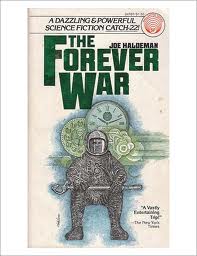
De Camp and his "camp" are certainly in the minority, though. For most practitioners of science fiction, it doesn't really matter whether or not mankind ever discovers a method of scientifically transcending the boundaries of time and space and so building galactic empires. Devices like "hyperspace" are tools by which authors can tell stories, whether they're wild adventure-epics like STAR WARS or relatively realistic dramas like Joe Haldeman's THE FOREVER WAR.
Nevertheless, though the majority of SF-writers perforce make up their technologies, their alien life-forms, etc., out of whole cloth, they don't entirely toss out the basic notion of science fiction, which is that scientific innovation proceeds out of incremental advancements in technological knowledge. No matter many SF-miracles a given writer may pull out of his hat, the general expectation for the genre is that space and time cannot really be transcended, only circumvented. Indeed, as heady as STAR WARS is, with its infusions of quasi-magic and mysticism, one of the original film's charms is that the characters exist in a world where machines get old and break down-- which is the very reason Luke Skywalker's uncle needs to buy a pair of new droids.
Now, fantasy is much less unified in its appeal than science fiction, and even the type I usually address here-- the "otherworldly fantasy"-- is divided into at least two major types, the "nonsense fantasies" of Lewis Carroll and similar authors, and the "mythic fantasies" of Tolkien, Lewis, Howard and many others. Putting aside the first type as irrelevant to this discussion, I would say that mythic fantasies usually (though not inevitably) endeavor to reproduce a mythology of magic and/or sorcery. This mythology is usually the source of the fantasy-author's miracle-making "devices." In rare instances some authors will introduce something comparable to the miracle-technology of straight science fiction, as when Lin Carter mixes Burroughsian technology with sorcerers in a work like THE WIZARD OF LEMURIA, his initial "Thongor" novel.
Not all mythic fantasies appeal to magical beings like Lewis' "Aslan" or Tolkien's "Valar." Nevertheless, writers who invoke miracles of magic and sorcery usually have to posit some source for their sorcerers' powers, and the default position is that the sorcerers earn or acquire powers from gods, demons, faeries, or comparable beings.
Such beings may not always be immune to the ravages of time and space, as we see in Neil Gaiman's AMERICAN GODS. Nevertheless, the dominant trend in mythic fantasy is one of "essence precedes existence"-- in other words, that a being like Aslan exists independently of the mundane realities he inhabits.
In Ursula LeGuin's Earthsea novels, LeGuin's protagonist repeatedly stresses that the nature of magic is essentially one of "uncreating," or at least reordering, the nature of the created universe. This takes the exact opposite philosophical position from that of science fiction, which is more along the line of "existence precedes essence."
More in Part 2.
I came across a remark in a lit-crit book, THE NARRATIVE OF REALISM AND MYTH, where author Greg Lucente argued that “myth” described worlds where time and space could be transcended, while “realism” described worlds where they could not be transcended. I’ve always felt that formula could have application to SF and fantasy, but others’ mileage may vary.Lucente's use of the term "myth" in this lit-crit book is highly idiosyncratic-- possibly even more so than my own, which I'll get to later. I wouldn't use "myth" this way myself, but I think that he's onto something by saying that's a mental distinction on the way readers think about time and space, specifically with regard to the differences in science fiction and fantasy.
It's beyond question that both genres are grounded in producing a wide spectrum of marvelous effects, many of which go far beyond the perimeter of known science. Some practitioners of science fiction don't hold with venturing into that "terra incognita;" allegedly at one point in his life, the late L. Sprague de Camp vowed that he wouldn't write any space-opera stories because he didn't believe in the real-world possibility of "hyperspace" and similar devices.
De Camp and his "camp" are certainly in the minority, though. For most practitioners of science fiction, it doesn't really matter whether or not mankind ever discovers a method of scientifically transcending the boundaries of time and space and so building galactic empires. Devices like "hyperspace" are tools by which authors can tell stories, whether they're wild adventure-epics like STAR WARS or relatively realistic dramas like Joe Haldeman's THE FOREVER WAR.
Nevertheless, though the majority of SF-writers perforce make up their technologies, their alien life-forms, etc., out of whole cloth, they don't entirely toss out the basic notion of science fiction, which is that scientific innovation proceeds out of incremental advancements in technological knowledge. No matter many SF-miracles a given writer may pull out of his hat, the general expectation for the genre is that space and time cannot really be transcended, only circumvented. Indeed, as heady as STAR WARS is, with its infusions of quasi-magic and mysticism, one of the original film's charms is that the characters exist in a world where machines get old and break down-- which is the very reason Luke Skywalker's uncle needs to buy a pair of new droids.
Now, fantasy is much less unified in its appeal than science fiction, and even the type I usually address here-- the "otherworldly fantasy"-- is divided into at least two major types, the "nonsense fantasies" of Lewis Carroll and similar authors, and the "mythic fantasies" of Tolkien, Lewis, Howard and many others. Putting aside the first type as irrelevant to this discussion, I would say that mythic fantasies usually (though not inevitably) endeavor to reproduce a mythology of magic and/or sorcery. This mythology is usually the source of the fantasy-author's miracle-making "devices." In rare instances some authors will introduce something comparable to the miracle-technology of straight science fiction, as when Lin Carter mixes Burroughsian technology with sorcerers in a work like THE WIZARD OF LEMURIA, his initial "Thongor" novel.
Not all mythic fantasies appeal to magical beings like Lewis' "Aslan" or Tolkien's "Valar." Nevertheless, writers who invoke miracles of magic and sorcery usually have to posit some source for their sorcerers' powers, and the default position is that the sorcerers earn or acquire powers from gods, demons, faeries, or comparable beings.
Such beings may not always be immune to the ravages of time and space, as we see in Neil Gaiman's AMERICAN GODS. Nevertheless, the dominant trend in mythic fantasy is one of "essence precedes existence"-- in other words, that a being like Aslan exists independently of the mundane realities he inhabits.
In Ursula LeGuin's Earthsea novels, LeGuin's protagonist repeatedly stresses that the nature of magic is essentially one of "uncreating," or at least reordering, the nature of the created universe. This takes the exact opposite philosophical position from that of science fiction, which is more along the line of "existence precedes essence."
More in Part 2.
TOLKIEN'S "ON FAIRY STORIES": A DELVING, PT. 6
Tolkien's next consideration is "origins." Here he finally breaks down and uses the term "folklore" as a wider phylum that embraces his more restrictive category of "fairy stories." However, he never defines this term adequately, either in his own terms or in those of some respected academic. He also makes his first references to the academic concept of "myth," and for the same essential purpose:" to show that academics have attempted to restrict the raw material of both subjects too neatly. But while Tolkien's invocation of folklore studies are too general, his invocation of myth-studies are both overly specific and overly limiting.
Tolkien is entirely opposed to the folklorists' tendency to lump all tales together on the basis of shared patterns. He names off several disparate tales that have been so confounded; for convenience, I'll use just one: the supposed identity of both "Eros and Psyche" and "Beauty and the Beast." Tolkien asserts that the reductive approach steamrolls over important differences in the stories for the sake of stressing only the similarities.
There's some justice in this. While "Eros" and "Beauty" certainly share some important story-motifs, there's no doubt that the stories are very different in plot, character and theme.
On the other hand, Tolkien goes a little too far later, when he claims that there's a similar gulf separating the RED RIDING HOOD of Charles Perrault (which has an unhappy ending, where the wolf simply eats Red) from later versions with happier denouements. That the endings are different, and that they have an altering effect on the theme, one cannot doubt. But in contrast to the "Eros/Beauty" pairing, these are more like variations on a common theme. The fact that each tale-teller surely meant to represent his version of RRH as "the" version actually reinforces the position of the folklorists. Disparate versions of a given folktale simply do not have the creative standing Tolkien applies to tales that simply share a few major motifs.
As if to dodge objections by academics steeped in their professional specialities, Tolkien confesses that he is too "unlearned" to dwell on the matter of origins. He merely provides a sketch of the methods by which traditional stories have been propagated: (1) "independent evolution," aka "invention," (2) "diffusion," and (3) "inheritance." Tolkien broadly implies that scholars focus too much on the latter methods, all the better to defer what he considers the key consideration:
However, what Tolkien omits in his quick dismissal of Muller is that the whole point of Muller's "disease of language" theory was to assert that myths originated because men had personified natural forces. From Wikipedia:
Tolkien, having said that Muller is yesterday's news, roundly contradicts himself by writing as if the only then-extant theory of mythology was the theory of "gods-as-incarnate-natural-forces"-- which is to imply that Muller was the dominant scholarly influence in myth-studies after all. It's certainly possible that Tolkien may have been thinking of authors who advocated the "nature myth" theory without endorsing "the disease of lanugage," but he does not name any such authors.
One need not be an expert on the academic myth-studies scene of the period to know that non-nature-centered theories of myth existed. My own source is Ernst Cassirer's book MYTHICAL THOUGHT, which attests to such theories dating back to the late 1800s. To be sure, Cassirer's 1925 book was not translated into an English edition until 1953, long after Tolkien penned this essay. Still, it's one thing for an author to modestly claim that he is "unlearned," perhaps with the strategy of convincing readers that he really is not. It's another thing for an author to give ample evidence that he hasn't done his homework.
Even though Tolkien is manifestly incorrect to assume that all mythographers were guilty of (say) understanding "Thorr" as nothing but a nature-myth, he makes this generalization to support a greater point: that even myth-characters possess a characterization essential to their narrative nature; that Thorr can't simply be reduced to his allegorical aspects.
As it happens, in many respects Tolkien's focus on the interrelatonship of language and stories very much resembles the German idealism of Cassirer.
Tolkien is entirely opposed to the folklorists' tendency to lump all tales together on the basis of shared patterns. He names off several disparate tales that have been so confounded; for convenience, I'll use just one: the supposed identity of both "Eros and Psyche" and "Beauty and the Beast." Tolkien asserts that the reductive approach steamrolls over important differences in the stories for the sake of stressing only the similarities.
There's some justice in this. While "Eros" and "Beauty" certainly share some important story-motifs, there's no doubt that the stories are very different in plot, character and theme.
On the other hand, Tolkien goes a little too far later, when he claims that there's a similar gulf separating the RED RIDING HOOD of Charles Perrault (which has an unhappy ending, where the wolf simply eats Red) from later versions with happier denouements. That the endings are different, and that they have an altering effect on the theme, one cannot doubt. But in contrast to the "Eros/Beauty" pairing, these are more like variations on a common theme. The fact that each tale-teller surely meant to represent his version of RRH as "the" version actually reinforces the position of the folklorists. Disparate versions of a given folktale simply do not have the creative standing Tolkien applies to tales that simply share a few major motifs.
As if to dodge objections by academics steeped in their professional specialities, Tolkien confesses that he is too "unlearned" to dwell on the matter of origins. He merely provides a sketch of the methods by which traditional stories have been propagated: (1) "independent evolution," aka "invention," (2) "diffusion," and (3) "inheritance." Tolkien broadly implies that scholars focus too much on the latter methods, all the better to defer what he considers the key consideration:
Of these three invention is the most important and fundamental, and so (not surprisingly) also the most mysterious. To an inventor, that is to a storymaker, the other two must in the end lead back. Diffusion (borrowing in space) whether of an artefact or a story, only refers the problem of origin elsewhere. At the centre of the supposed diffusion there is a place where once an inventor lived. Similarly with inheritance (borrowing in time): in this way we arrive at last only at an ancestral inventor. While if we believe that sometimes there occurred the independent striking out of similar ideas and themes or devices, we simply multiply the ancestral inventor but do not in that way the more clearly understand his gift.Tolkien, having marginalized the contributions of the folklorists, immediately turns to the complementary academic theorists of myth-- or one of them, at least.
Philology has been dethroned from the high place it once had in this court of inquiry. Max Müller's view of mythology as a “disease of language” can be abandoned without regret. Mythology is not a disease at all, though it may like all human things become diseased. You might as well say that thinking is a disease of the mind.I certainly agree with these assertions. Not only is Muller's theory worthless today, save as an indicator of early patterns in myth-analysis, the bloom was off that particular rose in 1939 as well.
However, what Tolkien omits in his quick dismissal of Muller is that the whole point of Muller's "disease of language" theory was to assert that myths originated because men had personified natural forces. From Wikipedia:
For Müller, the culture of the Vedic peoples represented a form of nature worship, an idea clearly influenced by Romanticism. He saw the gods of the Rig-Veda as active forces of nature, only partly personified as imagined supernatural persons. From this claim Müller derived his theory that mythology is 'a disease of language'. By this he meant that myth transforms concepts into beings and stories. In Müller's view 'gods' began as words constructed in order to express abstract ideas, but were transformed into imagined personalities. Thus the Indo-European father-god appears under various names: Zeus, Jupiter, Dyaus Pita. For Müller all these names can be traced to the word 'Dyaus', which he understands to imply 'shining' or 'radiance'. This leads to the terms 'deva', 'deus', 'theos' as generic terms for a god, and to the names 'Zeus' and 'Jupiter' (derived from deus-pater). In this way a metaphor becomes personified and ossified. This aspect of Müller's thinking closely resembled the later ideas of Nietzsche
Tolkien, having said that Muller is yesterday's news, roundly contradicts himself by writing as if the only then-extant theory of mythology was the theory of "gods-as-incarnate-natural-forces"-- which is to imply that Muller was the dominant scholarly influence in myth-studies after all. It's certainly possible that Tolkien may have been thinking of authors who advocated the "nature myth" theory without endorsing "the disease of lanugage," but he does not name any such authors.
One need not be an expert on the academic myth-studies scene of the period to know that non-nature-centered theories of myth existed. My own source is Ernst Cassirer's book MYTHICAL THOUGHT, which attests to such theories dating back to the late 1800s. To be sure, Cassirer's 1925 book was not translated into an English edition until 1953, long after Tolkien penned this essay. Still, it's one thing for an author to modestly claim that he is "unlearned," perhaps with the strategy of convincing readers that he really is not. It's another thing for an author to give ample evidence that he hasn't done his homework.
Even though Tolkien is manifestly incorrect to assume that all mythographers were guilty of (say) understanding "Thorr" as nothing but a nature-myth, he makes this generalization to support a greater point: that even myth-characters possess a characterization essential to their narrative nature; that Thorr can't simply be reduced to his allegorical aspects.
As it happens, in many respects Tolkien's focus on the interrelatonship of language and stories very much resembles the German idealism of Cassirer.
The incarnate mind, the tongue, and the tale are in our world coeval. The human mind, endowed with the powers of generalization and abstraction, sees not only green-grass, discriminating it from other things (and finding it fair to look upon), but sees that it is green as well as being grass. But how powerful, how stimulating to the very faculty that produced it, was the invention of the adjective: no spell or incantation in Faerie is more potent. And that is not surprising: such incantations might indeed be said to be only another view of adjectives, a part of speech in a mythical grammar. The mind that thought of light, heavy, grey, yellow, still, swift, also conceived of magic that would make heavy things light and able to fly, turn grey lead into yellow gold, and the still rock into a swift water. If it could do the one, it could do the other; it inevitably did both.In other words, the ability to parcel out aspects of the creative order also carries with it the power to imagine transgressions of that order. Though not until near the essay's end does Tolkien unfold the majority of his Christian concerns, one can certainly find mentions of them here, as when he alludes to "fallen man" in paragraph 28. Thus for Tolkien man's ability to transgress the natural order can be turned to good or to evil.
When we can take green from grass, blue from heaven, and red from blood, we have already an enchanter's power—upon one plane; and the desire to wield that power in the world external to our minds awakes. It does not follow that we shall use that power well upon any plane. We may put a deadly green upon a man's face and produce a horror; we may make the rare and terrible blue moon to shine; or we may cause woods to spring with silver leaves and rams to wear fleeces of gold, and put hot fire into the belly of the cold worm.However, this mental capacity also gives man the power, as I mentioned in Part 2, to "imitate God" in a good way-- perhaps extending even to the Catholic miracle of transubstantiation. It's in this section that Tolkien first links the idea of Faerie to this creative ability.
Faerie begins; Man becomes a sub-creator.The remainder of the "Origins" section largely repeats Tolkien's anti-reductionist stance with variations. Therefore in my next essay I'll proceed to his next heading, entitled "Children."
TOLKIEN'S "ON FAIRY STORIES": A DELVING, PT. 5
Finishing up the section in which Tolkien discusses the types of stories that he doesn't deem "fairy stories..."
There's not a great deal to add with respect to Tolkien's exclusion of "any story that uses the machinery of Dream, the dreaming of actual human sleep, to explain the apparent occurrence of its marvels." The only example he gives is that of Lewis Carroll's two ALICE books, which probably were deemed "fairy tales" by some adults simply because they contained marvels (albeit rationalized) and were (in theory) aimed at children. But as Tolkien says in his footnotes, it's also widely recognized that the ALICE books are satire, which carries little mood of "faerie."
At the same time, there do exist works that evoke a strong "faerie" touch despite resorting to dream-mechanism. Ironically, though the Oz books of Frank Baum are not justified as dreams, MGM's 1939 film does convey a strong mood of enchantment, despite telegraphing the "only a dream" ending early in the narrative.
Tolkien's ruminations on the "beast-fable" are a little more involved. It's true that there are many stories-- particularly those of Aesop and Uncle Remus-- in which the only marvelous element is that animals are portrayed as doing very human things. And Tolkien is also correct in saying that such stories, insofar as they cease to deal with "the proper languages of birds and beasts and trees," do not possess the faerie charm; that they are merely extensions of a human ethos and do not address the faerie desire to know "communion with other living things."
Still, Tolkien provides insufficient examples of those stories that successfully blend faerie magic with anthropomorphic animals. One might expect him to discuss traditional folktales, since he has been so insistent about disincluding literary fantasies of various types. Instead his positive examples include "the stories of Beatrix Potter" and a George McDonald tale. He mentions the Egyptian "Tale of Two Brothers" as a positive example of the motif of the "soul/heart separated from its body," but this doesn't support his point about beast-fables. He seems to have tossed it in as a counter-example to the beast-fable "The Monkey's Heart," in which a character alludes to such a separation but no such separation actually takes place. In my somewhat humble opinion he might have done better to have discussed a traditional folktale in which the beast-element is tied in with some magical circumstances, such as-- just to name one at random-- the Grimm's tale Hans My Hedgehog. In contrast to an over-anthropomorphized "fairy tale" like "Puss in Boots," "Hedgehog" should satisfy Tolkien's desire to find an "arresting strangeness" in his tales of faerie.
There's not a great deal to add with respect to Tolkien's exclusion of "any story that uses the machinery of Dream, the dreaming of actual human sleep, to explain the apparent occurrence of its marvels." The only example he gives is that of Lewis Carroll's two ALICE books, which probably were deemed "fairy tales" by some adults simply because they contained marvels (albeit rationalized) and were (in theory) aimed at children. But as Tolkien says in his footnotes, it's also widely recognized that the ALICE books are satire, which carries little mood of "faerie."
At the same time, there do exist works that evoke a strong "faerie" touch despite resorting to dream-mechanism. Ironically, though the Oz books of Frank Baum are not justified as dreams, MGM's 1939 film does convey a strong mood of enchantment, despite telegraphing the "only a dream" ending early in the narrative.
Tolkien's ruminations on the "beast-fable" are a little more involved. It's true that there are many stories-- particularly those of Aesop and Uncle Remus-- in which the only marvelous element is that animals are portrayed as doing very human things. And Tolkien is also correct in saying that such stories, insofar as they cease to deal with "the proper languages of birds and beasts and trees," do not possess the faerie charm; that they are merely extensions of a human ethos and do not address the faerie desire to know "communion with other living things."
Still, Tolkien provides insufficient examples of those stories that successfully blend faerie magic with anthropomorphic animals. One might expect him to discuss traditional folktales, since he has been so insistent about disincluding literary fantasies of various types. Instead his positive examples include "the stories of Beatrix Potter" and a George McDonald tale. He mentions the Egyptian "Tale of Two Brothers" as a positive example of the motif of the "soul/heart separated from its body," but this doesn't support his point about beast-fables. He seems to have tossed it in as a counter-example to the beast-fable "The Monkey's Heart," in which a character alludes to such a separation but no such separation actually takes place. In my somewhat humble opinion he might have done better to have discussed a traditional folktale in which the beast-element is tied in with some magical circumstances, such as-- just to name one at random-- the Grimm's tale Hans My Hedgehog. In contrast to an over-anthropomorphized "fairy tale" like "Puss in Boots," "Hedgehog" should satisfy Tolkien's desire to find an "arresting strangeness" in his tales of faerie.
TOLKIEN'S "ON FAIRY STORIES": A DELVING, PT. 4
Continuing with Tolkien:
In the pages following his remarks on magic and enchantment, Tolkien, having already disagreed with the characterization of fairies themselves as darling little peewees, takes similar issue with how many people define "fairy stories."
He remarks, a little dismissively, of the disproportionate influence of French folktales (my word) on the concept of the fairy tale:
Also lacking in Tolkien's essay is a definition of the folktale as such, which would take in some though not all of the tales he refers to.
Instead, Tolkien takes something of a digression by taking issue with the incorrect labeling of various stories with marvelous content as "fairy stories."
His point about two Wellsian science-fiction novels is harder to follow. I doubt that Tolkien had ever heard such technological marvel-stories referred to as "fairy stories," so it follows that his main point is that these items, that are never referred to as fairytales, are closer in spirit to faerie than the work of Jonathan Swift, since Swift's Lilliputians only resemble the smaller breed of fairies in terms of size, and not in terms of content. He then makes an odd digression.
More discriminations to come in Part 5.
In the pages following his remarks on magic and enchantment, Tolkien, having already disagreed with the characterization of fairies themselves as darling little peewees, takes similar issue with how many people define "fairy stories."
He remarks, a little dismissively, of the disproportionate influence of French folktales (my word) on the concept of the fairy tale:
The number of collections of fairy-stories is now very great. In English none probably rival either the popularity, or the inclusiveness, or the general merits of the twelve books of twelve colours which we owe to Andrew Lang and to his wife. The first of these appeared more than seventy years ago (1889), and is still in print. Most of its contents pass the test, more or less clearly. I will not analyse them, though an analysis might be interesting, but I note in passing that of the stories in this Blue Fairy Book none are primarily about “fairies,” few refer to them. Most of the tales are taken from French sources: a just choice in some ways at that time, as perhaps it would be still (though not to my taste, now or in childhood). At any rate, so powerful has been the influence of Charles Perrault, since his Contes de ma Mère l'Oye were first Englished in the eighteenth century, and of such other excerpts from the vast storehouse of the Cabinet des Fées as have become well known, that still, I suppose, if you asked a man to name at random a typical “fairy-story,” he would be most likely to name one of these French things: such as Puss-in-Boots, Cinderella, or Little Red Riding Hood. With some people Grimm's Fairy Tales might come first to mind.It's a shame that Tolkien did not take a stab at generalizing what sorts of "magic" and "enchantment" might appear in these dominantly French tales, even though they did not usually contain fairies as Tolkien perceived them. What would he have made of the archetypal "fairy godmother" of CINDERELLA, for example, given that he preferred to view his world of faerie as much less predictable in its effects:
In that [faerie] realm a man may, perhaps, count himself fortunate to have wandered, but its very richness and strangeness tie the tongue of a traveller who would report them. And while he is there it is dangerous for him to ask too many questions, lest the gates should be shut and the keys be lost.
Also lacking in Tolkien's essay is a definition of the folktale as such, which would take in some though not all of the tales he refers to.
Instead, Tolkien takes something of a digression by taking issue with the incorrect labeling of various stories with marvelous content as "fairy stories."
Such tales report many marvels, but they are marvels to be seen in this mortal world in some region of our own time and space; distance alone conceals them. The tales of Gulliver have no more right of entry than the yarns of Baron Munchausen; or than, say, The First Men in the Moon or The Time-Machine.Unquestionably Tolkien is right that some modern children's tales-- or stories that are deemed as children's tales-- have been lumped in with fairy tales. Tolkien cites a particular Andrew Lang collection that includes Swift's voyage to Lilliput, and in this century television watchers have been treated to the dubious teleseries ONCE UPON A TIME, which flings together folktale characters like Rumplestiltskin and the Beanstalk-giant with literary creations like Pinocchio and Captain Hook. The tales of Munchausen would in my opinion also belong to the category of literary creations.
His point about two Wellsian science-fiction novels is harder to follow. I doubt that Tolkien had ever heard such technological marvel-stories referred to as "fairy stories," so it follows that his main point is that these items, that are never referred to as fairytales, are closer in spirit to faerie than the work of Jonathan Swift, since Swift's Lilliputians only resemble the smaller breed of fairies in terms of size, and not in terms of content. He then makes an odd digression.
Indeed, for the Eloi and the Morlocks there would be a better claim than for the Lilliputians. Lilliputians are merely men peered down at, sardonically, from just above the house-tops. Eloi and Morlocks live far away in an abyss of time so deep as to work an enchantment upon them; and if they are descended from ourselves, it may be remembered that an ancient English thinker once derived the ylfe, the very elves, through Cain from Adam.Is Tolkien stating that such technological marvels participate in the same "enchantment" as his concept of faerie? In all likelihood Tolkien did not pursue this thought with any rigor, for then he abandons it to speak of his central theme again.
The magic of Faerie is not an end in itself, its virtue is in its operations: among these are the satisfaction of certain primordial human desires. One of these desires is to survey the depths of space and time. Another is (as will be seen) to hold communion with other living things. A story may thus deal with the satisfaction of these desires, with or without the operation of either machine or magic, and in proportion as it succeeds it will approach the quality and have the flavour of fairy-story.
More discriminations to come in Part 5.
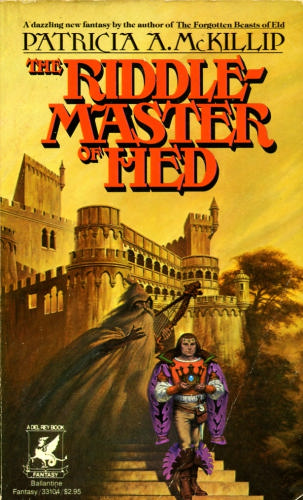
REVIEW: THE RIDDLE-MASTER OF HED
I read Patricia McKillip’s 1976 “Hed” trilogy over twenty years ago, but my memory was basically favorable, though I didn’t recall esteeming the trilogy as highly as her 1974 stand-alone novel “The Forgotten Beasts of Eld.” So I gave the first novel in the trilogy a re-read.
I give McKillip points for trying to find a novel approach to the “reluctant hero,” which, within the genre of modern fantasy, is practically defined by Tolkien’s Frodo. Like Frodo McKillip’s hero Morgon lives in a quiet, bucolic territory bordered by more bellicose realms. In part Morgon wants to do no more than live out his life farming and keeping pigs. But in Morgon McKillip paints a man at odds with his own conscious tendencies—and with a destiny signified by a unique birthmark: three star-shapes on his forehead. Later in life, he enrolls in a college of riddle-masters, whose purpose is to decipher all of the ancient riddles left behind by the long-vanished wizards of their world. Finally, following the death of his parents at sea, he leaves his rulership in the quiet kingdom of Hed and enters a haunted tower, where he challenges a ghost to a riddle-contest and wins. Morgon conceals his great deed and hides his prize under his bed in a doomed effort to return to mundanity. A visit from the harpist of the reigning High One provides a call to action, forcing Morgon to embark upon a quest to solve further riddles.
RIDDLE-MASTER is a solid effort, though on many occasions it feels too transparently like what it is, a setup-novel for the next two parts—which, my memory tells me, read much better. McKillip creates some tantalizing mysteries but sometimes plays a little too coy in fleshing out the details of her world. Sometimes “infodump” in a fantasy can be a good thing, at least when the alternative is leaving the reader floundering about, trying to figure out the histories of the various war-embroiled countries. McKillip seems determined to avoid challenging Tolkien on these terms, seeking instead to focus on mundane, common activities. Perhaps under different circumstances, her aim might have been realized. However, you know you’re in trouble when Morgon learns shapechanging magic from two different masters of the art, and both characters sound roughly the same.
It’s my memory that she does better with her characterization in the latter two segments of the trilogy. Time, and future reviews, will tell.
TOLKIEN'S "ON FAIRY STORIES": A DELVING, PT. 3
My theory that Tolkien regarded human beings as a "supernatural" by virtue of their ability to imitate the deity finds some support in another of the more heavily-quoted passages of ON FAIRY STORIES.
My solution to the conundrum falls in two parts. First, I believe Tolkien made about man being "supernatural" to counter the usual belief that it was fairies and their relations who held that status. If as I believe Tolkien identified fairies with nature, then they are coterminous with nature and so cannot be either above or beyond it, as mankind can. Certainly I don't think it's coincidence that in this passage it parallels all the supposedly-supernatural denizens of Faerie-- elves, giants, dragons, etc.-- with various natural phenomena: heavenly bodies, living creatures, and natural foodstuffs ("wine and bread," which also happen to be significant in Catholic liturgy).
However, on a second level Tolkien was certainly aware that mortals tend to be governed by their more mundane moods, in which they don't often have much patience for tales of faerie or even narratives of Christian salvation. Therefore, "man" can be supernatural in a way that fairies cannot be, because man is able to transcend his mundane nature whenever he becomes "enchanted."
It's slightly after this that Tolkien descants for the first time in the essay on "magic," tying it in to the nature of Faerie:
Having finished his preliminary meditations of Faerie, Tolkien next proceeds to the question of the origin of fairy stories, which I will examine in my next Tolkien essay.
Now, though I have only touched (wholly inadequately) on elves and fairies, I must turn back; for I have digressed from my proper theme: fairy-stories. I said the sense “stories about fairies” was too narrow. It is too narrow, even if we reject the diminutive size, for fairy-stories are not in normal English usage stories about fairies or elves, but stories about Fairy, that is Faerie, the realm or state in which fairies have their being. Faerie contains many things besides elves and fays, and besides dwarfs, witches, trolls, giants, or dragons: it holds the seas, the sun, the moon, the sky; and the earth, and all things that are in it: tree and bird, water and stone, wine and bread, and ourselves, mortal men, when we are enchanted.Now on the face of things, this sounds like a contradiction when placed alongside Tolkien's earlier claim that "it is man who is, in contrast to fairies, supernatural." One must wonder that if mortal men are "supernatural," why does faerie contain them only when they are "enchanted?" Why would mankind not belong to faerie at all times?
My solution to the conundrum falls in two parts. First, I believe Tolkien made about man being "supernatural" to counter the usual belief that it was fairies and their relations who held that status. If as I believe Tolkien identified fairies with nature, then they are coterminous with nature and so cannot be either above or beyond it, as mankind can. Certainly I don't think it's coincidence that in this passage it parallels all the supposedly-supernatural denizens of Faerie-- elves, giants, dragons, etc.-- with various natural phenomena: heavenly bodies, living creatures, and natural foodstuffs ("wine and bread," which also happen to be significant in Catholic liturgy).
However, on a second level Tolkien was certainly aware that mortals tend to be governed by their more mundane moods, in which they don't often have much patience for tales of faerie or even narratives of Christian salvation. Therefore, "man" can be supernatural in a way that fairies cannot be, because man is able to transcend his mundane nature whenever he becomes "enchanted."
It's slightly after this that Tolkien descants for the first time in the essay on "magic," tying it in to the nature of Faerie:
...“fairy-story” is one which touches on or uses Faerie, whatever its own main purpose may be: satire, adventure, morality, fantasy. Faerie itself may perhaps most nearly be translated by Magic—but it is magic of a peculiar mood and power, at the furthest pole from the vulgar devices of the laborious, scientific, magician.It follows that Tolkien's concept of magic heavily draws on the idea of one being "enchanted." Certainly magic in Tolkien's faerie-universe cannot be drearily functional, along the lines of the "scientific magician," by which I assume Tolkien means the "stage magician." One sentence later Tolkien adds:
There is one proviso : if there is any satire present in the tale, one thing must not be made fun of, the magic itself. That must in that story be taken seriously, neither laughed at nor explained away.To laugh at the magic, one assumes, would undermine one's credence-- one might even call it "faith"-- in the magic within the fairy-story. The concept of magic as vital to the world of Faerie would seem to be tied into Tolkien's concept of man as being capable of being "supernatural" so long as he is "enchanted."
Having finished his preliminary meditations of Faerie, Tolkien next proceeds to the question of the origin of fairy stories, which I will examine in my next Tolkien essay.
TOLKIEN'S "ON FAIRY STORIES": A DELVING, PT. 2
This passage from the Tolkien essay will be familiar to many readers of fantasies:
The passage contains one of Tolkien's key concepts in the essay, the idea that fairy-stories promote the feeling of "enchantment" which may also be a "peril." As I note in my previous essay, Tolkien was not interested in comparativism, so he did not wonder about whether other species of fantastic fiction offered similar "enchantments." His sphere of comparison, to the extent that he makes one explicit, would seem to be that of naturalistic literary works. In 1936 many academics regarded naturalistic modernism as the *sine qua non* of good literature, and anything else was "escapist"-- a term with which Tolkien would take issue later in the essay.
A few paragraphs later Tolkien makes this assertion, which has not been reprinted quite so often.
The inhabitants of "faerie," then, occupy a middle ground between "Heaven" and "Hell," a sphere which might be deemed the realm of Pure Nature, not yet redeemed but capable of redemption through Man-- who is for that reason truly "supernatural." The comment upon man being more "diminutive" is a barb at those who assume that "fairies" must be cute little sprites, and doesn't make quite as much logical sense as the "supernatural" line, since most archaic representations of "the fay" show them as being of human proportions.
More to come.
The realm of fairy-story is wide and deep and high and filled with many things: all manner of beasts and birds are found there; shoreless seas and stars uncounted; beauty that is an enchantment, and an ever-present peril; both joy and sorrow as sharp as swords. In that realm a man may, perhaps, count himself fortunate to have wandered, but its very richness and strangeness tie the tongue of a traveller who would report them. And while he is there it is dangerous for him to ask too many questions, lest the gates should be shut and the keys be lost.
The passage contains one of Tolkien's key concepts in the essay, the idea that fairy-stories promote the feeling of "enchantment" which may also be a "peril." As I note in my previous essay, Tolkien was not interested in comparativism, so he did not wonder about whether other species of fantastic fiction offered similar "enchantments." His sphere of comparison, to the extent that he makes one explicit, would seem to be that of naturalistic literary works. In 1936 many academics regarded naturalistic modernism as the *sine qua non* of good literature, and anything else was "escapist"-- a term with which Tolkien would take issue later in the essay.
A few paragraphs later Tolkien makes this assertion, which has not been reprinted quite so often.
Supernatural is a dangerous and difficult word in any of its senses, looser or stricter. But to fairies it can hardly be applied, unless super is taken merely as a superlative prefix. For it is man who is, in contrast to fairies, supernatural (and often of diminutive stature); whereas they are natural, far more natural than he.This is an interesting way of approaching the question of "what is natural." For proponents of literary naturalism, man was the measure of all things, and man was inherently a creature bounded by natural law. But Tolkien was a Christian, and for him man has a unique contact with God. No other creature can relate to God as man does; no other creature can attempt the so-called *imitatio dei*-- which ability, as we will see later, extends also to Tolkien's magisterial concept of "subcreation."
The inhabitants of "faerie," then, occupy a middle ground between "Heaven" and "Hell," a sphere which might be deemed the realm of Pure Nature, not yet redeemed but capable of redemption through Man-- who is for that reason truly "supernatural." The comment upon man being more "diminutive" is a barb at those who assume that "fairies" must be cute little sprites, and doesn't make quite as much logical sense as the "supernatural" line, since most archaic representations of "the fay" show them as being of human proportions.
More to come.
TOLKIEN'S "ON FAIRY STORIES": A DELVING, PT. 1
I've given a certain amount of thought over the years as to what the particular charms of "otherworldly fantasy" as compared to those of other types of fantastic fiction. I've coined my own word for such fiction-- "the metaphenomenal," which I sometimes toss out in my film-reviews-- but I'll avoid that theoretical briar-patch here.
I mentioned in that initial post that I believed Tolkien would have many if not all the answers. But now that I've reread it, I think the essay offers some interesting points, but it doesn't solve all the problems.
"On Fairy Stories," as Tolkien himself says on his first page, is entirely about identifying the nature of the genre Tolkien advocates. This is essentially an insular endeavor, one not concerned with drawing comparisons to other genres. Once or twice Tolkien makes reference to fantasy's "rival" (my word) science fiction, but he doesn't offer a sustained comparison between the two. He makes some isolated comments about how fantasy differs from naturalistic fiction as well, but Tolkien is also not particularly interested in these differences except insofar as they help him define the genre of "faery stories"-- which in his mind would seem to include THE HOBBIT, completed a few years before the essay. By extension, that would imply that he deemed the rest of his works to be in the same genre as well, though few moderns would refer to LORD OF THE RINGS and SILMARILLION as "fairy stories.".
So as I pick my way slowly through the various complexities of Tolkien's most famous essay in future posts, I will do so with the knowledge that Tolkien was manifestly NOT interested in what interests me in the definition of fantasy: i.e., what makes it different from other forms of fantastic fiction.
More to come.
I mentioned in that initial post that I believed Tolkien would have many if not all the answers. But now that I've reread it, I think the essay offers some interesting points, but it doesn't solve all the problems.
"On Fairy Stories," as Tolkien himself says on his first page, is entirely about identifying the nature of the genre Tolkien advocates. This is essentially an insular endeavor, one not concerned with drawing comparisons to other genres. Once or twice Tolkien makes reference to fantasy's "rival" (my word) science fiction, but he doesn't offer a sustained comparison between the two. He makes some isolated comments about how fantasy differs from naturalistic fiction as well, but Tolkien is also not particularly interested in these differences except insofar as they help him define the genre of "faery stories"-- which in his mind would seem to include THE HOBBIT, completed a few years before the essay. By extension, that would imply that he deemed the rest of his works to be in the same genre as well, though few moderns would refer to LORD OF THE RINGS and SILMARILLION as "fairy stories.".
So as I pick my way slowly through the various complexities of Tolkien's most famous essay in future posts, I will do so with the knowledge that Tolkien was manifestly NOT interested in what interests me in the definition of fantasy: i.e., what makes it different from other forms of fantastic fiction.
More to come.
Subscribe to:
Posts (Atom)