Wednesday, August 19, 2015

A BROKEN FOUNDATION


I began reading prose fantasy and science fiction, in addition to comic books, steadily at the age of 15 and have never stopped. In my first ten years of SF-reading, I probably read most of the works that early fans considered "the classics," not least the works of "the Big Three:" Asimov, Clarke, and Heinlein. None of them wrote the sort of fantastic fiction to which I aspired, as I soon became most enamored with the genre of fantasy, but of the three, Asimov was the one whose works I most consistently enjoyed.

Yet I did not enjoy the two books in the FOUNDATION series that I read in those days, and consequently did not bother to read the first book in the series, entitled simply FOUNDATION. Much more recently, though, my SF-book club voted to read the book. Therefore I finally read the missing chapter in the series once given a 1966 Hugo Award for "Best All-Time Series."

Harlan Ellison once gave an interview-- which I'm recalling purely from memory here-- in which he described talking to Asimov about adapting the latter's "Robot" stories into a coherent screenplay-- which was certainly not used for the later Will Smith movie I, ROBOT. Ellison claimed that Asimov cautioned him that these were all "bad stories" and wouldn't make good movie-fodder.

I've no way of knowing whether or not Asimov actually said this. But if he did, it's interesting that he would downgrade the "Robot" stories, since in my eyes the early tales are eminently good reading. They're simple, problem-oriented stories, but they have the sort of humor and lively dialogue that I found characteristic in the best works of the author.

In contrast, I still remember my extreme distaste for the two FOUNDATION novels that I did read. All novels in the series were predicated on the idea that in a far-future galactic empire, founded exclusively by humans from Earth, which was doomed to fall into chaos (Asimov was reading Gibbon's DECLINE AND FALL OF THE ROMAN EMPIRE at the time). However, this Empire could be saved, thanks to the genius of one scientist, Hari Seldon. Seldon creates a mathematical science called "psychohistory" that can predict large-scale future developments by analyzing the movements of the societal masses. Although the original Empire does decline and fall, Seldon's system, carried on by his adherents long after his death, manages to circumvent total galactic chaos, making possible the rise of a better form of empire, called the Foundation. 

The original book is not a novel as such, having been composed of eight interrelated stories originally serialized in SF-magazines; to the best of my knowledge, the two sequels followed the same pattern. And all of the story-arcs follow the same basic story-pattern. An adherent of Seldon encounters some obstruction to the grand plan for the Foundation's rise, and takes steps, usually off-camera, to prevent them. Then  he sits down with his opponent, and the two of them go back and forth in endless talking-head scenes, as the "Seldonite" demonstrates his superior cleverness and the inevitability of psychohistorical destiny. 

I remember thinking that the Foundation novels were just like watching chess-moves translated into vapid dialogue from cookie-cutter characters: "You thought you had me with that move, but I countered thusly." "Yes, but I knew you would counter thusly, so I counter-countered you." "Yes, but I knew that you knew that you would counter-counter, so..." Since even watching a real chess-match would probably be more entertaining than this folderol, I'm somewhat of a loss to figure out how such a series became so popular in science-fiction.

A simple answer would be that the appeal of the FOUNDATION novels is basically "Revenge of the Nerds." Characters endlessly chant the favorite maxim of Hari Seldon, that "violence is the last resort of the incompetent," while finding all sorts of ways to trick or hoodwink their opponents into defeat. The Seldonites, then, use indirect rather than direct, violent means to effect compulsion, just as the heroes of the "Nerds" movies use trickery to get around their stronger opponents. However, that by itself seems too simple an answer.

Long before reading FOUNDATION, I'd come across another critic's assertion that psychohistory was just Karl Marx's historical materialism under the veil of pretend-science. And indeed, the book ends with one of its sound-alike narrators predicting the likelihood of future problems:

What business of mine is the future? No doubt Seldon has foreseen it and prepared against it. There will be other crises in the time to come when money power has become as dead a force as religion is now. Let my successors solve those new problems, as I have solved the one of today.

This is probably the principal appeal of the FOUNDATION series: it offers a technocratic solution to all of the inequities against which modern-day man struggles.  Not surprisingly, the main opponents to the rise of the Foundation are "religion" and "money power," the same factors that Marx hoped would be nullified by the rise of the proletariat. Asimov, himself a scientist, envisions a world where 
such factors cannot affect man's destiny, which is controlled entirely by rational scientists.

I could probably tolerate Asimov's simplistic enshrinement of scientific knowledge and methodology, if FOUNDATION had put across his wonky technocracy with any wit or charm. But even though Asimov was a master at creating simple but charming characters, all of his characters in the series are walking ciphers, whether good or bad. The common world of birth, death, and family relations does not exist for them, and I don't even remember any female characters in FOUNDATION itself.  Like Marx's historical materialism, Asimov's psychohistory can only work within a universe where human beings are almost completely predictable. The only exception to this rule appears in the latter two books, as the Foundation is threatened by a psychically-endowed mutant named "the Mule"-- and he's the only character I remember from these books.

I can't fairly review the latter two books, not having read them for over thirty years. But FOUNDATION is an awful "classic" of science fiction, full of stodgy characters and preening self-congratulation.  


Tuesday, August 18, 2015

THE 100 GREATEST CROSSOVERS OF ALL TIME #53


One of the most impressive feats of Roy Thomas during his last years as an exclusive employee of Marvel Comics was a multi-issue THOR storyline involving Wagner's Ring operas, the polytheistic pantheons of the Marvelverse, and the reason that Thor's daddy Odin created the Destroyer. However, as explained by Thomas in the comic's letters-column, one of the main purposes of the storyline was to bring Kirby's 1976-78 concept THE ETERNALS into Marvel continuity. Though it's clear that Jack Kirby didn't care anything about melding his creation with the other Marvel books, Thomas clearly intuited that since Marvel owned the whole concept, sooner or later someone would bring Kirby's creations into mainstream Marvel, if only within the context of some dismal team-up issue. Thus the principal purpose of THOR #283-300 was to produce a mammoth crossover that did justice to the scope of Kirby's creation, by having the Lee-Kirby version of Thor investigate this strange new breed of "gods"-- although they were only gods in terms of the names they inherited. In truth, the Eternals were not creative forces, but the creations of brobdinagian aliens called the "Celestials," with whom Thor finds himself in conflict.

Having re-read the continuity, I have to admit that the crossovers with Thor and the Eternals are probably the clunkiest parts of the long sequence, although the Celestials make for great villains. Thomas did not actually complete the entire epic, as exigencies forced him to turn over the writing duties to Mark Gruenwald and Ralph Macchio. Similarly, though John Buscema began the sequence, the majority of the penciling was done by Keith Pollard, and may represent his best work for Marvel Comics.

Despite Thomas' legendary commitment to continuity, he drops the ball in the "Seigfried" sections in that he shows how Odin gave birth to Thor by a non-Asgardian mother-- yet somehow tries to imply that Odin's mortal spawn, the Seigfried of the Wagnerian narrative, is also actually Thor by some unexplained logic, rather than being simply the Thunder God's half-brother. Perhaps Thomas meant to use one concept introduced in issue #294, "the Celestial Axis," as a catch-all explanatory device, but if so, he failed to follow up on it, as did Macchio and Gruenwald.

Nevertheless, it's a great romp through the many worlds of the Marvel cosmos.

Monday, June 15, 2015

THE 100 GREATEST CROSSOVERS OF ALL TIME #52

A small number of hero-crossovers appear in the Italian "muscleman adventure" subgenre of the late 1950s and early 1960s. Until recently I'd considered choosing, as the best representative of these, 1963's HERCULES, SAMSON, AND ULYSSES. Like most of these mini-epics, the storyline of H,S & U is so conventional as to stifle one's imagination, though there is at least a decent fight-scene between the two strongmen of the title.


Happily, thanks to a contributor to Youtube, I came across a far superior nominee: a broad comedy entitled SAMSON AND THE MIGHTY CHALLENGE. I go into more detail in my review, but suffice to say that Hercules falls in love with a young woman who doesn't want him-- a development that probably never occurred in any other Italian Hercules film.  The lady's parents try to stave Hercules with a challenge-- and from a plot-standpoint, the film really is a challenge given to Hercules, not to Samson. They tell Hercules that the gods will not give permission for the marriage unless Hercules can defeat the Jewish strongman Samson.

In addition to once again bringing together Samson and Hercules-- this time in a humorous context-- two other heroes also jump into the mix. One is "Maciste," who began his career in the 1914 Italian historical epic CABIRIA, and who then starred as the hero of various silent films, as well as a horde of muscleman-adventures of the fifties and sixties, many of which were re-titled as Hercules films for the American market. The other is "Ursus," whose name was taken from the novel/film QUO VADIS for a handful of "Ursus" films. The Ursus of MIGHTY CHALLENGE is more like a comic brute rather than a hero in his own right, so he's not really a continuation of the noble fellow who had his own series. Then again, I must admit that almost none of these muscleman films maintain any consistency from one episode to the next. So the Hercules, Samson and Maciste of MIGHTY CHALLENGE are similarly not in line with any of the previous adventures of those cinema-characters, much less any mythic or literary forbears.

The highest compliment I can pay the film is to say that while most Italian knockabout comedies aren't nearly as funny as their makers think they are, this one actually brings the goods.

Thursday, June 11, 2015

THE 100 GREATEST CROSSOVERS OF ALL TIME #51


It's a slam dunk that Jack Kirby, co-creator of both Thor and the Hulk, should be the one to render the best (thus far) face-off between the two Marvel titans, covered in my previous post.

Nevertheless, the Hulk-Thor battle in DEFENDERS #10, scripted by Steve Englehart and pencilled by Sal Buscema, comes a close second. The scene represented on the cover, in which the two super-strong guys, after lots of pounding and throwing things, presents the argument that the two are fundamentally equals, in that they struggle against each other, arm against arm, for something like a solid hour.

This was the high point-- though not the only good moment-- of the seven-issue crossover  called "The Avengers-Defenders War." This took place in the AVENGERS (issues #115-118) and DEFENDERS (issues #8-10) titles, both at the time being written by Englehart. In later interviews Englehart would assert that other Marvel employees doubted that he and his artists could pull off a crossover that had to be timed so that each segment came out precisely on the heels of the last installment. Later, this sort of multi-issue crossover would become standard practice at both Marvel and DC, often criticized for weak storylines and a transparent attempt to boost sales in an artificial manner. But Englehart's story carries the same innocent thrill of the "heroes-meet-and-fight-cute" trope that Marvel perfected in its Silver Age heyday.

The plot, dealing with a conspiracy by villains Loki and Dormammu to reshape the Earth into one of Dormammu's realms, serves adequately to bring the two teams into a conflict in which each believes the other to be villains. The only downside of this generally enjoyable outing is that although Sal Buscema is perfectly fine in his DEFENDERS segments, penciller Bob Brown, given mediocre inks by Mike Esposito, gives the AVENGERS segments a sloppy and unfocused look. The one exception to this generalization is a chapter devoted to a battle between Captain America and the Sub-Mariner, but only because this section is crisply inked by an uncredited Frank McLaughlin.

Monday, May 11, 2015

THE 100 GREATEST CROSSOVERS OF ALL TIME #50

FANTASTIC FOUR 25-26, with its Thing-Hulk battle, remains the best example of Jack Kirby cutting loose with his trademark fight-kinetics. However, despite a shorter length, the first major battle between the Hulk and the Mighty Thor-- appearing in JOURNEY INTO MYSTERY #112-- is nothing to sneeze at.


Rather than coming up with a new reason for the Asgardian hero to confront the Green Goliath, Lee and Kirby choose to tell an "untold story" of a previous meeting.  Thor himself narrates the story to a gaggle of young admirers, revealing that during the Avengers' sortie against the team of the Hulk and the Sub-Mariner in AVENGERS #3, Thor managed to get the Hulk alone in a room and the two of them matched muscles for roughly a minute. This, Thor tells his comics-audience (but not his listeners), is all the time the hero allows himself to defeat the Hulk, swearing not to pick up his dropped hammer until he defeats his monstrous opponent. Since in those days Thor would revert to the human Doc Blake if the hammer was out of his hands for more than 60 seconds, this sounds like a suicide impulse on Thor's part-- though it certainly fits in with his Viking macho rep.

It's a good fight, but the panels above capture a curious dichotomy in the Lee-Kirby corpus: an admiration for the brutal power of the Hulk played off against Thor's embodiment of the virtues of nobility. The THOR feature would sometimes explore these issues, resonant of class conflict, but here it's just a side-note to the Clashing of Titans.

Saturday, May 9, 2015

THE 100 GREATEST CROSSOVERS OF ALL TIME #49


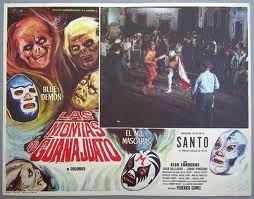
I selected this film for roughly the same reasons I chose CRISIS ON INFINTE EARTHS here in post #47, less for the work's quality than for its significance as a crossover.

As all fans of luchaodore cinema know, the dominant idea behind the genre was to portray established professional wrestlers as itinerant superheroes, running around fighting everything from crime bosses and spies to aliens and monsters. IMDB cites the date of the first crossover, SANTO AND BLUE DEMON AGAINST THE MONSTERS, as 1970. I haven't screened this flick as yet, but I have seen two other Santo-Blue Demon team-ups from the same period, so I have to pass on these two-wrestler team-ups to stand as the best of the genre.

If 1972's THE MUMMIES OF GUANAJUATO had nothing else going for it, at least it brought together the three wrestlers who had the longest careers as movie superheroes: Santo, the Blue Demon, and Mil Mascaras. Fortunately, the film also gave the wrestlers opponents who aren't simply retreads of Hollywood figures. These mummies were based on a group of well- preserved corpses found in Guanajuato, Mexico, which city subsequently became a major Mexican tourist attraction.

These two elements are the best aspects of the film: otherwise MUMMIES is not the equal of the more brain-fried Mex-horror films. For most of the narrative, director Federico Curiel seems content to show the heroes in a series of running battles with their super-strong, almost invulnerable enemies. More than that I can't  say, for I only watched a Spanish language version of the film. However, I honestly don't think I'm missing any great subtleties here.

The mummies are moderately imposing, if not scary, and there's lots of action. I should note, though, that Santo doesn't show up until the last fifteen minutes; it's been strongly suggested that he was a last-minute addition to the film..

Monday, April 13, 2015

THE 100 GREATEST CROSSOVERS OF ALL TIME #48


PLOT SPOILERS AHEAD...

While a lot of the crossovers I've covered here have elements of hand-to-hand conflict, here's one based in "foot vs. foot."

FLASH #175 was published as a follow-up to a similar set-up in SUPERMAN #199, which had only seen publication about three months earlier. The Superman story is a good read, but it has a somewhat "kiddie-level" feel to it. Superman and the Flash race one another for charity, but have to deal with illegal gamblers trying to sabotage the race for their own benefit.

As the cover above shows, the FLASH version of this conflict hinges more on the hero's pathos in contention with DC's premiere hero. The script by E. Nelson Bridwell shows a little more concern with overall continuity than was typical of DC comics in 1967.

In short, Superman and the Flash are forced to run across the galaxy in a competition managed by two alien gamblers, Rokk and Sorban, who had appeared in an earlier Superman story. The aliens also hold the whole Justice League hostage and threaten to destroy the home city of whichever hero loses the race. Refreshingly, Bridwell does manage to find ways for three of the Justice Leaguers to provide aid to the racing heroes, so that they're not simply confined to sitting around playing cheerleaders.

The story doesn't stand up to close scrutiny. Since Flash can't breathe in space, the alien betting on him promises to supply him with a force-field of breathable air throughout the race. However, you learn by story's end that the aliens are actually two of Flash's old foes, Professor Zoom and Abra Kadabra, who have only instigated the race in order to lure the Flash into various death-traps. When one of the villains says that he cancelled the force-field so that Flash should have died in space, Superman advances the absurd explanation that he provided the Flash with enough air to breathe via his "super-breath." Hmm, so Superman can expel pure oxygen from his lungs, rather than carbon dioxide? Still, I didn't really worry about such niceties as a kid reading this comic.

Ross Andru's art puts a lot of verve into the galaxy-spanning race, and the two heroes are seen to be somewhat distrustful of one another, possibly in response to the pervasive influence of Marvel Comics during the period.