Finishing up the section in which Tolkien discusses the types of stories that he doesn't deem "fairy stories..."
There's not a great deal to add with respect to Tolkien's exclusion of "any story that uses the machinery of Dream, the dreaming of actual human sleep, to explain the apparent occurrence of its marvels." The only example he gives is that of Lewis Carroll's two ALICE books, which probably were deemed "fairy tales" by some adults simply because they contained marvels (albeit rationalized) and were (in theory) aimed at children. But as Tolkien says in his footnotes, it's also widely recognized that the ALICE books are satire, which carries little mood of "faerie."
At the same time, there do exist works that evoke a strong "faerie" touch despite resorting to dream-mechanism. Ironically, though the Oz books of Frank Baum are not justified as dreams, MGM's 1939 film does convey a strong mood of enchantment, despite telegraphing the "only a dream" ending early in the narrative.
Tolkien's ruminations on the "beast-fable" are a little more involved. It's true that there are many stories-- particularly those of Aesop and Uncle Remus-- in which the only marvelous element is that animals are portrayed as doing very human things. And Tolkien is also correct in saying that such stories, insofar as they cease to deal with "the proper languages of birds and beasts and trees," do not possess the faerie charm; that they are merely extensions of a human ethos and do not address the faerie desire to know "communion with other living things."
Still, Tolkien provides insufficient examples of those stories that successfully blend faerie magic with anthropomorphic animals. One might expect him to discuss traditional folktales, since he has been so insistent about disincluding literary fantasies of various types. Instead his positive examples include "the stories of Beatrix Potter" and a George McDonald tale. He mentions the Egyptian "Tale of Two Brothers" as a positive example of the motif of the "soul/heart separated from its body," but this doesn't support his point about beast-fables. He seems to have tossed it in as a counter-example to the beast-fable "The Monkey's Heart," in which a character alludes to such a separation but no such separation actually takes place. In my somewhat humble opinion he might have done better to have discussed a traditional folktale in which the beast-element is tied in with some magical circumstances, such as-- just to name one at random-- the Grimm's tale Hans My Hedgehog. In contrast to an over-anthropomorphized "fairy tale" like "Puss in Boots," "Hedgehog" should satisfy Tolkien's desire to find an "arresting strangeness" in his tales of faerie.
Saturday, March 15, 2014

TOLKIEN'S "ON FAIRY STORIES": A DELVING, PT. 4
Continuing with Tolkien:
In the pages following his remarks on magic and enchantment, Tolkien, having already disagreed with the characterization of fairies themselves as darling little peewees, takes similar issue with how many people define "fairy stories."
He remarks, a little dismissively, of the disproportionate influence of French folktales (my word) on the concept of the fairy tale:
Also lacking in Tolkien's essay is a definition of the folktale as such, which would take in some though not all of the tales he refers to.
Instead, Tolkien takes something of a digression by taking issue with the incorrect labeling of various stories with marvelous content as "fairy stories."
His point about two Wellsian science-fiction novels is harder to follow. I doubt that Tolkien had ever heard such technological marvel-stories referred to as "fairy stories," so it follows that his main point is that these items, that are never referred to as fairytales, are closer in spirit to faerie than the work of Jonathan Swift, since Swift's Lilliputians only resemble the smaller breed of fairies in terms of size, and not in terms of content. He then makes an odd digression.
More discriminations to come in Part 5.
In the pages following his remarks on magic and enchantment, Tolkien, having already disagreed with the characterization of fairies themselves as darling little peewees, takes similar issue with how many people define "fairy stories."
He remarks, a little dismissively, of the disproportionate influence of French folktales (my word) on the concept of the fairy tale:
The number of collections of fairy-stories is now very great. In English none probably rival either the popularity, or the inclusiveness, or the general merits of the twelve books of twelve colours which we owe to Andrew Lang and to his wife. The first of these appeared more than seventy years ago (1889), and is still in print. Most of its contents pass the test, more or less clearly. I will not analyse them, though an analysis might be interesting, but I note in passing that of the stories in this Blue Fairy Book none are primarily about “fairies,” few refer to them. Most of the tales are taken from French sources: a just choice in some ways at that time, as perhaps it would be still (though not to my taste, now or in childhood). At any rate, so powerful has been the influence of Charles Perrault, since his Contes de ma Mère l'Oye were first Englished in the eighteenth century, and of such other excerpts from the vast storehouse of the Cabinet des Fées as have become well known, that still, I suppose, if you asked a man to name at random a typical “fairy-story,” he would be most likely to name one of these French things: such as Puss-in-Boots, Cinderella, or Little Red Riding Hood. With some people Grimm's Fairy Tales might come first to mind.It's a shame that Tolkien did not take a stab at generalizing what sorts of "magic" and "enchantment" might appear in these dominantly French tales, even though they did not usually contain fairies as Tolkien perceived them. What would he have made of the archetypal "fairy godmother" of CINDERELLA, for example, given that he preferred to view his world of faerie as much less predictable in its effects:
In that [faerie] realm a man may, perhaps, count himself fortunate to have wandered, but its very richness and strangeness tie the tongue of a traveller who would report them. And while he is there it is dangerous for him to ask too many questions, lest the gates should be shut and the keys be lost.
Also lacking in Tolkien's essay is a definition of the folktale as such, which would take in some though not all of the tales he refers to.
Instead, Tolkien takes something of a digression by taking issue with the incorrect labeling of various stories with marvelous content as "fairy stories."
Such tales report many marvels, but they are marvels to be seen in this mortal world in some region of our own time and space; distance alone conceals them. The tales of Gulliver have no more right of entry than the yarns of Baron Munchausen; or than, say, The First Men in the Moon or The Time-Machine.Unquestionably Tolkien is right that some modern children's tales-- or stories that are deemed as children's tales-- have been lumped in with fairy tales. Tolkien cites a particular Andrew Lang collection that includes Swift's voyage to Lilliput, and in this century television watchers have been treated to the dubious teleseries ONCE UPON A TIME, which flings together folktale characters like Rumplestiltskin and the Beanstalk-giant with literary creations like Pinocchio and Captain Hook. The tales of Munchausen would in my opinion also belong to the category of literary creations.
His point about two Wellsian science-fiction novels is harder to follow. I doubt that Tolkien had ever heard such technological marvel-stories referred to as "fairy stories," so it follows that his main point is that these items, that are never referred to as fairytales, are closer in spirit to faerie than the work of Jonathan Swift, since Swift's Lilliputians only resemble the smaller breed of fairies in terms of size, and not in terms of content. He then makes an odd digression.
Indeed, for the Eloi and the Morlocks there would be a better claim than for the Lilliputians. Lilliputians are merely men peered down at, sardonically, from just above the house-tops. Eloi and Morlocks live far away in an abyss of time so deep as to work an enchantment upon them; and if they are descended from ourselves, it may be remembered that an ancient English thinker once derived the ylfe, the very elves, through Cain from Adam.Is Tolkien stating that such technological marvels participate in the same "enchantment" as his concept of faerie? In all likelihood Tolkien did not pursue this thought with any rigor, for then he abandons it to speak of his central theme again.
The magic of Faerie is not an end in itself, its virtue is in its operations: among these are the satisfaction of certain primordial human desires. One of these desires is to survey the depths of space and time. Another is (as will be seen) to hold communion with other living things. A story may thus deal with the satisfaction of these desires, with or without the operation of either machine or magic, and in proportion as it succeeds it will approach the quality and have the flavour of fairy-story.
More discriminations to come in Part 5.
REVIEW: THE RIDDLE-MASTER OF HED
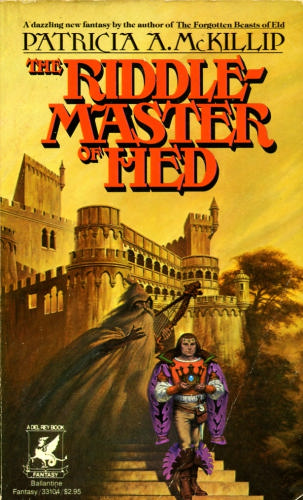
I read Patricia McKillip’s 1976 “Hed” trilogy over twenty years ago, but my memory was basically favorable, though I didn’t recall esteeming the trilogy as highly as her 1974 stand-alone novel “The Forgotten Beasts of Eld.” So I gave the first novel in the trilogy a re-read.
I give McKillip points for trying to find a novel approach to the “reluctant hero,” which, within the genre of modern fantasy, is practically defined by Tolkien’s Frodo. Like Frodo McKillip’s hero Morgon lives in a quiet, bucolic territory bordered by more bellicose realms. In part Morgon wants to do no more than live out his life farming and keeping pigs. But in Morgon McKillip paints a man at odds with his own conscious tendencies—and with a destiny signified by a unique birthmark: three star-shapes on his forehead. Later in life, he enrolls in a college of riddle-masters, whose purpose is to decipher all of the ancient riddles left behind by the long-vanished wizards of their world. Finally, following the death of his parents at sea, he leaves his rulership in the quiet kingdom of Hed and enters a haunted tower, where he challenges a ghost to a riddle-contest and wins. Morgon conceals his great deed and hides his prize under his bed in a doomed effort to return to mundanity. A visit from the harpist of the reigning High One provides a call to action, forcing Morgon to embark upon a quest to solve further riddles.
RIDDLE-MASTER is a solid effort, though on many occasions it feels too transparently like what it is, a setup-novel for the next two parts—which, my memory tells me, read much better. McKillip creates some tantalizing mysteries but sometimes plays a little too coy in fleshing out the details of her world. Sometimes “infodump” in a fantasy can be a good thing, at least when the alternative is leaving the reader floundering about, trying to figure out the histories of the various war-embroiled countries. McKillip seems determined to avoid challenging Tolkien on these terms, seeking instead to focus on mundane, common activities. Perhaps under different circumstances, her aim might have been realized. However, you know you’re in trouble when Morgon learns shapechanging magic from two different masters of the art, and both characters sound roughly the same.
It’s my memory that she does better with her characterization in the latter two segments of the trilogy. Time, and future reviews, will tell.
TOLKIEN'S "ON FAIRY STORIES": A DELVING, PT. 3
My theory that Tolkien regarded human beings as a "supernatural" by virtue of their ability to imitate the deity finds some support in another of the more heavily-quoted passages of ON FAIRY STORIES.
My solution to the conundrum falls in two parts. First, I believe Tolkien made about man being "supernatural" to counter the usual belief that it was fairies and their relations who held that status. If as I believe Tolkien identified fairies with nature, then they are coterminous with nature and so cannot be either above or beyond it, as mankind can. Certainly I don't think it's coincidence that in this passage it parallels all the supposedly-supernatural denizens of Faerie-- elves, giants, dragons, etc.-- with various natural phenomena: heavenly bodies, living creatures, and natural foodstuffs ("wine and bread," which also happen to be significant in Catholic liturgy).
However, on a second level Tolkien was certainly aware that mortals tend to be governed by their more mundane moods, in which they don't often have much patience for tales of faerie or even narratives of Christian salvation. Therefore, "man" can be supernatural in a way that fairies cannot be, because man is able to transcend his mundane nature whenever he becomes "enchanted."
It's slightly after this that Tolkien descants for the first time in the essay on "magic," tying it in to the nature of Faerie:
Having finished his preliminary meditations of Faerie, Tolkien next proceeds to the question of the origin of fairy stories, which I will examine in my next Tolkien essay.
Now, though I have only touched (wholly inadequately) on elves and fairies, I must turn back; for I have digressed from my proper theme: fairy-stories. I said the sense “stories about fairies” was too narrow. It is too narrow, even if we reject the diminutive size, for fairy-stories are not in normal English usage stories about fairies or elves, but stories about Fairy, that is Faerie, the realm or state in which fairies have their being. Faerie contains many things besides elves and fays, and besides dwarfs, witches, trolls, giants, or dragons: it holds the seas, the sun, the moon, the sky; and the earth, and all things that are in it: tree and bird, water and stone, wine and bread, and ourselves, mortal men, when we are enchanted.Now on the face of things, this sounds like a contradiction when placed alongside Tolkien's earlier claim that "it is man who is, in contrast to fairies, supernatural." One must wonder that if mortal men are "supernatural," why does faerie contain them only when they are "enchanted?" Why would mankind not belong to faerie at all times?
My solution to the conundrum falls in two parts. First, I believe Tolkien made about man being "supernatural" to counter the usual belief that it was fairies and their relations who held that status. If as I believe Tolkien identified fairies with nature, then they are coterminous with nature and so cannot be either above or beyond it, as mankind can. Certainly I don't think it's coincidence that in this passage it parallels all the supposedly-supernatural denizens of Faerie-- elves, giants, dragons, etc.-- with various natural phenomena: heavenly bodies, living creatures, and natural foodstuffs ("wine and bread," which also happen to be significant in Catholic liturgy).
However, on a second level Tolkien was certainly aware that mortals tend to be governed by their more mundane moods, in which they don't often have much patience for tales of faerie or even narratives of Christian salvation. Therefore, "man" can be supernatural in a way that fairies cannot be, because man is able to transcend his mundane nature whenever he becomes "enchanted."
It's slightly after this that Tolkien descants for the first time in the essay on "magic," tying it in to the nature of Faerie:
...“fairy-story” is one which touches on or uses Faerie, whatever its own main purpose may be: satire, adventure, morality, fantasy. Faerie itself may perhaps most nearly be translated by Magic—but it is magic of a peculiar mood and power, at the furthest pole from the vulgar devices of the laborious, scientific, magician.It follows that Tolkien's concept of magic heavily draws on the idea of one being "enchanted." Certainly magic in Tolkien's faerie-universe cannot be drearily functional, along the lines of the "scientific magician," by which I assume Tolkien means the "stage magician." One sentence later Tolkien adds:
There is one proviso : if there is any satire present in the tale, one thing must not be made fun of, the magic itself. That must in that story be taken seriously, neither laughed at nor explained away.To laugh at the magic, one assumes, would undermine one's credence-- one might even call it "faith"-- in the magic within the fairy-story. The concept of magic as vital to the world of Faerie would seem to be tied into Tolkien's concept of man as being capable of being "supernatural" so long as he is "enchanted."
Having finished his preliminary meditations of Faerie, Tolkien next proceeds to the question of the origin of fairy stories, which I will examine in my next Tolkien essay.
TOLKIEN'S "ON FAIRY STORIES": A DELVING, PT. 2
This passage from the Tolkien essay will be familiar to many readers of fantasies:
The passage contains one of Tolkien's key concepts in the essay, the idea that fairy-stories promote the feeling of "enchantment" which may also be a "peril." As I note in my previous essay, Tolkien was not interested in comparativism, so he did not wonder about whether other species of fantastic fiction offered similar "enchantments." His sphere of comparison, to the extent that he makes one explicit, would seem to be that of naturalistic literary works. In 1936 many academics regarded naturalistic modernism as the *sine qua non* of good literature, and anything else was "escapist"-- a term with which Tolkien would take issue later in the essay.
A few paragraphs later Tolkien makes this assertion, which has not been reprinted quite so often.
The inhabitants of "faerie," then, occupy a middle ground between "Heaven" and "Hell," a sphere which might be deemed the realm of Pure Nature, not yet redeemed but capable of redemption through Man-- who is for that reason truly "supernatural." The comment upon man being more "diminutive" is a barb at those who assume that "fairies" must be cute little sprites, and doesn't make quite as much logical sense as the "supernatural" line, since most archaic representations of "the fay" show them as being of human proportions.
More to come.
The realm of fairy-story is wide and deep and high and filled with many things: all manner of beasts and birds are found there; shoreless seas and stars uncounted; beauty that is an enchantment, and an ever-present peril; both joy and sorrow as sharp as swords. In that realm a man may, perhaps, count himself fortunate to have wandered, but its very richness and strangeness tie the tongue of a traveller who would report them. And while he is there it is dangerous for him to ask too many questions, lest the gates should be shut and the keys be lost.
The passage contains one of Tolkien's key concepts in the essay, the idea that fairy-stories promote the feeling of "enchantment" which may also be a "peril." As I note in my previous essay, Tolkien was not interested in comparativism, so he did not wonder about whether other species of fantastic fiction offered similar "enchantments." His sphere of comparison, to the extent that he makes one explicit, would seem to be that of naturalistic literary works. In 1936 many academics regarded naturalistic modernism as the *sine qua non* of good literature, and anything else was "escapist"-- a term with which Tolkien would take issue later in the essay.
A few paragraphs later Tolkien makes this assertion, which has not been reprinted quite so often.
Supernatural is a dangerous and difficult word in any of its senses, looser or stricter. But to fairies it can hardly be applied, unless super is taken merely as a superlative prefix. For it is man who is, in contrast to fairies, supernatural (and often of diminutive stature); whereas they are natural, far more natural than he.This is an interesting way of approaching the question of "what is natural." For proponents of literary naturalism, man was the measure of all things, and man was inherently a creature bounded by natural law. But Tolkien was a Christian, and for him man has a unique contact with God. No other creature can relate to God as man does; no other creature can attempt the so-called *imitatio dei*-- which ability, as we will see later, extends also to Tolkien's magisterial concept of "subcreation."
The inhabitants of "faerie," then, occupy a middle ground between "Heaven" and "Hell," a sphere which might be deemed the realm of Pure Nature, not yet redeemed but capable of redemption through Man-- who is for that reason truly "supernatural." The comment upon man being more "diminutive" is a barb at those who assume that "fairies" must be cute little sprites, and doesn't make quite as much logical sense as the "supernatural" line, since most archaic representations of "the fay" show them as being of human proportions.
More to come.
TOLKIEN'S "ON FAIRY STORIES": A DELVING, PT. 1
I've given a certain amount of thought over the years as to what the particular charms of "otherworldly fantasy" as compared to those of other types of fantastic fiction. I've coined my own word for such fiction-- "the metaphenomenal," which I sometimes toss out in my film-reviews-- but I'll avoid that theoretical briar-patch here.
I mentioned in that initial post that I believed Tolkien would have many if not all the answers. But now that I've reread it, I think the essay offers some interesting points, but it doesn't solve all the problems.
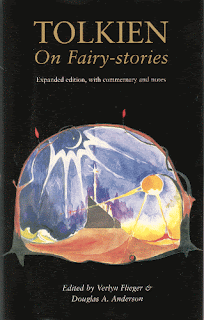
"On Fairy Stories," as Tolkien himself says on his first page, is entirely about identifying the nature of the genre Tolkien advocates. This is essentially an insular endeavor, one not concerned with drawing comparisons to other genres. Once or twice Tolkien makes reference to fantasy's "rival" (my word) science fiction, but he doesn't offer a sustained comparison between the two. He makes some isolated comments about how fantasy differs from naturalistic fiction as well, but Tolkien is also not particularly interested in these differences except insofar as they help him define the genre of "faery stories"-- which in his mind would seem to include THE HOBBIT, completed a few years before the essay. By extension, that would imply that he deemed the rest of his works to be in the same genre as well, though few moderns would refer to LORD OF THE RINGS and SILMARILLION as "fairy stories.".
So as I pick my way slowly through the various complexities of Tolkien's most famous essay in future posts, I will do so with the knowledge that Tolkien was manifestly NOT interested in what interests me in the definition of fantasy: i.e., what makes it different from other forms of fantastic fiction.
More to come.
I mentioned in that initial post that I believed Tolkien would have many if not all the answers. But now that I've reread it, I think the essay offers some interesting points, but it doesn't solve all the problems.

"On Fairy Stories," as Tolkien himself says on his first page, is entirely about identifying the nature of the genre Tolkien advocates. This is essentially an insular endeavor, one not concerned with drawing comparisons to other genres. Once or twice Tolkien makes reference to fantasy's "rival" (my word) science fiction, but he doesn't offer a sustained comparison between the two. He makes some isolated comments about how fantasy differs from naturalistic fiction as well, but Tolkien is also not particularly interested in these differences except insofar as they help him define the genre of "faery stories"-- which in his mind would seem to include THE HOBBIT, completed a few years before the essay. By extension, that would imply that he deemed the rest of his works to be in the same genre as well, though few moderns would refer to LORD OF THE RINGS and SILMARILLION as "fairy stories.".
So as I pick my way slowly through the various complexities of Tolkien's most famous essay in future posts, I will do so with the knowledge that Tolkien was manifestly NOT interested in what interests me in the definition of fantasy: i.e., what makes it different from other forms of fantastic fiction.
More to come.
FIRST DREAM
In November 2012 I launched a blog entitled THE FANTASY FANE-- a pun-no-one-would-get, based on the name of an early science fiction fanzine edited by Jerry Siegel, THE FANTASY FAN.
At the time I had it in mind to devote the blog entirely to the topic of magical fantasy, since that's what I've most often written in the arena of fiction. FANTASY FANE would have been a site to set down my opinions or observations about that particular genre of what some call "the fantastic" and what I term "the metaphenomenal."
This might have worked out fine, if my circumstances were such that I could only read magical fantasy. But as I've mentioned on my blog ARCHETYPAL ARCHIVE, I'm involved in a grandiose personal project that involves my constant examination of many genres of the metaphenomenal-- science fiction, horror, superheroes, or even cartoon fantasy.
Bottom line: I want OUROBOROS DREAMS to reflect my opinions and observations in all of these genres. My contributions to FANTASY FANE always remained sporadic precisely because I couldn't find time to concentrate only on subjects relating to magical fantasy.
So my current game plan is to transfer to this blog all of the essays relevant to this current project. Then I'll either delete or abandon THE FANTASY FANE (I lean toward the former).
Whether this blog receives any more readers than the other one, its greater compass will make it easier for me to update.
At the time I had it in mind to devote the blog entirely to the topic of magical fantasy, since that's what I've most often written in the arena of fiction. FANTASY FANE would have been a site to set down my opinions or observations about that particular genre of what some call "the fantastic" and what I term "the metaphenomenal."
This might have worked out fine, if my circumstances were such that I could only read magical fantasy. But as I've mentioned on my blog ARCHETYPAL ARCHIVE, I'm involved in a grandiose personal project that involves my constant examination of many genres of the metaphenomenal-- science fiction, horror, superheroes, or even cartoon fantasy.
Bottom line: I want OUROBOROS DREAMS to reflect my opinions and observations in all of these genres. My contributions to FANTASY FANE always remained sporadic precisely because I couldn't find time to concentrate only on subjects relating to magical fantasy.
So my current game plan is to transfer to this blog all of the essays relevant to this current project. Then I'll either delete or abandon THE FANTASY FANE (I lean toward the former).
Whether this blog receives any more readers than the other one, its greater compass will make it easier for me to update.
Subscribe to:
Posts (Atom)